

Flame-fused, leak-inspected, and CNC cold-machined components manufactured in Donghai County for precision scientific and semiconductor assemblies.



Unlike common borosilicate glassware, hot-working fused silica demands an oxy-hydrogen flame exceeding 2,000°C to overcome extreme softening viscosity, eliminating structural thermal stress and contamination risks.
Transparent fused quartz exhibits a near-zero coefficient of thermal expansion (5.5 × 10⁻⁷ /°C). This allows glass blowers to produce complex components that withstand rapid thermal transitions from 1,150°C furnace zones straight to ambient water baths without micro-fracturing.
Trace alkali impurities (Li, Na, K) act as nucleating catalysts for cristobalite recrystallization (devitrification) above 1,000°C. Custom glass blowing operations require precision chemical acid etching and clean-room torch manipulation to secure purity ratings up to 99.999% SiO₂.
Manual and mechanized quartz glass blowing pairs high-precision optical lathes with automated oxygen-hydrogen burners. This achieves full penetration joints, flanged ports, internal vapor manifolds, and graded seals without micro-voids, bubbling, or localized stress concentrations.
Situated in Donghai County, Jiangsu Province—the epicenter of crystal and high-purity quartz processing on the Eurasian continent—Southeast Quartz commands distinct supply chain resilience.
Direct geographic integration with high-purity silica beneficiation facilities grants rapid access to 4N8 to 5N raw quartz sand, fused quartz ingots, and oversized mother tubes without transit delays or raw supply bottlenecks.
Complex fused quartz blowing cannot be fully automated. Donghai hosts three generations of master glassblowers capable of manually manipulating 450 mm OD quartz chambers, compound multi-path manifolds, and delicate 1 mm capillary junctions.
Our localized facility unites hot flame fabrication with CNC 5-axis ultrasonic drilling, laser interferometry, cleanroom chemical washing, and in-line helium mass-spectrometer leak certification under one ISO-managed roof.
From single wafer thermal processing to extreme-corrosion plasma reactors, discover how custom quartz glass blowing provides baseline process containment.
In horizontal and vertical LPCVD, diffusion, and dry oxidation processes, contamination by transition metals causes catastrophic junction leakage. Southeast Quartz fabricates blown quartz injector torches, paddle cantilever systems, welded multi-port bubblers, and monolithic wafer boats using synthetic and high-purity natural silica to ensure sub-ppb trace contamination.
The rapid transition to N-type TOPCon and perovskite tandem cells demands oversized quartz diffusion tubes reaching diameters up to 450 mm to accommodate dense wafer spacing. Our specialized torch-welding lathes handle heavy-wall furnace tubes and quartz carrier boats designed to resist thermal sagging during prolonged POCl₃ doping runs.
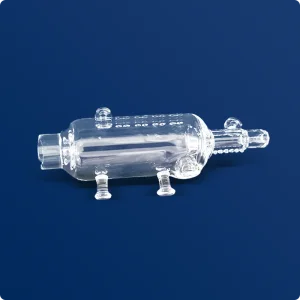
Analytical digestion chambers, plasma ICP torches, microchannel flow cells, and photochemical immersion wells require chemically inert fused silica that is impermeable to boiling acids (except HF). Custom glass blowing enables bespoke condenser coils, ground ball-and-socket vacuum joints, and high-transmission optical window attachments.
How semiconductor fab expansions, next-gen green energy, and high-frequency communication drive strategic fused silica procurement.
As nodes advance below 7 nm and advanced excimer UV systems expand, natural quartz reaches its optical threshold. Custom synthetic silica fabrication (free from metallic clusters) is rising to provide 193 nm transmission with negligible solarization damage over prolonged runs.
Chlorine and fluorine-based dry etch processes rapidly consume standard quartz rings and bell jars. Sourcing departments increasingly demand hybrid quartz-ceramic composites and post-blowing surface-glazed fused silica parts to extend chamber MTBF (Mean Time Between Failures).
Global procurement teams in North America, Europe, and East Asia are moving away from monolithic standard catalogs. Sourcing directors favor Chinese fabricators who accept CAD/STEP files directly, providing finite element analysis and rapid sample verification in days instead of months.
Explore our specialized diffusion boats, custom furnace reactors, high-temperature rings, and laboratory digestion vessels.



Clear answers covering thermal limits, tolerances, leak verification, and drawing submission criteria for engineering teams.