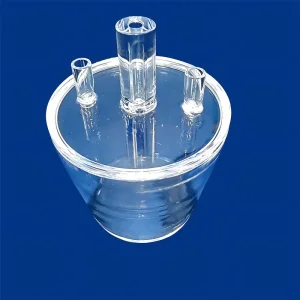
Manufactured to critical tolerances with surface flatness up to λ/10 and continuous thermal durability up to 1,100 °C.
Comprehensive technical and economic analysis of synthetic vs. natural fused quartz substrates across international manufacturing ecosystems.
The worldwide consumption of precision quartz plates has transitioned rapidly from standardized laboratory glass toward advanced wafer carriers, dielectric substrates, and extreme ultraviolet (EUV) optical windows. As semiconductor foundries expand sub-3nm nodes, the demand for trace-metal-free, plasma-etched resistant quartz plates has outpaced conventional capacity, emphasizing vertical supply integration from raw sand to polished plates.
In high-temperature dry etching and rapid thermal processing (RTP), alkaline element migration causes devastating wafer contamination. Contemporary quartz plate suppliers must control sodium (Na), potassium (K), and lithium (Li) thresholds below 0.1 ppm. High-purity synthetic fused silica (SFS) plates eliminate bubble inclusion defects, ensuring zero micro-fracturing under intense excimer laser irradiation.
Engineering procurement requires documented dimensional compliance: parallelism within 0.005 mm, total thickness variation (TTV) below 2 µm, and laser interferometry surface wave-front error validation. Helium mass-spectrometry leak detection and spectroradiometric UV-NIR baseline testing protect institutional buyers from premature failure in mission-critical vacuums.
Direct comparison of industrial quartz plate substrates utilized across vacuum, laser, and thermal reactor tooling.
| Property Parameter | Natural Fused Quartz (JGS2) | Optical Synthetic Silica (JGS1) | Infrared Optical Silica (JGS3) | Semiconductor Tooling Grade |
|---|---|---|---|---|
| SiO₂ Purity Level | ≥ 99.99% | ≥ 99.9999% | ≥ 99.99% | ≥ 99.995% |
| Spectral Range (Transmittance) | 260 nm – 2,500 nm | 185 nm – 2,500 nm (Deep UV) | 260 nm – 3,500 nm (Low OH⁻) | Broadband Optical / Thermal |
| OH Content (ppm) | 150 – 200 ppm | ≤ 1200 ppm | ≤ 5 ppm (Water-Free) | 30 – 80 ppm |
| Coefficient of Thermal Expansion | 5.5 × 10⁻⁷ / °C | 5.4 × 10⁻⁷ / °C | 5.5 × 10⁻⁷ / °C | 5.5 × 10⁻⁷ / °C |
| Softening Point Temperature | 1,683 °C | 1,600 °C | 1,680 °C | 1,683 °C |
| Dielectric Strength (20°C, 1MHz) | 25 – 40 kV/mm | 30 – 45 kV/mm | 25 – 40 kV/mm | 30 kV/mm |
| Typical Process Integration | Furnace viewing, industrial windows | Laser lithography, UV spectrometry | IR thermography, pyro-processing | Plasma etch rings, wafer boats |
Engineered quartz plate substrates solving aggressive chemical, thermal, and optical failure modes across key manufacturing hubs.
Quartz plates serve as insulating covers, susceptor plates, and plasma chamber sight windows in Low-Pressure Chemical Vapor Deposition (LPCVD), diffusion, and wet-etch baths. Their near-zero thermal expansion prevents stress cracking when cycled between ambient load locks and 1,050 °C reaction chambers, while chemical inertness resists blistering from concentrated hydrofluoric or phosphoric acid cleaning cycles.
In high-throughput N-type TOPCon and HJT solar cell manufacturing lines, high-purity quartz plates act as structural thermal baffles, load guides, and carrier covers in diffusion furnaces. They withstand volatile phosphorus oxychloride (POCl₃) and boron tribromide (BBr₃) atmospheres without devitrification, safeguarding electrical conversion efficiency against particulate contamination.
Utilized as ultra-flat optical windows, debris shields for fiber laser cutters, high-precision photomask blanks, and spectrometry sample carriers. Deep-UV synthetic fused silica provides internal optical transmission above 92% at 193 nm, eliminating beam distortion and chromatic aberration in advanced imaging and medical diagnostic apparatus.
Accelerating fabrication breakthroughs to align with angstrom-level semiconductor processing and extreme-environment energy sectors.
Conventional mechanical lapping introduces subsurface micro-fissures that expand under cyclic thermal stress. Our technical roadmap incorporates robotic MRF and chemical mechanical polishing (CMP), targeting surface roughness values under Ra < 0.1 nm. This level of finish avoids localized plasma arcing and micro-bubble vapor traps during high-vacuum atomic layer deposition (ALD).
By transitioning from electrical fusion to continuous vertical axial vapor deposition (VAD) and induction plasma sintering, our facility is eliminating transitional hydroxyl radicals (OH⁻) to below 1 ppm. This enables structural integrity at prolonged operating temperatures surpassing 1,200 °C without creep deflection or structural sag on oversized furnace floor plates.
Future lithography and analytical sensors require complex micro-channels and precision mounting bores without localized edge spalling. The integration of 5-axis ultrasonic CNC milling centers allows Southeast Quartz to manufacture intricate geometries, stepped ports, and multi-tier cooling pathways on quartz plates up to 1,200 mm in diameter with zero crack propagation.
A strategic framework that reduces procurement lead times, protects against freight damage, and ensures strict batch-to-batch repeatability.
Every inbound RFQ is evaluated by our dedicated engineering workshop. We analyze geometric tolerances, aspect ratios, chamfer stresses, and mounting bolt configurations against real furnace operating profiles. Our team suggests cost-reducing geometry modifications, optimizes thermal stress distribution, and certifies compatibility with equipment brands such as TEL, ASML, Lam Research, and Centrotherm.
Thin and oversized quartz plates are vulnerable to surface abrasion and shock-induced fracture during transoceanic shipping. We use automated ultrasonic multi-stage acid washing, DI-water rinse baths, Class 10,000 cleanroom vacuum packaging, and custom suspended shock-damped wooden crating. This zero-particle protocol guarantees out-of-the-box readiness for fab cleanrooms.
Reliable fabrication demands comprehensive compliance documentation. Southeast Quartz furnishes trace-element ICP-MS analysis, 3D coordinate CMM dimensional inspection sheets, laser interferometer surface interferograms, and stress birefringence polariscope certificates with every shipment, ensuring end-to-end traceability for critical fab qualification audits.
Essential guidance on tolerance limitations, cleaning chemistry, thermal profiles, and lead times for procurement teams and process engineers.
Manufactured in Donghai County with full hot-working lathe forming and cold-machining CNC lines.