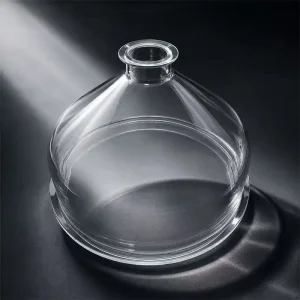
Explore precision-machined fused silica rods, high-purity furnace envelopes, and specialized carrier vessels tested to sub-ppb trace contamination limits.
A deep engineering overview of atomic silica purification, hot flame elongation, and microstructural stress control for extreme thermal environments.
Fused quartz rods and high-purity fused silica structural elements serve as critical components in state-of-the-art thermal processing systems, specialized fiber optic preform consolidation, and plasma etch chambers. Synthesized from ultra-refined silicon dioxide (SiO₂ ≥ 99.99%), fused quartz features an amorphous structure that yields exceptional physical and chemical stability. Unlike conventional borosilicate or soda-lime glass, amorphous fused silica exhibits a near-zero coefficient of thermal expansion (α ≈ 5.5 × 10⁻⁷/K), enabling components to endure severe thermal cycling from room temperature to beyond 1150°C without micro-fracturing or catastrophic failure.
Situated in Donghai County, Jiangsu—the premier silica processing hub on the Eurasian continent—Southeast Quartz operates directly adjacent to the world's most concentrated natural crystal deposits and advanced chemical purification centers. This industrial proximity guarantees continuous access to raw feedstock with alkali trace metals (Na, K, Li) kept strictly under 1.0 ppm, eliminating sourcing delays and ensuring batch-to-batch metallurgical consistency.
Fabricating high-performance quartz rods involves automated hydrogen-oxygen flame lathe pulling paired with 5-axis CNC diamond grinding. Southeast Quartz achieves tight dimensional controls, maintaining outer diameter (OD) tolerances within ±0.05 mm, camber under 0.1 mm/m, and surface roughness down to Ra < 0.2 μm via uniform fire polishing that heals micro-cracks and prevents premature devitrification under high thermal stress.
Every structural quartz component undergoes stringent polarized light strain-viewing to verify complete stress relief after continuous annealing cycles at 1120°C. For assemblies involving hollow rods, integrated thermocouples, or flanged seals, helium mass-spectrometry leak detection certifies integrity down to 1 × 10⁻⁹ mbar·l/s, guaranteeing zero process-gas leakage inside ultra-high vacuum environments.
How specialized quartz rods address operational friction across semiconductor, photovoltaic, optical communication, and synthesis reactors.
In low-pressure chemical vapor deposition (LPCVD), atomic layer deposition (ALD), and horizontal/vertical diffusion towers, quartz rods function as critical structural support rails, paddle pushers, and carrier boat bases. Their non-reactive chemical profile prevents metallic ionic migration from ruining sub-7nm node silicon architectures.
As PV architectures shift toward N-type TOPCon and tandem perovskites requiring prolonged tube furnace runs at >1000°C, Southeast Quartz rods deliver high sag resistance and low hydroxyl (OH) values (< 20 ppm), ensuring long operating cycles under corrosive phosphorus oxychloride (POCl₃) gas exposure.
With transmission bands stretching from deep ultraviolet (185 nm) through the near-infrared spectrum (2500 nm), optically clear fused silica rods act as core handles for fiber preform synthesis, high-power laser beam homogenizers, and light guide cylinders that maintain stable index of refraction (n = 1.458) without bubble defects.
| Property Parameter | High-Purity Electrically Fused | Synthetic Fused Silica | Standard Laboratory Grade |
|---|---|---|---|
| SiO₂ Purity (%) | ≥ 99.995% | ≥ 99.9999% | ≥ 99.95% |
| Hydroxyl (OH⁻) Content | < 15 ppm - 30 ppm | < 1 ppm (Dry) / 1200 ppm (Wet) | < 150 ppm |
| Maximum Working Temp (Continuous) | 1,150°C | 1,200°C | 1,050°C |
| Softening Point | 1,683°C | 1,730°C | 1,650°C |
| Key Target Sectors | Diffusion Tubes, Boats, Flanges | Deep-UV Optics, Excimer Laser Guides | General Labware, Level Gauges |
Mitigating lead-time risk, establishing QA audit protocols, and balancing customization tolerances for international buyers.
Enterprise procurement departments within Europe, North America, and East Asia encounter consistent operational hurdles when ordering non-standard quartz components: prolonged lead times for high-purity stock, fragile transit conditions, and micro-dimensional deviations that cause leaks inside vacuum-sealed systems. Understanding how tier-one manufacturers control quality ensures smooth transitions from CAD conceptualization to active cleanroom deployment.
Unannealed internal stress is the leading cause of quartz breakage during initial thermal loading. When sourcing rods exceeding 20 mm in diameter, buyers must verify that manufacturers run programmed multi-stage cooling routines (slow ramp down between 1150°C and 1000°C) to prevent frozen-in stresses, avoiding catastrophic crack propagation during post-machining.
Due to the brittle nature of high-aspect-ratio fused quartz rods, long items require specialized suspended packaging. Southeast Quartz utilizes custom EPE foam cradles, reinforced rigid PVC conduit casings, and hermetically sealed moisture-barrier bags to guarantee that ground finishes and flame-polished tips arrive free of scratches, chips, or surface contamination.
Every batch shipped from our Donghai facility is traceable through optical spectrum transmittance verification, GDMS trace element analysis, and dimensional CMM scanning. Buyers receive comprehensive material test reports confirming compliance with SEMI standards and ISO 9001 certified quality control systems.
Key technical answers regarding quartz fabrication, chemical handling, thermal limits, and bespoke production lines.
Explore customized carrier boats, heavy-wall quartz tubes, lamp holders, and specialized thermal containment hardware.