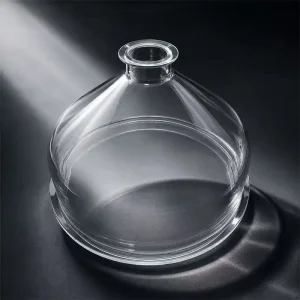
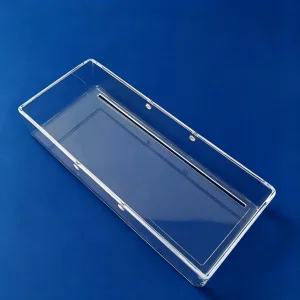
Explore our core catalog of standard and tailor-made quartzware. All components undergo helium mass-spectrometry leak detection, optical stress polarimetry, and high-purity ultrasonic acid purification before packaging.


A rigorous metallurgical overview of dielectric performance, thermal expansion coefficients, trace metal limits, and devitrification behavior under continuous high-temperature service.
Ultra-low transition metal & alkali element concentrations.
Sustained thermal resistance with continuous use at 1,100 °C.
Exceptional shock immunity from 1,100 °C directly into 20 °C water.
Helium mass spectrometer leak test certification (mbar·L/s).
Fused quartz and synthetic fused silica represent the ultimate high-performance amorphous material for mission-critical industrial systems. Unlike borosilicate or soda-lime glass, fused quartz is manufactured by melting high-purity natural silica sand or synthesized silicon precursors (such as SiCl₄) in electrical vacuum fusion furnaces or oxy-hydrogen / plasma flame reactors. The resulting silicon dioxide matrix provides a near-zero coefficient of thermal expansion, outstanding broad-spectrum optical transmission (from ultraviolet at 185 nm through visible light to near-infrared up to 3.5 μm), and chemical inertness toward virtually all inorganic acids, halogens, and aggressive process vapors (with the sole exceptions of hydrofluoric and hot concentrated phosphoric acid).
Selecting the appropriate quartz grade is essential for optimizing cost-performance ratios in advanced wafer manufacturing, laser optics, and CVD/LPCVD reactors. The table below details chemical purity, hydroxyl (OH⁻) content, and primary industrial applications:
| Material Classification | SiO₂ Content | OH Content (ppm) | Trace Metals (Al, Fe, Ti, Cu, Li) | Continuous Temp | Primary Industrial Use-Case |
|---|---|---|---|---|---|
| Electrically Fused Quartz (Type I) | ≥ 99.99% | < 5 - 30 ppm | < 15 - 25 ppm total | 1,150 °C | Semiconductor furnace tubes, diffusion liners, oversized process chambers |
| Flame Fused Quartz (Type II) | ≥ 99.995% | 150 - 450 ppm | < 10 - 20 ppm total | 1,050 °C | Quartz bell jars, bubbler vessels, digestion tubes, laboratory glassware |
| Synthetic Fused Silica (Type III / IV) | ≥ 99.9999% | < 1 ppm (Dry) to 1,200 ppm | < 0.1 - 1.0 ppm total | 1,000 °C | Deep-UV lithography optics, laser windows, microchannel flow cells |
| Opaque / Sintered Fused Silica | ≥ 99.95% | < 50 ppm | < 40 ppm total | 1,200 °C | Thermal insulation baffles, flange thermal blocks, solar crucible base-plates |
How Southeast Quartz leverages Donghai County’s world-leading raw quartz supply chain to deliver high-tolerance, rapid-turnaround custom quartzware to the global market.
Located in Qinghu Industrial Park, Donghai County (the global epicenter of high-purity silica distribution), Southeast Quartz maintains direct, traceable access to raw crystal ingots, continuous-draw mother tubes, and ultra-pure quartz sand. This vertical cluster reduces raw material delivery cycles by over 65% compared to non-integrated competitors.
Our workshop bridges artisanal oxy-hydrogen flame manipulation with multi-axis CNC cold diamond grinding, ultrasonic coring, and laser cutting. Whether joining heavy-wall flanged tubes with zero bubble inclusion or milling multi-level microchannels with ±0.02 mm precision, our dual tooling ensures structural stability and dimensional repeatability.
Every customized component is subjected to strict quality assurance steps: coordinate measuring machines (CMM) for geometric profiling, optical interferometry for surface planarity (λ/4 to λ/10), multi-stage hydrofluoric acid pickling, DI water cascade rinsing (>18 MΩ·cm), and cleanroom dual-bag vacuum packaging prior to overseas crating.
Technological migrations in advanced node semiconductors, TOPCon photovoltaics, and high-power optoelectronics are pushing quartz engineering to unprecedented dimensional and purity limits.
As semiconductor wafer fabrication standardizes on 300mm processes and explores larger substrate architectures, demand has surged for oversized quartz tubes exceeding outer diameters of 450 mm to 650 mm with wall thicknesses over 8 mm to 12 mm. Southeast Quartz employs dynamic vacuum continuous-rotation thermal lathes to guarantee strict circularity and zero sag during high-temp operations.
The photovoltaic industry's transition from P-type PERC to N-type TOPCon and heterojunction (HJT) architectures demands higher thermal budgets (1,150 °C+) and increased phosphorus/boron oxychloride gas resistance. Customized slotted quartz boats with specialized pitch clearances eliminate wafer warping, mechanical stress concentrations, and alkali atom migration.
Emerging artificial intelligence servers depend on high-speed co-packaged optics (CPO) and precision silica V-groove arrays. Simultaneously, modern analytical biotechnology utilizes synthetic fused quartz microchannel flow cells for high-throughput single-cell DNA sequencing, demanding bubble-free bonding and zero baseline fluorescence in the 200–400 nm excitation spectrum.
Every component is engineered to operate seamlessly within extreme industrial environments where chemical corrosiveness, mechanical fatigue, and thermal shock overlap.
Diffusion, oxidation, and chemical vapor deposition processes demand contamination-free containment that prevents silicon cross-contamination.
Crucial for single-crystal silicon pulling (CZ growth) and high-volume wafer thermal annealing for high-efficiency solar cells.
Acid cleaning, digestion, and chemical etching stations that process aggressive corrosive liquids under elevated pressure and temperature.
Spectroscopic measurement, laser optics, and micro-flow diagnostics demanding high transmission and thermal stability.
A comprehensive engineering framework designed for procurement managers, equipment OEMs, and plant operations engineers to reduce total cost of ownership (TCO).
Always specify critical vs. non-critical tolerances on CAD drawings (DWG/STEP/PDF). While standard furnace tubing tolerates outer diameter variations of ±0.5 mm, internal robot-slotted wafer boats and ground flange mating faces require precision CNC machining down to ±0.05 mm or tighter to prevent chamber vacuum blowouts and robotic handling crashes.
Devitrification (the transition from amorphous SiO₂ to crystalline cristobalite) begins around 1,100 °C to 1,150 °C and is accelerated exponentially by alkali metal residues (Na, K, Ca from human touch or dirty cleaning water). Southeast Quartz recommends periodic HF etching (5–10% solution for 3–5 minutes) and pure ethanol wiping before initial furnace baking.
Brittle high-purity glass components are prone to shipping damage if packed conventionally. Southeast Quartz utilizes custom CNC-routed high-density EVA foam inserts, secondary nitrogen-purged vacuum heat-sealed barrier bags, and heavy-duty ISPM-15 compliant shock-suspended export timber crates, reducing transatlantic transit breakage to below 0.05%.
In-depth engineering answers addressing devitrification, OH absorption bands, drawing requirements, chemical tolerance, and mass-spectrometry leak detection.
To provide a definitive DFM (Design for Manufacturability) review, pricing, and lead time within 24 hours, our engineering department requires:
1. Dimensional drawings in PDF, DWG, DXF, or 3D CAD format (STEP/IGES) specifying internal/outer diameters (ID/OD), wall thickness, total length, and critical tolerances.
2. End-terminal configuration: open-end, domed/flat closed end, ground joints (e.g., standard taper or spherical ball/socket), CF/KF vacuum flanges, or welded tubing ports.
3. Operational parameters: maximum continuous operating temperature, working thermal atmosphere (e.g., vacuum, inert Ar/N₂, oxidizing, or corrosive halogens), and thermal ramp rate.
4. Required optical or chemical grade: transparent electric fused quartz, flame-fused silica, or synthetic grade (deep UV transmission).
5. Batch production volume: prototyping quantities (1–5 pcs) vs. annual scheduled deliveries (100–5,000+ pcs).
Transparent fused quartz exhibits a transformation point near 1,075 °C, an annealing point at 1,180 °C, a strain point at 1,070 °C, and a softening point of approximately 1,683 °C. Under standard operational conditions, continuous service should remain at or below 1,100 °C, with short intermittent temperature excursions tolerated up to 1,250 °C–1,300 °C.
Devitrification represents the structural transition of amorphous silica into crystalline cristobalite. This degradation is catalyzed by surface impurities—specifically alkali metals (Li, Na, K) and alkaline earths (Ca, Mg). When a contaminated quartz surface is heated past 1,000 °C, nucleation sites form, creating a cloudy, white, brittle surface layer with a significantly higher thermal expansion coefficient. Upon subsequent cooling past 270 °C, phase transformation causes the cristobalite layer to micro-crack, destroying structural integrity. Preventing devitrification requires cleanroom handling, wearing powder-free gloves, and periodic acid cleaning.
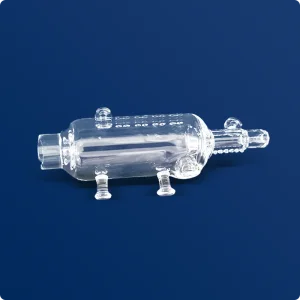
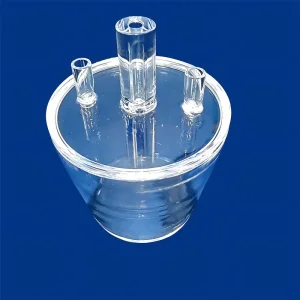
Welded quartz assemblies (such as multi-port bubblers, jacketed distillation vessels, and flanged reaction tubes) undergo rigorous testing: after flame-welding on our heavy-duty glass lathes, parts undergo electric resistance stress-relief annealing to eliminate localized micro-strains. Subsequently, components are mounted onto our helium mass-spectrometry leak detection stations. By spraying helium gas over weld seams under high vacuum, we verify leak rates below 1×10⁻⁹ mbar·L/s. Hydrostatic pressure testing is additionally conducted on pressure-bearing reactor vessels up to 1.5× the rated operational limit.
Hydroxyl (OH⁻) content directly controls a quartz component’s thermal viscosity, infrared absorption spectrum, and devitrification rate. Electrically fused quartz (Type I) is processed in vacuum induction furnaces, yielding an extremely low OH content (typically < 5 to 30 ppm). This grants it superior high-temperature mechanical viscosity, higher strain points, and maximum resistance to sagging under heavy thermal loads—making it the ideal choice for oversized semiconductor diffusion and LPCVD tubes.
Flame fused quartz (Type II) is melted using an oxy-hydrogen flame, naturally incorporating water vapor into the silica glass lattice. This results in higher OH concentrations (150 to 450 ppm), which creates a pronounced infrared absorption band at 2.73 μm and slightly lowers its thermal softening point, but provides virtually bubble-free optical transparency ideal for optical windows, laboratory glassware, and visual inspection ports.
Yes. Our in-house manufacturing facilities include dedicated 3-axis, 4-axis, and 5-axis CNC ultrasonic cold machining centers, CNC waterjet contour tables, precision flat grinding machines, and automated slotting saws. We routinely manufacture high-precision wafer boats for 4-inch, 6-inch, 8-inch, and 12-inch silicon, SiC, and GaN wafers with slot pitch tolerances held to ±0.02 mm and slot depth variances within ±0.03 mm. We also manufacture custom quartz microchannel flow cells, multi-chamber etching tanks, and irregular shaped thermal insulation windows tailored directly to proprietary OEM specifications.
Browse additional standardized components, including furnace rings, precision plates, digestion tubes, and customized reactor enclosures ready for worldwide deployment.