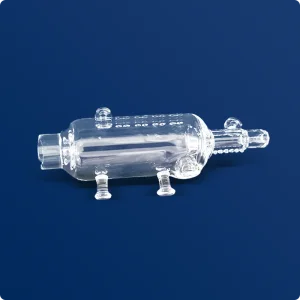
Explore our core selection of precision-drawn quartz furnace tubes, high-temperature carriers, and optical bell jars, manufactured under cleanroom-compliant parameters in Donghai County.





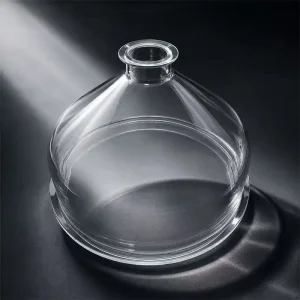
A rigorous examination of helical machining tolerances, structural integrity, and thermal-expansion equilibrium in high-vacuum, corrosive, and elevated-temperature environments.
Custom threaded quartz tubing replaces fragile ground-glass taper joints and problematic elastomer seals with robust, mechanically locked joints. By utilizing computerized 5-axis ultrasonic diamond grinding, Southeast Quartz fabricates ISO GL14, GL18, GL25, GL32, and GL45 threads, alongside proprietary coarse saw-tooth, buttress, and trapezoidal thread configurations. These standardized forms ensure zero-slop mating with PTFE, PEEK, or stainless steel compression collars while mitigating localized hoop stress under severe thermal cycling.
Fused silica boasts an exceptionally low coefficient of thermal expansion (CTE ≈ 5.5 × 10⁻⁷ / K from 20°C to 1000°C). Unlike borosilicate glass which softens near 500°C, fused quartz maintains mechanical rigidity up to its annealing point of 1,140°C and strain point of 1,070°C, with a softening threshold around 1,683°C. In threaded applications, precise root-radius machining eliminates notch sensitivity, preventing stress-concentration fractures when heating cycles transition from ambient to 1,100°C within seconds.
Fabricated from natural crystalline quartz from Donghai or synthetic SiCl4 precursors, our threaded tubes maintain SiO2 purities exceeding 99.99% to 99.999%. Transition metals (Fe, Cu, Ni) and mobile alkali ions (Na, K, Li) are restricted below 0.1 ppm to preclude devitrification seeding and semiconductor wafer counter-doping. Every threaded component undergoes HF etching and DI water cascades before thermal stress-relief annealing.
Examining how high-spec threaded fused quartz assemblies resolve bottleneck engineering challenges across advanced manufacturing sectors globally.
In LPCVD, atomic layer deposition (ALD), and rapid thermal processing (RTP), process gases including SiH4, DCS, NF3, and HCl are injected at vacuum or slight overpressure. Standard flanges can leak or introduce metallic particulate contaminants. Custom male- and female-threaded quartz tube connectors allow modular quartz-to-quartz seals using perfluoroelastomer (FFKM) or grafoil gaskets. This architecture prevents gas bypass, reduces chamber downtime during tube swap-outs, and upholds strict particle-per-wafer-pass guidelines.
As PV manufacturing shifts toward N-type TOPCon with boron diffusion and POCl3 phosphorus oxychloride doping, process tubes run hotter and longer. Threaded quartz manifolds, injector tubes, and exhaust stubs provide rigid mechanical couplings that resist the thermal sag common in unthreaded slip fits. This structural stability eliminates localized cracking caused by thermal movement against metallic furnace bulkheads.
Continuous-flow micro-reactors and high-temperature gas synthesis cells demand chemical inertia against boiling aqua regia, oleum, and halogen radicals. Threaded quartz tubes enable direct coupling to PTFE flow lines without contaminating intermediate greases or o-rings directly in the hot zone. Threaded quartz end-caps allow swift catalyst regeneration without disassembling entire furnace lines.
| Dimensional & Mechanical Parameter | Standard Commercial Grade | Southeast Quartz Precision Grade | Test & Verification Method |
|---|---|---|---|
| Outer Diameter (OD) Range | Ø 4 mm – Ø 120 mm | Ø 2 mm – Ø 450 mm (Oversized Capable) | Laser Micrometer Scanning / CMM |
| Thread Pitch Tolerance (Lead Error) | ± 0.20 mm per 10 mm | ± 0.03 mm per 10 mm (CNC Ground) | Optical Comparator / Thread Gauge |
| Hydrostatic Burst Pressure (Wall Dependent) | 3 – 8 bar (Nominal) | Up to 25 bar (Special Wall Profiles) | Hydrostatic Water Burst Rig |
| Vacuum Integrity (Hermetic Rating) | 1 × 10⁻⁶ mbar·L/s | < 1 × 10⁻⁹ mbar·L/s (He Mass Spec) | Pfeiffer Helium Leak Detector |
| Surface Finish of Thread Crests & Roots | Ground As-Cut (Ra 1.6 µm) | Fire-Polished / Micro-Etched (Ra < 0.4 µm) | White Light Interferometry |
| Total Metallic Impurities (Al, Fe, Ti, Ca, Mg) | < 30 ppm | < 8 ppm (Ultra-Pure Synthetic < 0.5 ppm) | ICP-MS Elemental Assay |
How Southeast Quartz integrates stringent international manufacturing codes with turnkey regional support across Europe, North America, and the Asia-Pacific basin.
Every custom threaded tube is manufactured under an ISO 9001:2015 audited quality management system. Where cleanroom components interface with front-end fabs, products conform to SEMI F21 (standard for dimensioning ultra-pure fluid systems) and SEMI C65-C68 analytical standards. Each batch includes a Certificate of Analysis (CoA) documenting raw ingot batch provenance, hydroxyl (OH⁻) content (standard < 20 ppm; low-OH < 2 ppm for IR heating), and trace metals.
Through our dedicated technical sales liaisons in Frankfurt, Munich, Austin, and Singapore, Southeast Quartz delivers localized design consultation. Whether adjusting a thread profile for mating with proprietary German vacuum fittings or retrofitting legacy MKS / Swagelok connectors in an American R&D lab, our engineering team responds within 24 hours with certified 2D CAD and 3D STEP drawings for mechanical clearance validation.
Quartz threading can be vulnerable to edge chipping if handled poorly during maritime or air freight. We employ a 4-tier packaging protocol: Class 10,000 cleanroom ultrasonic acid strip, clean dry nitrogen blow, double vacuum bagging with antistatic ESD pouches, and shock-isolated custom EPE foam inserts encased in wooden export crates. Shipments carry drop and tilt sensors, guaranteeing 100% intact arrival at global destination points.
Anticipating the evolving demands of sub-2nm node semiconductors, high-power excimer laser systems, and sustainable hydrogen energy processing through 2030.
Transitioning from manual lathe flame-forming to 50 kHz ultrasonic rotary machining. Reduces sub-surface micro-fractures in thread roots from 25 µm to under 3 µm, increasing cyclic tensile load thresholds by 40%.
Proprietary CNC hydrogen-oxygen burner rigs capable of selectively glazing thread crests and valleys. Delivers optical-grade surface finish without altering the thread's pitch diameter or cumulative pitch error.
Co-engineered silicon nitride (Si3N4) and alumina (Al2O3) threaded couplings with thermally matched compliant expansion layers. Extends continuous operational envelope beyond 1,350°C in oxidizing atmospheres.
Integration of plasma-assisted CVD silica deposition directly into tube preforms, targeting sub-ppb metallic tolerances for extreme ultraviolet (EUV) optical pellicles and next-generation atomic diffusion systems.
Key technical answers compiled by Southeast Quartz senior manufacturing engineers for equipment builders and procurement directors.
Because quartz has an extremely low CTE (5.5 × 10⁻⁷ / K) compared to stainless steel (~16 × 10⁻⁶ / K), direct rigid threaded metal-on-quartz contact will cause the quartz to shatter upon heating. We design threaded quartz joints with clearance tolerances paired with stepped spring-loaded PEEK/PTFE sleeves or high-temperature metal Belleville washers that absorb differential thermal expansion without overloading the quartz thread flanks.
Unlike steel or brass, quartz is a brittle material susceptible to shear fracture. For GL14 to GL25 threads mated with PTFE/fluoropolymer caps, tightening torque should not exceed 1.2 to 2.5 N·m. For larger GL32 to GL45 configurations, a maximum torque of 3.5 to 5.0 N·m is advised. Always employ calibrated torque wrenches or slip-clutch caps to prevent over-tightening during assembly.
Yes. Southeast Quartz utilizes custom CNC internal diamond threading tools with internal coolant flush to mill internal female threads down to ID 10 mm. For smaller diameters, we produce externally threaded adapters or precision weld factory-threaded tubular sleeves to the main tube body.
Devitrification (crystallization from amorphous SiO2 into cristobalite) occurs above 1,150°C and is drastically accelerated by alkaline metals, finger grease, or salt residues. Operators should handle quartz components exclusively using powder-free nitrile or lint-free cotton gloves. Prior to initial firing, threaded parts should be rinsed with a 5% HF solution or high-purity isopropyl alcohol and dried with filtered nitrogen.
Complementary high-performance quartz solutions engineered to integrate with our custom threaded tubing for complete process chamber architecture.