
1 / 5
| Mechanical Behavior | Standard Values |
|---|---|
| Density | 2.2 g/cm³ |
| Compressive Strength | 1100 MPa |
| Flexural Strength | 67 MPa |
| Poisson's Ratio | 0.14 ~ 0.17 |
| Young's Modulus | 72,000 MPa |
| Modulus of Rigidity | 31,000 MPa |
| Mohs Hardness | 5.5 ~ 6.5 |
| Transformation Point | 1280 °C |
| Softening Point | 1780 °C |
| Annealing Point | 1250 °C |
| Specific Heat (20 ~ 350 °C) | 670 J/kg·°C |
| Thermal Conductivity (20 °C) | 1.4 W/m·°C |
| Index of Refraction | 1.4585 |
| Low Thermal Expansion Coefficient | 5.5 × 10⁻⁷ cm/cm·°C |
| Thermal Processing Temperature | 1750 ~ 2050 °C |
| Short-Term Use Temperature | 1300 °C |
| Long-Term Use Temperature | 1100 °C |
| Material | Silicon Dioxide (Natural Quartz) |
| Color | Transparent or Colorless |
| Surface | No Air Bubble, No Line |
| Strain | 1270°C Fused Quartz Glass Brick |
| PPM Grade | Controlled 10 / 20 / 100 PPM |
| Shape | Circle |
| Thickness | 2 mm – 20 mm |
Fused quartz glass can withstand a short-term use temperature of up to 1300 °C and a long-term continuous use temperature of up to 1100 °C. Its thermal processing temperature ranges from 1750 °C to 2050 °C, making it suitable for high-temperature industrial applications.
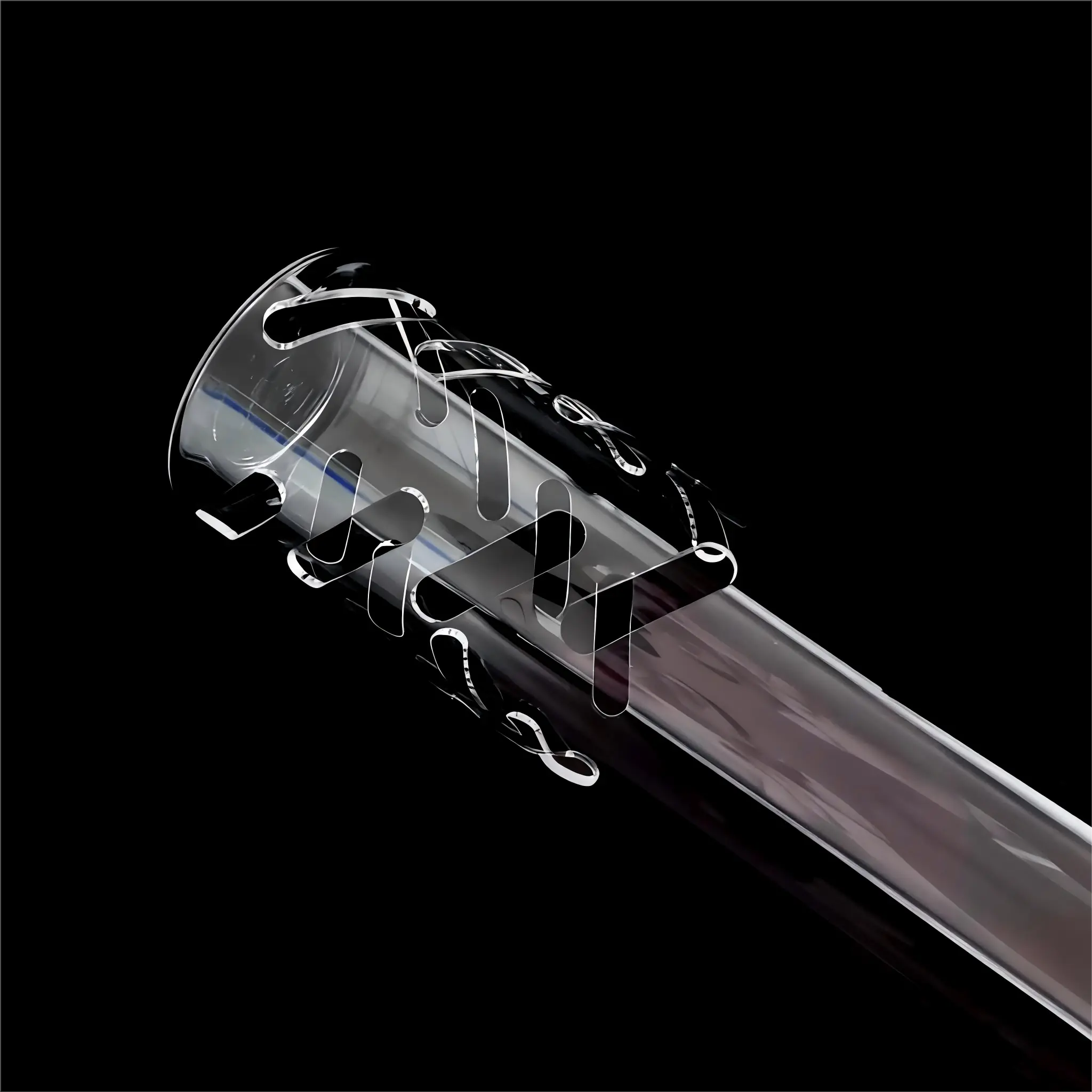
Fused quartz glass is made from Silicon Dioxide (SiO₂) sourced from natural quartz. It is transparent or colorless in appearance and features a surface free of air bubbles and lines, ensuring high optical clarity and structural integrity.
Its exceptional thermal shock resistance is primarily due to its extremely low thermal expansion coefficient of 5.5 × 10⁻⁷ cm/cm·°C. This minimal expansion under heat prevents cracking or deformation during rapid temperature changes, which is a key advantage over standard glass materials.
Fused quartz glass is available in circular shapes with thicknesses ranging from 2 mm to 20 mm. The PPM grade can be precisely controlled at 10, 20, or 100 PPM to meet specific purity requirements for different industrial and scientific applications.
Fused quartz glass has a Mohs hardness of 5.5 to 6.5, placing it in the mid-to-upper range of hardness on the Mohs scale. Combined with a compressive strength of 1100 MPa and a Young's modulus of 72,000 MPa, it offers excellent mechanical durability for demanding environments.
The index of refraction for fused quartz glass is 1.4585. This precise optical property makes it highly suitable for use in optical instruments, lenses, prisms, and UV-transmitting applications, where consistent light transmission and minimal distortion are critical requirements.






