
High-Quality Custom Transparent Quartz Glass Ring - High Temperature Resistant Insulation Ring from China Suppliers & Factory Suppliers, Products

,

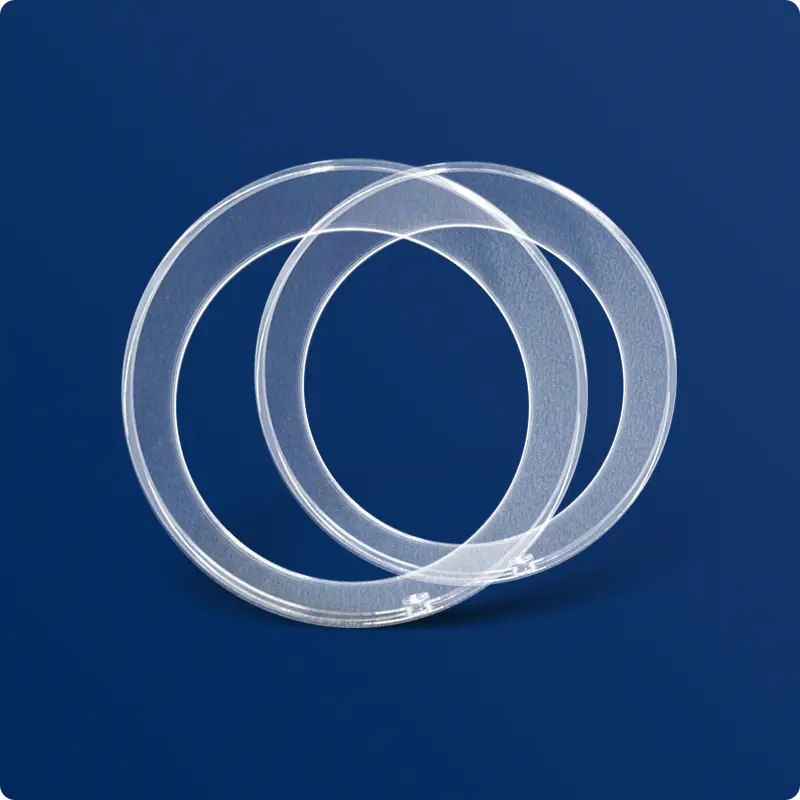
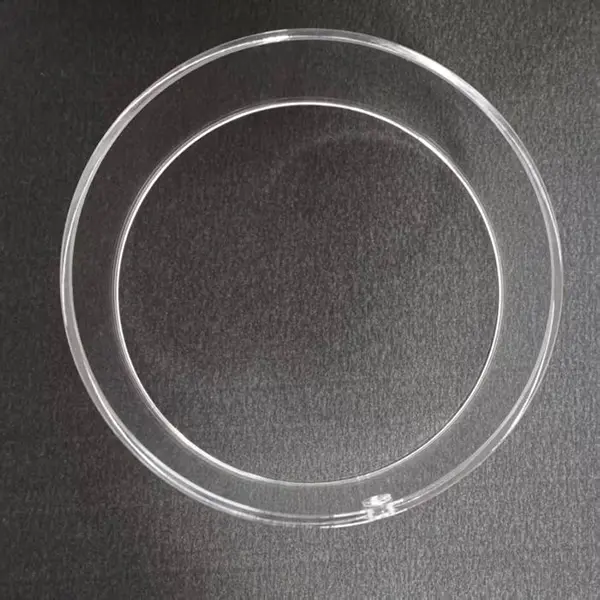
Our quartz rings, produced in China, are high-purity components crafted from fused silica. These rings provide excellent thermal stability and can withstand high temperatures up to 1100°C, along with featuring low thermal expansion. They are known for outstanding light transmittance and exceptional resistance to acids and corrosion, making them ideal for a variety of applications. These superior electrical insulators offer high dimensional accuracy and robust mechanical strength, making them essential in semiconductor manufacturing, high-temperature furnaces, optical devices, laboratory equipment, and the photovoltaic industry. As reliable sealing rings, insulation parts, and structural components, our quartz rings are designed to perform in harsh environments. Trust our factory as a leading supplier of quartz rings for all your industrial needs.

,

Product Description

Product Specifications
Outer Diameter Inner Diameter Height Outer Diameter Tolerance Inner Diameter Tolerance Height Tolerance
20 10 5~20 ±0.2 ±0.2 ±0.2
30 15/20 5~30 ±0.2 ±0.2 ±0.2
40 20/30 5~30 ±0.2 ±0.2 ±0.2
50 30/40 5~50 ±0.3 ±0.3 ±0.3
60 40/50 5~50 ±0.3 ±0.3 ±0.3
80 50/60/70 10~60 ±0.3 ±0.3 ±0.3
100 60/80/90 10~80 ±0.5 ±0.5 ±0.5
120 80/100 10~80 ±0.5 ±0.5 ±0.5
150 100/120 10~100 ±0.8 ±0.8 ±0.5
200 150/180 10~120 ±1.0 ±1.0 ±0.8
250 200/220 10~120 ±1.2 ±1.2 ±0.8
300 250/280 10~150 ±1.5 ±1.5 ±1.0
📐 All dimensions are in millimeters (mm). Tolerances increase proportionally with outer diameter size. Custom dimensions are available upon request.
❓ Frequently Asked Questions
Q What do the outer diameter and inner diameter values in the table represent?
A The outer diameter refers to the total external measurement of the component, while the inner diameter refers to the bore or hole diameter. Multiple inner diameter options (e.g., 15/20) indicate available configurations for that outer diameter size.
Q Why do tolerance values increase as the diameter gets larger?
A Larger components inherently involve greater material volume and machining complexity. As the outer diameter increases from 20mm to 300mm, the dimensional tolerances widen accordingly — from ±0.2mm to ±1.5mm — to account for practical manufacturing limitations while maintaining functional precision.
Q Can I request a custom height outside the listed range?
A Yes. The height ranges listed in the table (e.g., 5~20mm, 10~150mm) represent standard production ranges. Custom heights beyond these ranges may be available depending on the outer diameter and material. Please contact us with your specific requirements for a feasibility assessment.
Q Are tighter tolerances available for precision applications?
A The tolerances listed represent standard manufacturing specifications. For applications requiring tighter tolerances — such as aerospace, medical, or high-precision industrial uses — customized machining options may be available. Please reach out to discuss your specific tolerance requirements.
Q What is the height tolerance difference between outer diameter and height for larger sizes?
A For larger sizes (150mm and above), the height tolerance is intentionally kept tighter than the outer and inner diameter tolerances. For example, at 200mm outer diameter, the diameter tolerances are ±1.0mm while the height tolerance remains ±0.8mm. This reflects the importance of axial precision in many assembly applications.
Q How should I select the correct inner diameter for my application?
A When multiple inner diameter options are listed for a given outer diameter, selection depends on your shaft size, wall thickness requirements, and load-bearing needs. A thicker wall (larger difference between outer and inner diameter) generally provides greater structural strength, while a thinner wall reduces weight and material cost.

Related Products






