
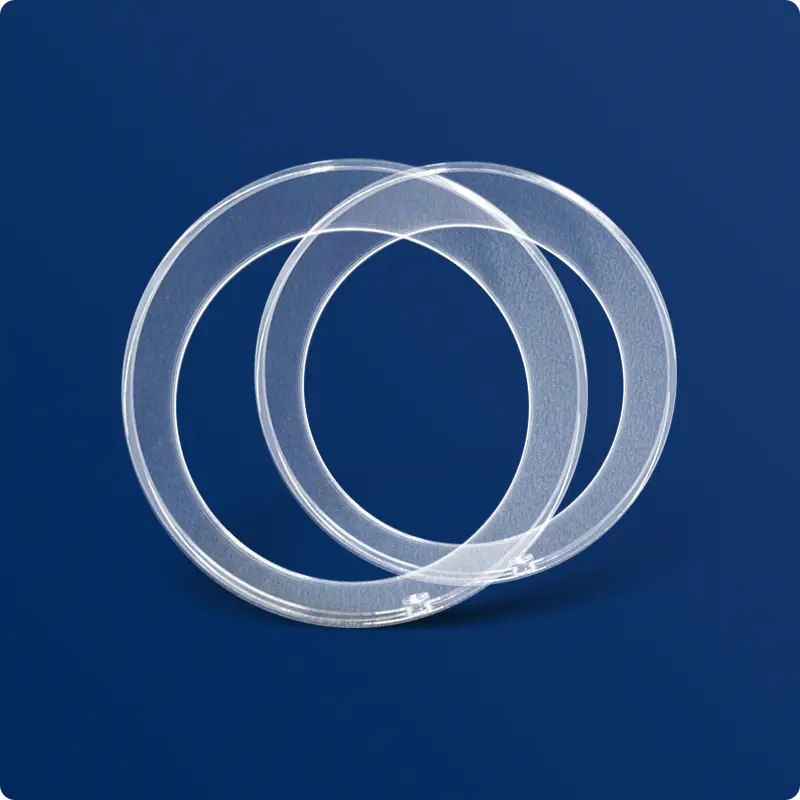
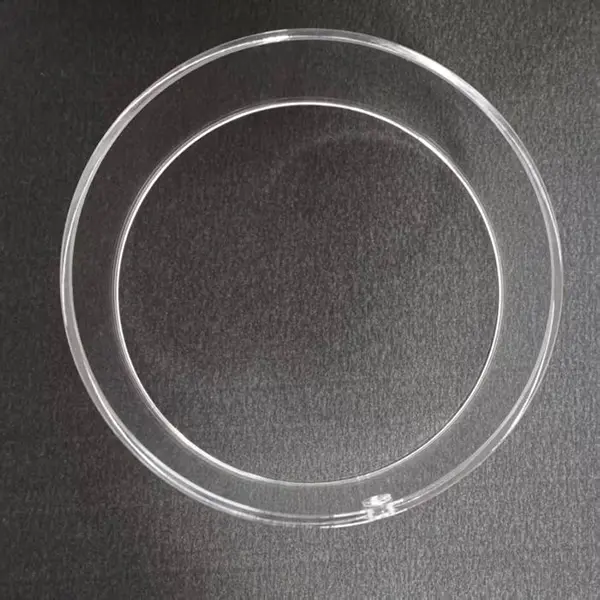
High-Quality High Purity Custom Transparent Quartz Glass Rings - China Suppliers & Factory for High-Temperature Insulation Components Supplier, Product

Quartz rings manufactured in China are high-purity components crafted from fused silica, known for their exceptional thermal stability and high-temperature resistance of up to 1100°C. These rings feature low thermal expansion and outstanding light transmittance, making them ideal for various applications. Renowned suppliers and factory producers offer quartz rings that exhibit strong acid and corrosion resistance, as well as superior electrical insulation properties. With their high dimensional accuracy and impressive mechanical strength, these quartz rings play a vital role in semiconductor manufacturing, high-temperature furnaces, optical devices, laboratory equipment, and photovoltaic industries. They serve as reliable sealing rings, insulation parts, and structural components in demanding environments, ensuring longevity and performance

Product Description

📊 Standard Dimensional Specifications & Tolerances
📐 All dimensions are in millimeters (mm). Tolerances apply to standard production conditions. Custom sizes and tolerances are available upon request.
Outer Diameter Inner Diameter Height Outer Diameter Tolerance Inner Diameter Tolerance Height Tolerance

20

10

5~20

±0.2

±0.2

±0.2

30

15/20

5~30

±0.2

±0.2

±0.2

40

20/30

5~30

±0.2

±0.2

±0.2

50

30/40

5~50

±0.3

±0.3

±0.3

60

40/50

5~50

±0.3

±0.3

±0.3

80

50/60/70

10~60

±0.3

±0.3

±0.3

100

60/80/90

10~80

±0.5

±0.5

±0.5

120

80/100

10~80

±0.5

±0.5

±0.5

150

100/120

10~100

±0.8

±0.8

±0.5

200

150/180

10~120

±1.0

±1.0

±0.8

250

200/220

10~120

±1.2

±1.2

±0.8

300

250/280

10~150

±1.5

±1.5

±1.0

❓ Frequently Asked Questions
🔵 What unit of measurement is used in the dimensional specification table?
✅ All dimensions listed in the table — including outer diameter, inner diameter, and height — are expressed in millimeters (mm). Tolerances are also stated in millimeters (mm).
🔵 Why does the tolerance increase as the outer diameter gets larger?
✅ Larger components naturally have greater dimensional variation during manufacturing due to increased material volume and machining complexity. Tolerances are scaled accordingly — from ±0.2 mm for small diameters (20 mm) up to ±1.5 mm for larger diameters (300 mm) — to reflect realistic and achievable manufacturing precision.
🔵 Can custom outer diameter and inner diameter combinations be ordered?
✅ Yes. The table provides standard size combinations for reference. Each outer diameter is offered with multiple inner diameter options (e.g., OD 80 mm is available with ID 50, 60, or 70 mm). Custom combinations outside the listed options can be discussed with our engineering team based on your application requirements.
🔵 What is the maximum height available for each size?
✅ The maximum height varies by outer diameter. For example, OD 20 mm supports heights up to 20 mm, while OD 300 mm supports heights up to 150 mm. The height range for each size is clearly listed in the "Height" column of the specification table above.
🔵 Are tighter tolerances available for precision applications?
✅ The tolerances shown in the table represent our standard manufacturing specifications. For applications requiring tighter dimensional control, please contact us directly. We can evaluate precision machining options depending on the size range and quantity required.
🔵 Is the height tolerance different from the diameter tolerance for larger sizes?
✅ Yes, for larger sizes the height tolerance is often tighter than the diameter tolerance. For instance, at OD 150 mm, the diameter tolerance is ±0.8 mm while the height tolerance is ±0.5 mm. At OD 300 mm, the diameter tolerance is ±1.5 mm while the height tolerance is ±1.0 mm. This reflects the different machining processes used for axial versus radial dimensions.

Related Products






