
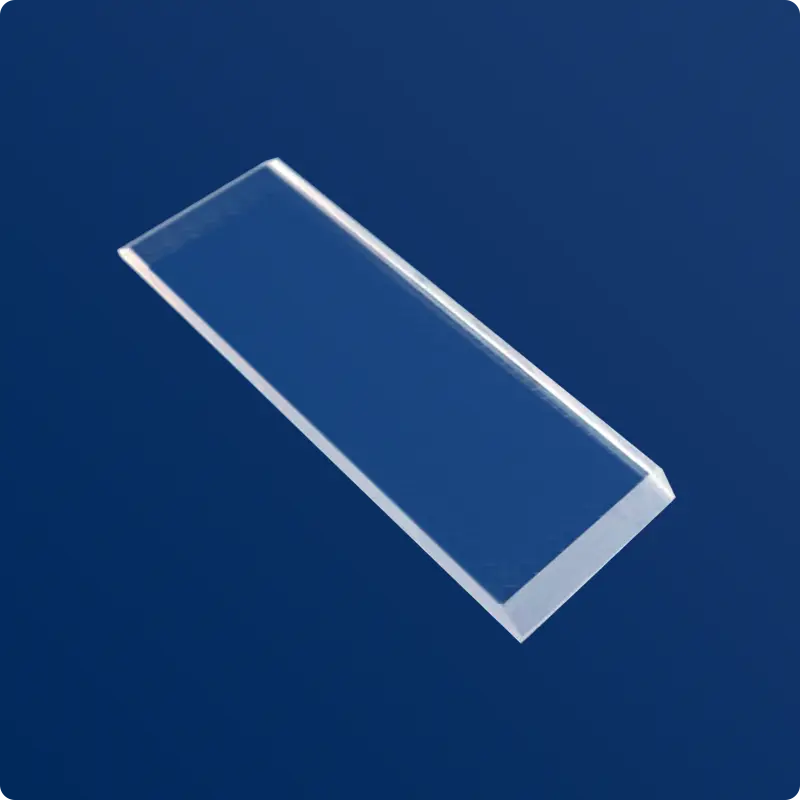

High-Quality High-Quality Fused Silica Quartz Plate from China Suppliers | Heat Resistant Factory Product Factories, Product

,

Discover our premium quartz sheets, crafted from high-purity silicon dioxide (SiO₂) at our state-of-the-art factory in China. Renowned for their exceptional characteristics, these quartz plates offer high temperature resistance, superior light transmittance, and a low coefficient of expansion. Our quartz sheets are customizable in size and thickness to meet your specific needs, making them ideal for a variety of applications, including optical windows, semiconductor manufacturing, and laboratory glassware.

,

As leading suppliers of quartz materials, we ensure that our quartz glass plates are produced by melting and refining natural or synthetic high-purity quartz, then expertly cutting and polishing them into flat panels. These key components are essential for optoelectronic devices and scientific research equipment, showcasing the quality and innovation that our factory in China delivers.

,

Product Description

📋 Product Specifications & Details

📐Length × Width (mm) 🔧Dimensional Tolerances (mm) 📏Standard Thickness (mm) ⚙️Thickness Tolerances (mm)
10 × 10 ±0.1 0.5 / 1.0 / 2.0 ±0.05 ~ ±0.1
20 × 20 ±0.1 0.5 / 1.0 / 2.0 / 3.0 ±0.05 ~ ±0.1
30 × 30 ±0.1 1.0 / 2.0 / 3.0 ±0.05 ~ ±0.1
40 × 40 ±0.1 ~ ±0.2 1.0 / 2.0 / 3.0 / 4.0 ±0.08 ~ ±0.1
50 × 50 ±0.1 ~ ±0.2 1.0 / 2.0 / 3.0 / 5.0 ±0.08 ~ ±0.1
60 × 60 ±0.2 2.0 / 3.0 / 5.0 ±0.1
80 × 80 ±0.2 2.0 / 3.0 / 5.0 ±0.1
100 × 100 ±0.2 ~ ±0.3 2.0 / 3.0 / 5.0 ±0.1
150 × 150 ±0.3 3.0 / 5.0 ±0.1 ~ ±0.2
200 × 200 ±0.3 ~ ±0.5 3.0 / 5.0 ±0.1 ~ ±0.2

❓ Frequently Asked Questions

Q What do the dimensional tolerances in this table represent?
Dimensional tolerances refer to the allowable deviation range for the length and width of each piece. For example, a tolerance of ±0.1 mm means the actual dimension may be up to 0.1 mm larger or smaller than the specified size, ensuring consistent quality in manufacturing.
Q Why do larger sizes have wider dimensional tolerances?
As the length and width of a piece increase, minor variations in the manufacturing process can accumulate, making it more challenging to maintain extremely tight tolerances. Larger pieces such as 150×150 mm and 200×200 mm therefore have wider tolerances (up to ±0.5 mm) compared to smaller pieces like 10×10 mm (±0.1 mm).
Q What standard thickness options are available for small sizes like 10×10 mm?
For the 10×10 mm size, three standard thickness options are available: 0.5 mm, 1.0 mm, and 2.0 mm. Smaller sizes generally support thinner options, including 0.5 mm, which is not available for larger formats.
Q Can custom sizes or thicknesses be ordered outside of the standard specifications?
The table lists standard size and thickness combinations that are regularly available. For custom dimensions or thicknesses not listed, it is recommended to contact the manufacturer directly to discuss feasibility, lead times, and any additional tolerances that may apply.
Q What is the thickness tolerance for pieces sized 200×200 mm?
For the 200×200 mm size, the thickness tolerance ranges from ±0.1 mm to ±0.2 mm, depending on the selected standard thickness (3.0 mm or 5.0 mm). Thicker pieces may carry a slightly wider thickness tolerance due to processing characteristics.
Q How should I select the appropriate size and thickness for my application?
Selection should be based on your application's structural requirements, load-bearing needs, and space constraints. For precision applications, choose sizes with tighter tolerances (e.g., 10×10 mm to 30×30 mm). For larger structural uses, sizes from 100×100 mm to 200×200 mm with greater thickness options offer enhanced stability and durability.

Related Products






