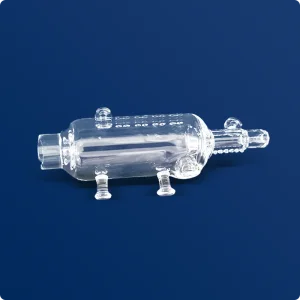
Standardized high-temperature quartz tubes, structural carriers, and wafer processing platforms manufactured to micro-tolerances with certified chemical purity.
Synthesized from ultra-high purity natural crystal grain and synthetic chemical silica precursors, micro quartz components operate at physical and thermodynamic margins where traditional borosilicate and technical ceramics fail.
Total metallic impurities (Al, Fe, Ti, Cu, Na, K, Li) kept strictly below 5 ppm through selective acid refining.
Continuous thermal structural stability at 1,100°C with transient thermal peak handling up to 1,280°C.
Virtually zero CTE (per °C, 20-320°C), granting extreme thermal shock immunity from 1,100°C rapid water quench.
Sub-micron dimensional accuracy achieved across ultrasonic milling, laser ablation, and cleanroom polishing.
The global fused quartz and micro-engineered silica market is undergoing a fundamental structural transition. Moving away from commodity furnace tubes toward highly integrated, sub-millimeter micro quartz solutions, this evolution is driven by sub-3nm node semiconductor manufacturing, lab-on-a-chip microfluidics, and deep-UV photonic interconnects.
High-purity quartz (HPQ) sand represents an asymmetric strategic commodity globally. The geopolitical concentration of raw pegmatite quartz deposits in Spruce Pine (North Carolina, USA) and selective regions of Eurasia creates acute downstream supply constraints. In response, China's Donghai quartz cluster—anchored by facilities like Southeast Quartz—has established comprehensive vertical integration. By coupling plasma chemical refining with ultra-precision cold-machining, localized clusters deliver raw material traceability and de-risk supply chain volatility for tier-1 semiconductor OEMs.
Standard industrial quartz tolerances (±0.5 mm) are obsolete for modern microfluidic sensors, fiber-optic V-grooves, and wafer carrier boats. Micro quartz factories now function as hybrid precision foundries, deploying picosecond and femtosecond cold laser machining, reactive ion etching (RIE), and sub-aperture CNC ultrasonic milling. Components with internal bore diameters down to 50 μm, optical surface roughness (Ra) ≤ 0.5 nm, and angular parallelism within 3 arcseconds have transitioned from specialized lab experiments to scaled serial fabrication.
Thermal devitrification—the polymorphic phase transformation of metastable amorphous fused silica into crystalline cristobalite above 1,150°C—is the primary failure mode in high-temperature industrial tools. Micro quartz manufacturers implement clean-room hot fire polishing and proprietary hydroxyl (OH-) radical doping controls. By optimizing hydroxyl concentrations from ultra-low dry quartz (<1 ppm OH for IR systems) to wet synthetic silica (>1,000 ppm OH for deep UV transmission), factories engineer micro-components engineered specifically to resist thermal creep and micro-fractures.
Selecting the appropriate silica class requires cross-referencing trace element concentrations, optical transmission spectra, and manufacturing methodologies. Below is the technical performance baseline governing precision custom micro quartz manufacturing.
| Performance Characteristic | Type I (Electrically Fused Natural Quartz) | Type II (Flame Fused Natural Quartz) | Type III (Synthetic Fused Silica - Gas Phase) | Type IV (Plasma Fused Synthetic Silica) |
|---|---|---|---|---|
| Precursor Origin | Purified Pegmatite Quartz Crystals | Refined Quartz Granules | Silicon Tetrachloride (SiCl₄) Hydrolysis | Vaporized SiCl₄ in Water-Free Plasma |
| Purity Level (SiO₂) | ≥ 99.995% (4N5) | ≥ 99.998% (4N8) | ≥ 99.9999% (6N) | ≥ 99.99999% (7N) |
| Typical Hydroxyl (OH⁻) Content | < 5 ppm (Water-free) | 150 - 400 ppm | 800 - 1,200 ppm (High OH) | < 0.5 ppm (Extreme Low OH) |
| Transmission Spectrum | 260 nm - 3,500 nm (Near-IR optimized) | 220 nm - 2,700 nm (General Purpose) | 185 nm - 2,500 nm (Deep DUV grade) | 160 nm - 3,600 nm (Broadband DUV to IR) |
| Refractive Index Homogeneity | ± 1 × 10⁻⁵ | ± 5 × 10⁻⁶ | ≤ ± 1 × 10⁻⁶ | ≤ ± 4 × 10⁻⁷ (Lithography grade) |
| Primary Micro Applications | Furnace diffusion tubes, micro boats | High-temp sight windows, lamp envelopes | Microfluidic chips, UV flow cells | Laser optics, EUV photomask substrates |
Where conventional materials degrade under ionizing radiation, corrosive halogens, or thermal fatigue, engineered micro quartz components guarantee deterministic uptime.
Within advanced front-end wafer fabrication, furnace boats must endure repeated cyclic thermal ramping from 400°C to 1,050°C in hazardous SiH₄, NH₃, and HCl atmospheres. Micro-slotted quartz boats provide micro-machined wafer pitch slot tolerances (±0.01 mm) that eliminate wafer slipping during robotic end-effector handoffs. Plasma-etched high-purity quartz bell jars ensure complete absence of iron and copper ionic migration into gate oxide layers during thermal drive-in diffusion.
High-throughput DNA sequencing, liquid chromatography detectors, and droplet microfluidics demand optically isotropic fluid channels. Micro quartz flow cells utilize direct fusion bonding—without epoxy resins or adhesives—yielding monolithic assemblies that eliminate autofluorescence across the 254-365 nm excitation spectrum. Microchannel internal dimensions as compact as 25 μm × 25 μm resist aggressive solvents (DMSO, acetone, concentrated sulfuric acid) across unlimited lifecycle runs.
As solar cell efficiency races past 25% with TOPCon and heterojunction architectures, low-pressure boron diffusion necessitates furnace tubes with ultra-large outer diameters (>450 mm) coupled with micro-scale wall uniformity. Tube wall thickness deviations must be kept within ±3% to prevent local thermal hotspots that cause micro-crack propagation under intense phosphine and boron tribromide dopant flow.
Implementing quartzware in automated fabs requires systemic process management. Southeast Quartz deploys comprehensive structural defense solutions against known operational risks.
Failure Risk: Sub-surface bubbles (>20 μm) burst under vacuum or during high-temperature etching cycles, releasing trapped nitrogen/argon gases and shattering wafer lots.
Factory Solution: Vacuum plasma continuous melting coupled with automated high-resolution optical scanning (AOI) to achieve DIN ISO 10110-3 bubble-class 0 compliance.
Failure Risk: Weld seams on torch-joined quartz tubes and flange transitions harbor residual tensile stress, triggering catastrophic stress cracking upon first thermal ramp to 800°C.
Factory Solution: Dual-zone digital ramp annealing at 1,180°C for 8 hours followed by controlled cooling (≤1.5°C/min) with crossed-polarizer photoelastic stress evaluation (<5 nm/cm).
Failure Risk: Hand sweat or ambient sodium (Na+) / potassium (K+) contact acts as a catalyst, rapidly nucleating cristobalite crystallization at 1,000°C, turning quartz milky and brittle.
Factory Solution: 18% multi-stage hydrofluoric (HF) acid chemical de-skinning, Class 100 cleanroom ultrasonic megasonic bath deionized rinsing, and airtight vacuum packaging.
Our strategic manufacturing horizon targets the transition from manual hot-working to closed-loop digital laser forming and additive fused silica fabrication.
Computer numerical vision-guided hydrogen-oxygen torches delivering ±0.05 mm flange concentricity on oversized 500 mm OD furnace tubes.
Femtosecond laser modification followed by wet chemical etching to create 3D internal micro-channels with 1,000:1 aspect ratios inside solid quartz blocks.
Direct binder jetting of nano-scale silica powders followed by hot isostatic pressing (HIP) to produce monolithic complex non-standard reactor geometries without seams.
Hermetically sealed micro-vapor quartz absorption cells for atomic clocks and chip-scale quantum gravimeters with helium permeation rates ≤ 10⁻¹² mbar·l/s.
Factory-direct specialized optical plates, microfluidic components, digestion tubes, and industrial thermal insulators produced to precise client drawings.
Critical technical inquiries addressed by Southeast Quartz senior materials scientists regarding dimensioning, manufacturing limits, tolerances, and quality verification.