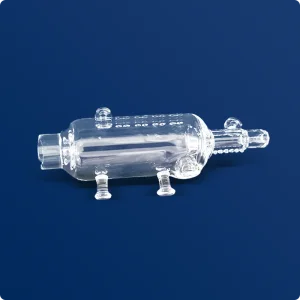
Engineered for high-heat resilience, trace-metal cleanliness, and extreme vacuum integrity in next-generation wafer fabrication and optical manufacturing.
In modern industrial thermal processing, component integrity directly dictates yield rate, cross-contamination risks, and mean-time-between-failures (MTBF).
Thermal diffusion, LPCVD, PECVD, and rapid thermal oxidation (RTO) operate at temperatures reaching 1,150°C. Our ultra-pure quartz diffusion tubes and slotted boats prevent heavy metal ion migration (Fe, Cu, Ni < 0.1 ppm), mitigating carrier lifetime degradation in sub-micron node architectures.
Next-generation solar technologies demand massive throughput without structural sag. Our large-bore oversized fused silica furnace tubes (diameters reaching 450mm+) deliver excellent thermal stability and resistance to thermal shock, supporting extended campaign lifespans under corrosive POCl3 and silane environments.
For crystal pulling, vacuum vapor deposition, and optical preform synthesis, our plasma-fused ingots and machined quartz plates provide high optical transmission across UV-Vis-NIR spectra alongside minimal thermal expansion (5.5 × 10⁻⁷/K), preventing dimensional drift under rapid thermal cycling.
Global thermal processing operators are transitioning away from commodity synthetic glasses to ultra-refined natural and synthetic fused silica to reduce system total cost of ownership (TCO).
Trace alkali metals < 1.5 ppm, preventing early crystallization
Continuous thermal threshold operating reliably at 1,100°C
Helium mass-spectrometry leak-tested before global dispatch
Extreme thermal shock resilience without micro-fracturing
From the world-renowned Donghai quartz cluster directly to your cleanroom, our five-stage thermal manufacturing pipeline enforces exacting dimensional and chemical standards.
ICP-MS purity analysis on raw ingots, selecting premium silica grains with minimal OH- radicals and negligible metallic contaminants.
Oxy-hydrogen flame processing, mechanized glass lathes, flanging, dome closing, and robotic torch welding to eliminate joint porosity.
Multi-axis diamond CNC cutting, ultrasonic drilling, precision grinding, and laser wafer slotting down to ±0.05 mm tolerances.
Controlled electric furnace annealing removes internal thermal stresses, followed by multi-stage ultra-pure deionized acid pickling.
Helium mass-spectrometry leak-rate testing, coordinate measuring machine (CMM) verification, and cleanroom vacuum packaging.
Operating across North America, Europe, and Asia-Pacific with comprehensive export documentation, traceability, and material certifications.
Every furnace batch comes backed with verifiable Certificate of Analysis (COA) specifying elemental compositions down to ppb levels. Fully compliant with RoHS, REACH, and SEMI E10 standards for fab safety and environmental protocols.
Our dedicated bilingual application engineering team reviews custom STEP, DWG, and PDF technical prints within 24 hours. We evaluate structural wall-thickness ratios, flange loads, and thermal devitrification risks prior to machine commitment.
Custom structural timber crating with high-density shock-absorbing EPE closed-cell liners ensures fragile oversized tubes and high-precision slotted boats withstand intercontinental transits without micro-cracking or dimensional warpage.
Pioneering advancements in low-hydroxyl content, plasma vitrification, and sub-nanometer surface planarization for next-generation thermal nodes.
Engineered electric fusing protocols mitigating bubble density and internal OH concentrations, preventing premature sag during sustained 1,200°C furnace runs.
Chemical-mechanical polishing (CMP) for quartz windows and plates, reducing surface roughness to Ra < 0.5 nm to eliminate particulate micro-traps in CVD tools.
Scaling automated hot-working capabilities to fabricate single-piece quartz furnace chambers exceeding 600 mm in diameter for next-gen 450 mm semiconductor tooling.
Opaque/reflective and metal-doped barrier formulations providing infrared shielding while maintaining interior thermal homogeneity across broad heating profiles.
Essential technical and sourcing guidelines compiled by our chief metallurgical and quartz process engineers.
Fused quartz consists almost entirely of pure silicon dioxide (>99.99% SiO₂), possessing an exceptionally high softening point of 1,683°C and an ultra-low coefficient of thermal expansion (5.5 × 10⁻⁷/K). Unlike borosilicate glass which softens around 500-600°C, fused quartz resists thermal shock and sustains temperatures up to 1,150°C without mechanical failure or chemical outgassing.
Devitrification is the phase transformation from amorphous silica to crystalline cristobalite, which creates structural cracking and opacity. It accelerates at temperatures above 1,000°C when catalyzed by alkali surface contaminants (Na, K, Ca from tap water or skin contact). It can be prevented through ultra-clean acid washing, operating in cleanroom conditions, and always handling quartzware with lint-free gloves.
To provide an accurate technical review and quote, provide outer/inner diameter dimensions, wall thickness tolerances, operating atmospheres (e.g., oxidizing, reducing, or vacuum), maximum continuous working temperature, flange or welded port drawings (PDF, DWG, or STEP format), and projected order volumes.
All finished welded tubes, bell jars, and custom chambers undergo helium mass-spectrometry vacuum leak testing capable of detecting leakage rates smaller than 1 × 10⁻⁹ mbar·L/s. Dimensional compliance is strictly documented via calibrated coordinate measuring machines.
Reliable, factory-direct industrial quartz equipment engineered to withstand demanding laboratory and industrial operating environments.
Submit your CAD designs, dimensional tolerances, and operating thermal profiles. Southeast Quartz guarantees a comprehensive engineering feasibility review, DFM assessment, and competitive pricing within 24 hours.