Manufactured in Donghai County with plasma fusion and CNC diamond-tooled finishing. Every furnace tube and quartz component is helium mass-spectrometer leak tested and dimensional tolerance certified.





As semiconductor fabrication migrates deeper into sub-3nm nanosheet GAAFET architectures and monolithic 3D NAND stacking exceeding 300 physical layers, the thermal reaction chamber has become a primary bottleneck for wafer yield management.
At ultra-deep submicron nodes, mobile ionic contaminants (Na⁺, K⁺, Li⁺) and heavy transition metals (Fe, Cu, Ni) diffuse rapidly through gate dielectrics at furnace temperatures above 900°C. Southeast Quartz sources raw natural crystal feedstocks and plasma-fused ingots with strict elemental control:
Elevated thermal cycling between ambient idle and 1,200°C oxidation cycles causes metastable amorphous fused silica to crystallize into high-cristobalite. Cristobalite undergoes a sharp 2.8% volume shrinkage at 220°C–270°C, causing surface spalling, micro-cracks, and catastrophic vacuum implosions.
Large-bore horizontal and vertical furnace tubes (diameters 300mm to 550mm) undergo continuous gravimetric and vacuum stress. High-temperature structural creep (sagging) causes wafer transfer robotic alignment errors, unsealing of vacuum O-rings, and uneven gas distribution profiles.
Procurement teams across Europe, North America, and East Asia validate quartz manufacturers not simply on tube geometry, but on verifiable trace elemental analyses and structural thermal limits.
| Trace Element / Parameter | Commercial Grade (General Industrial) | Solar Grade (PV Cell Diffusion) | Semiconductor Grade (Southeast Quartz Ultra) | Detection Method |
|---|---|---|---|---|
| Aluminum (Al) | 15.0 - 25.0 ppm | 8.0 - 14.0 ppm | < 4.0 - 7.0 ppm | ICP-MS / GD-MS |
| Iron (Fe) | 0.8 - 2.5 ppm | 0.2 - 0.5 ppm | < 0.1 ppm | ICP-MS / AAS |
| Sodium (Na) | 1.5 - 3.0 ppm | 0.5 - 1.0 ppm | < 0.2 ppm | Flame Emission |
| Potassium (K) | 1.2 - 2.8 ppm | 0.4 - 0.9 ppm | < 0.2 ppm | Flame Emission |
| Lithium (Li) | 0.5 - 1.2 ppm | 0.2 - 0.4 ppm | < 0.1 ppm | ICP-MS |
| Calcium (Ca) | 1.0 - 3.0 ppm | 0.4 - 0.8 ppm | < 0.3 ppm | ICP-MS |
| Copper (Cu) | < 0.05 ppm | < 0.02 ppm | < 0.005 ppm | ICP-MS |
| Hydroxyl Content (OH⁻) | < 50 ppm | < 30 ppm | 10 - 25 ppm (Electrically Fused) | FTIR Spectrometry |
| Thermal Expansion Coeff. (20-320°C) | 5.5 × 10⁻⁷ / °C | 5.5 × 10⁻⁷ / °C | 5.4 - 5.5 × 10⁻⁷ / °C | Dilatometry |
| Helium Leak Rate Sensitivity | 1.0 × 10⁻⁷ mbar·L/s | 1.0 × 10⁻⁸ mbar·L/s | < 1.0 × 10⁻⁹ mbar·L/s | Mass Spectrometry |
From batch vertical furnaces in front-end silicon fabs to 210mm large-format N-type TOPCon solar lines and analytical microfluidics, our quartzware portfolio meets specialized thermal and mechanical constraints.
Vertical quartz process tubes, inner liners, gas injector tubes, and exhaust baffles configured for Low-Pressure Chemical Vapor Deposition of Si3N4, poly-Si, and high-k gate dielectrics with zero precursor leakage.
High-purity slotted quartz wafer carriers and diffusion boats for 150mm, 200mm, and 300mm silicon wafers. Slot profiles machined with sub-20μm precision to eliminate wafer scratching and backside chipping.
Ultra-large diameter quartz furnace tubes (OD 450mm to 550mm) engineered for POCl3 diffusion and boron trichloride (BBr3) drive-in furnaces supporting gigawatt-scale solar cell yields.
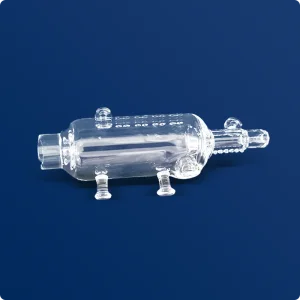
High-purity quartz digestion vessels, acid bath tanks, and reflux condensor quartz components that resist attack by concentrated nitric, hydrochloric, and sulfuric acids at boiling temperatures.
To prevent contamination of cleanroom fabrication suites, all quartz furnace tubes and delicate quartz boats undergo strict post-machining purification and clean-packaging routines.
Components undergo a proprietary multi-cycle ultrasonic bath in high-purity Electronic Grade (SEMI-grade) hydrofluoric (HF) and nitric acid (HNO3) mixtures. This removes microscopic micro-cracks, surface alkali contaminants, and metallic residues introduced during CNC cutting and hot lathe forming.
Following chemical decontamination, quartzware is rinsed continuously in high-resistivity deionized water until effluent particle count and conductivity conform to fab-ready specifications, followed by drying inside Class 100 laminar-flow drying tunnels.
Parts are double-bagged in antistatic, cleanroom-grade polyethylene bags under Class 100 (ISO Class 5) cleanroom environments, purged with ultra-pure dry nitrogen, and packed into shock-dampening floating-suspension transit cases to prevent micro-fracturing during global shipping.
Southeast Quartz operates standardized workshops in Qinghu Industrial Park, Donghai County, Jiangsu — the epicenter of the Eurasian quartz industrial belt. Our vertical integration spans raw silica crystal sorting, plasma melting, precision flame-working, CNC ultrasonic milling, and comprehensive testing laboratories.
As plasma etching chemistry becomes more aggressive with fluorocarbon and NF3 plasmas, and thermal processes operate under narrower temperature windows, next-generation quartzware is evolving through four core development vectors.
Adopting chemical vapor deposition (CVD) of SiCl4 precursors to achieve synthetic silica tubes with zero metallic impurities (<0.05 ppm) and extreme deep-UV transmission for excimer laser and photolithography chambers.
Developing rare-earth and aluminum micro-doping technologies to retard plasma etching corrosion rates in dielectric oxide etch chambers, reducing particle generation and extending Mean Time Between Maintenance (MTBM).
Expanding continuous vacuum fusion furnaces capable of pulling oversized fused quartz cylinders up to 600mm external diameter with wall thickness variance restricted to < 0.2mm along a 2,500mm process length.
Implementing sustainable quartz cleaning, fire-polishing, and dimension resizing programs for expensive fab chambers, allowing worn diffusion tubes to be recycled and recertified for secondary process layers.
Detailed technical answers to common queries regarding material selection, devitrification mitigation, dimensional tolerancing, and supply chain logistics.
To produce a compliant manufacturing blueprint, our engineering team requires: outer diameter (OD), inner diameter (ID) or wall thickness, overall length, tolerance thresholds, end configurations (e.g., flat ground flange, ball-and-socket O-ring seal, open end, or sealed dome), port positions, gas feed injectors, operating atmosphere (vacuum, inert, or corrosive halogens), peak operating temperature, and thermal ramp rates. Engineering drawings in PDF, DWG, DXF, or STEP format are accepted for 24-hour review.
Thermal sagging (creep) is primarily determined by quartz purity, hydroxyl [OH⁻] concentration, and wall thickness uniformity. We utilize electrically fused, low-OH raw quartz feedstock (OH < 20 ppm) which exhibits a significantly higher viscosity at temperatures between 1,100°C and 1,250°C compared to gas-fused silica. Furthermore, precision hot lathe annealing relieves internal residual mechanical stresses, ensuring dimensional rigidity during horizontal cantilever furnace operation.
Devitrification is the phase transformation from amorphous silica glass to crystalline cristobalite, initiated when surface alkali contaminants (sodium, potassium) or moisture act as nucleation catalysts at temperatures above 1,000°C. To prevent devitrification: 1) Never handle quartz with bare hands—clean cotton or nitrile gloves are mandatory; 2) Perform periodic chemical wiping with high-purity ethanol or dilute HF acid; 3) Ensure process gases are free from moisture and alkaline vapors.
Every welded or sealed quartz assembly (such as double-walled cooling tubes, bell jars, flanged reactors, and bubblers) is tested using a Pfeiffer or Inficon Helium Mass Spectrometer Leak Detector. The chamber is evacuated to < 10⁻³ mbar, and high-purity helium is sprayed across all weld seams and joints. Products must demonstrate a leak rate lower than 1.0 × 10⁻⁹ mbar·L/s to achieve dispatch clearance.
Expanding our specialized product scope across chemical synthesis, wafer transfer, digestion labs, and precision high-temperature infrared lighting systems.



Send your equipment specifications, tolerances, and process conditions directly to Southeast Quartz's engineering department. We evaluate CAD/STEP drawings, recommend optimized fused silica raw material grades, and confirm mass-spectrometry leak test protocols within 24 hours.
