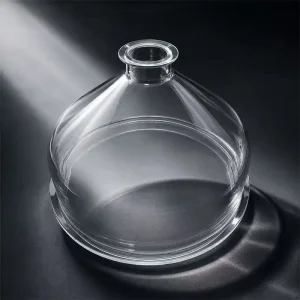
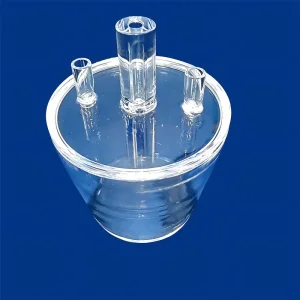
Ultra-low hydroxyl (OH) synthetic fused quartzware precision-machined for etching, diffusion, and thermal processing lines.





Deciphering material thermodynamics, bath chemistry resilience, and micro-contamination mitigation in sub-5nm fabrication.
In modern semiconductor front-end-of-line (FEOL) and back-end-of-line (BEOL) wet processing architectures, the chemical reaction vessel represents the single most crucial interface between corrosive reagent fluids and cleanroom environmental integrity. Quartz tanks engineered by Southeast Quartz are developed with an unyielding objective: absolute containment and pristine chemical isolation. As semiconductor nodes advance to sub-3nm fin-FET and gate-all-around (GAA) structures, bath contamination risks involving transition metals (Fe, Cu, Ni, Cr) cannot exceed parts-per-trillion (ppt) thresholds without causing disastrous gate dielectric breakdowns and fatal wafer yield collapse.
High-purity quartz tanks engineered from electric-arc fused or oxyhydrogen flame-melted natural silica provide an impervious barrier against aggressive acids. Whether deploying hot concentrated sulfuric acid mixtures (SPM/Piranha at 120°C to 160°C), hydrochloric peroxide cleans (SC-2), or boiling phosphoric acid ($H_3PO_4$ at 150°C to 180°C for stoichiometric silicon nitride stripping), fused quartz demonstrates an etching dissolution rate orders of magnitude lower than commercial borosilicate glasses. This provides ultra-low particle spallation, zero plasticizer leaching, and unwavering bath geometry across operational campaigns extending over thousands of thermal cycles.
| Material Metric | High-Purity Fused Quartz (Southeast Grade A) | Standard Synthetic Quartz | PTFE / PFA Fluoropolymers |
|---|---|---|---|
| Operating Temperature Limit | 1100°C continuous / 1250°C peak | 1150°C continuous / 1300°C peak | 260°C peak (degrades rapidly above 200°C) |
| Thermal Shock Resistance | Withstands quenching from 1000°C to 20°C water | Exceptional resistance to thermal rupture | Susceptible to creep, thermal warpage & hysteresis |
| Acid Resistance ($H_2SO_4$, $HNO_3$, $HCl$) | Zero chemical degradation; non-porous surface | Absolute chemical stability | Prone to gas permeation and leaching over time |
| Metallic Impurities (Al, Fe, Cu, Ca) | Total impurities < 15 ppm (down to < 5 ppm) | Total impurities < 0.1 ppm (ppt level) | Trace metal leaching from processing stabilizers |
Strategic geographic production mapping, high-purity natural silica reserves, and multi-tier procurement strategies.
Situated in Donghai County, Jiangsu Province—globally acknowledged as the premier hub for quartz raw materials processing—Southeast Quartz maintains unencumbered access to premium raw quartz crystal and high-purity fused silica ingots. This integration insulates global buyers from raw feedstock delays and guarantees total supply traceability from raw rock to finished precision vessel.
As the international silicon wafer industry rapidly migrates toward N-type TOPCon and Heterojunction (HJT) architectures, global demand for oversized quartz processing tanks, texturization baths, and wet-etching sinks has skyrocketed. Southeast Quartz addresses this industrial constraint through multi-axis CNC glass machining and automated hot flame fusion stations capable of high-throughput capacity.
From North American semiconductor wafer fabs in Texas and Oregon to European chip manufacturers in Dresden and Grenoble, our logistic networks operate in full compliance with international maritime shipping standards. Each quartz tank is packed within shock-isolated, hermetically sealed, desiccated wood crating specifically designed to eliminate transit-induced micro-fractures.
Proprietary seam-welding methodologies, fire-polishing thermodynamics, and strict laser-interferometric QA.
Traditional multi-piece joined quartz tanks can present thermal stress concentrations along seam intersections. Southeast Quartz utilizes advanced computerized oxyhydrogen torch lathes to execute uniform fusion welding. The seam zone undergoes deep thermal penetration, achieving grain-level structural homogeneity identical to the parent quartz plate, fully eliminating microscopic seam porosity.
Residual internal stresses induced during flame manipulation are the leading cause of catastrophic tank implosion under thermal shock. All welded assemblies pass through programmable multi-zone electric annealing furnaces. By maintaining precise dwell temperatures at 1150°C followed by controlled cooling curves, residual birefringence is lowered below 5 nm/cm, verified via polariscopic analysis.
Before quality sign-off, every tank undergoes an aggressive hydrofluoric acid (HF) wash to remove micro-scratches and superficial micro-crack propagation sites. Vessels are then treated in multi-stage cascade UPW (ultra-pure water, 18.2 MΩ·cm) baths within an ISO Class 5/6 cleanroom, packaged under cleanroom-certified double vacuum poly-wrapping to prevent particulate settlement during transit.
Custom-engineered bath geometries configured to integrate seamlessly with automated wet bench stations.
Standard Clean 1 ($NH_4OH/H_2O_2/H_2O$) operates at 70°C–80°C to strip organics and micro-particles, while SC-2 ($HCl/H_2O_2/H_2O$) extracts trace ionic metals. Our tanks preserve chemistry purity without ion leaching into the bath fluid, ensuring steady wafer yields across high-volume production runs.
Operating continuously at 160°C to 180°C, these vessels demand flawless thermal endurance and boiling containment. Integrated reflux condense rims and weir overflow structures allow chemical recycling without bubble stagnation or thermal boundary warping.
Integrated with multi-frequency transducer plates bonded to ultra-flat bottom plates ($<0.05$ mm planarity), our tanks efficiently transmit acoustic energy across 800 kHz to 2 MHz without acoustic cavitation erosion or premature quartz fatigue.
Large-format baths designed for high-throughput batch solar cell etching ($KOH/IPA$). Engineered with reinforced perimeter flanges and external support cradles to withstand heavy batch carriers without dimensional deflection.
Stringent adherence to international equipment safety codes and wafer fab contamination specifications.
Our quartz vessels are manufactured in strict conformance with SEMI standards governing semiconductor equipment fabrication. This ensures chemical resistance against hazardous production materials, pressure containment validation, and ergonomic handling geometries compatible with standard robot end-effectors.
Every welded joint, bottom flange, overflow weir, and sensor nozzle is subjected to 100% helium mass-spectrometer leak testing down to a baseline of $1.0 \times 10^{-9}\text{ mbar}\cdot\text{L/s}$. This eliminates risk of hazardous chemical leakage into wet-bench sub-assemblies.
Every batch of quartzware is shipped with an exhaustive Certificate of Analysis (CoA). Inductively Coupled Plasma Mass Spectrometry (ICP-MS) trace-element quantification documents the absence of harmful metallic and alkali impurities, providing full audit compliance for quality-conscious fab engineers.
In-depth responses covering thermal dynamics, chemical compatibility, structural tolerances, and custom configurations.
Engineered to withstand rigorous operational environments across chemical, thermal, and vacuum systems.


Send your custom drawings (PDF, DWG, or STEP). Our process engineering specialists will deliver a complete design-for-manufacturability review, material certificate verification, and a tailored quote within 24 hours.
