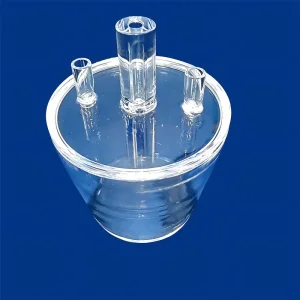
Direct from Donghai manufacturing lines: precision-tolerance fused silica rods, oversized furnace tubes, optical plates, and specialized components.
An authoritative analysis of high-purity amorphous SiO2 raw materials, critical machining tolerances, and supply chain stability for enterprise buyers.
Global procurement teams in tier-1 semiconductor foundries and fiber optics fabrication facilities are migrating away from fragmented regional machine shops. The shift favors integrated manufacturers capable of melting raw quartz sand into ingots and executing diamond CNC rod machining in-house, significantly driving down total cost of ownership (TCO).
Machined quartz rods serve as structural lifters, substrate pins, and guide rails. Enterprise procurement demands strict control over trace alkali metals (Li, Na, K < 0.1 ppm) and transition metals (Fe < 0.2 ppm) to prevent lethal devitrification and cross-contamination during thermal diffusion processes at 1,100°C+.
Modern applications require tight dimensional discipline. Rod camber must be constrained within < 0.1 mm/meter, circular runout within ±0.005 mm, and surface finishes achieving optical fire-polish or micro-crack-free CNC grinding (Ra < 0.2 μm) to resist cyclic thermal stresses without mechanical propagation.
Tailored thermodynamic and optical properties configured for high-stress manufacturing sectors.
Machined quartz rods form the structural skeletons for slotted wafer boats, wafer lift pins, and thermal sensors in LPCVD, ALD, and oxidation furnaces. Excellent resistance to chemical etching (HF excluded) and minimal thermal expansion (5.5 × 10⁻⁷ /K) prevent wafer warpage and dislocation slip during rapid thermal processing (RTP).
In CZ silicon crystal growth, precision-machined quartz rods serve as seed holders, purge tubes, and mechanical support struts. Their absolute structural rigidity at 1,400°C ensures uninterrupted pulling of large-format N-type TOPCon and heterojunction silicon ingots without introducing melt turbulence or structural sag.
Optical-grade synthetic and fused silica rods function as light guides, laser gain-medium supports, and preform cladding tubes for specialty fiber-optic drawing. With exceptional transmission ranging from Deep Ultraviolet (DUV 190 nm) to Near Infrared (NIR 2,500 nm), these machined rods maintain near-zero attenuation coefficients.
| Property Parameter | Electric Melted Quartz (Clear) | Plasma Arc / Gas Fused Quartz | Synthetic Fused Silica (VAD/CVD) |
|---|---|---|---|
| SiO2 Purity (%) | ≥ 99.992% | ≥ 99.998% | ≥ 99.9999% |
| OH Content (ppm) | < 5 - 30 ppm | 150 - 200 ppm | < 1 ppm (Low OH) / > 1000 ppm |
| Thermal Expansion (0-300°C) | 5.5 × 10⁻⁷ / °C | 5.4 × 10⁻⁷ / °C | 5.2 × 10⁻⁷ / °C |
| Dielectric Strength (20°C, kV/mm) | 25 - 40 | 30 - 45 | 45 - 50 |
| Target Manufacturing Applications | Furnace rods, heaters, PV struts | Semiconductor boats, etch rings | Excimer lasers, DUV optics, telecom |
Strategic advancements shaping the next generation of quartzware engineering through 2030.
Traditional diamond abrasive grinding introduces subsurface micro-fissures in brittle quartz matrices. Next-generation facilities are transitioning to high-frequency (20-40 kHz) ultrasonic-assisted 5-axis CNC machining, reducing brittle-mode cutting forces by 40% and enabling micro-grooving on quartz rods without subsurface damage.
Direct CO2 laser thermal ablation replaces labor-intensive mechanical and oxy-hydrogen flame polishing. This contactless method seals micro-scale cracks at 2,000°C within microseconds, guaranteeing ultra-low surface roughness (Ra < 0.05 μm) while eliminating internal residual stresses and flame contamination.
As semiconductor wafer diameters push toward expanded chamber footprints, the demand for monolithic oversized machined components is surging. The scale-up of electrodeless RF plasma torch fusion enables bubble-free ingots over 600 mm in diameter, providing pure billets for large-bore rods and containment rings.
Navigating raw material clusters, fabrication hubs, and trade balance dynamics across key geographies.
Centering in Donghai County, Jiangsu, this industrial cluster represents the highest concentration of quartz thermal processing and machining infrastructure globally. With integrated access to raw crystal feedstock, refining operations, and specialized high-temp lathe artisans, Southeast Quartz provides unmatched production scale, rapid prototyping, and competitive direct-factory pricing.
Re-shoring initiatives in domestic semiconductor fabrication (CHIPS Act, European Chips Act) have created acute shortages of precision quartzware. Tier-1 OEMs are relying on strategic partnerships with qualified Asian factories to supply critical components, provided materials maintain traceable lot records, RoHS/REACH compliance, and verified dimensional stability.
Geopolitical dependencies on high-purity quartz sand from key granitic pegmatite deposits have accelerated secondary refining developments. Forward-thinking manufacturers like Southeast Quartz have diversified supply routes across synthetic silica and high-grade mineral purifications, guaranteeing uninterrupted production schedules.
Exceeding international aerospace, medical, and semiconductor standards through verified quality testing.
Every batch of machined quartz rods is shipped with comprehensive inspection documentation, including Inductively Coupled Plasma Mass Spectrometry (ICP-MS) elemental certificates tracking 14 critical trace impurities down to single-digit parts per billion (ppb).
For custom engineered sealed, hollow, or flanged quartz assemblies, testing protocols employ Pfeiffer helium mass spectrometry leak detectors down to leak rates of < 1 × 10⁻¹⁰ mbar·l/s, ensuring hermetic containment for high-vacuum CVD reactors.
Components undergo ultrasonic degreasing, HF surface acid etching, and ultrapure DI-water cascade rinsing before double-vacuum polyethylene packaging inside a Class 1,000 cleanroom. Multi-layer shock-absorbing crates guarantee zero mechanical micro-fractures during air or sea transit.
Expert answers to the most common engineering and procurement questions regarding fused quartz machining.
Standard CNC turning and diamond abrasive grinding routinely achieve outer diameter (OD) tolerances of ±0.02 mm. For precision optical guides, laser core rods, and wafer handling pins, fine polishing and ultrasonic micro-machining achieve tolerances as tight as ±0.005 mm, with surface roughness (Ra) down to 0.1 μm.
Devitrification (transformation from amorphous silica to crystalline cristobalite) is primarily initiated by surface micro-cracks and trace alkali contaminants (sodium, potassium, lithium). We mitigate this through hot hydrofluoric acid etching to remove mechanical stresses, followed by annealing in dust-free electric kilns at 1,150°C, ensuring extended operational life above 1,100°C.
Yes. Southeast Quartz operates precision multi-axis CNC machines and glassworking lathes capable of cutting micro-metric wafer retention slots, metric/imperial threading, internal bore drilling, stepped diameters, and torch-welded flange ends according to customer-supplied STEP, IGES, DWG, or PDF engineering blueprints.
Natural fused quartz is manufactured from refined natural crystalline silica sand; it delivers excellent thermodynamic performance, high viscosity, and cost efficiency for furnace tubes and semiconductor structural rods. Synthetic fused silica is synthesized through chemical vapor deposition of silicon halides (SiCl4); it offers virtually zero trace metallic impurities (total metallic impurities < 0.1 ppm) and superior DUV optical transmission.
Standard rod diameters held in inventory ship within 48 to 72 hours. For specialized custom-machined rods, our low MOQ model supports prototype validation runs (from 5-10 units) up to containerized batch production (10,000+ units), with standard turnaround times averaging 2 to 3 weeks including full cleanroom packaging and QC documentation.
Every rod is individually wrapped in cleanroom-grade polyethylene foam sleeving, vacuum-sealed to prevent airborne particulate contamination, and suspended inside high-density expandable polyethylene (EPE) foam cavities. These are then encased within reinforced fumigated plywood export crates equipped with drop and tilt monitoring indicators.
Explore our complete spectrum of high-temperature quartz vessels, bubblers, lamp fixtures, and diffusion hardware.