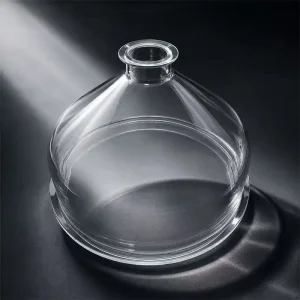
Explore high-temperature and chemical-resistant quartz boats, tubes, and furnace accessories optimized for high thermal shock tolerance and zero-leak integrity.
A rigorous review of structural material trends, cleanroom thermal yields, and raw quartz supply chains driving current semiconductor fabrication standards.
Modern sub-10nm foundries and 3D NAND plants subject wafer boats to rapid ramp cycles exceeding 15°C/min. Custom fused silica (synthetic and high-grade natural quartz) prevents carrier sag, micro-cracking, and wafer pitch distortion under continuous operations above 1,100°C.
Any migration of alkali metals such as Na+, K+, or transition ions like Fe and Cu results in gate-oxide dielectric breakdown. Southeast Quartz processes raw ingots through rigorous plasma refinement and multi-stage purification baths to secure ultra-trace impurity barriers.
In compound semiconductor processing (GaAs, GaN, InP) and advanced silicon wet processing lines, fused silica components resist harsh chemical cavitation. Precise flame-polishing prevents micro-crack formation where fluorinated acids initiate destructive intergranular erosion.
Technical Assessment: Transitioning from standard pressed quartz to laser-inspected synthetic fused silica wafer carriers provides a 4.2× reduction in particulate flake-off during extended 1,050°C LPCVD boron/phosphorus diffusion passes.
Engineered quartz carrier architectures supporting specialized front-end-of-line (FEOL) and optoelectronic process flows worldwide.
Custom disc-pitch ladders designed to reduce robotic end-effector vibration and eliminate wafer walking in vertical low-pressure CVD furnaces.
High-load horizontal boats configured with twin-rod structural rails, eliminating sagging across 150mm, 200mm, and custom substrate profiles.
Silicon Carbide (SiC) and Gallium Nitride (GaN) carriers requiring non-contaminating support structures up to 1,200°C oxidation environments.
Contamination-free optical-grade fused silica plates with optical surface flatness below λ/4 for specialized thin-film dielectric sintering.
Anticipating next-generation node requirements through advanced materials, composite joining, and precision additive quartz machining.
Refining flame hydrolysis techniques to maintain OH content strictly below 5 ppm, maximizing service lifetime under prolonged H₂ and plasma atmospheres.
Eliminating flame welded joints by deploying direct 5-axis ultrasonic CNC milling of single fused silica ingots, eradicating localized mechanical stress concentrations.
Real-time optical mapping during fire polishing, ensuring standard dimensional tolerances under ±5 μm for automated 300mm/450mm fab robotic systems.
Complete custom fabrications designed strictly to customer drawings, verified with helium mass spectrometry and thermal stress interferometry.
Strict quality assurance protocols deployed from Donghai County quartz clusters to global semiconductor facilities.
All flanged components and sealed double-wall reactor tubes are tested down to 1×10⁻¹⁰ mbar·L/s leakage rates before crating, preventing vacuum degradation in cleanroom runs.
Every welded bridge, slotted crossbar, and end handle undergoes thermal stress birefringence mapping. Quantitative annealing reduces residual stress below 2.5 MPa to avoid catastrophic thermal breakage.
High-temperature baked components undergo HF/deionized ultrasonic bath wash cycles followed by class 100 packaging, guaranteeing uncompromised particle metrics upon customer cleanroom arrival.
In-depth responses resolving engineering questions on thermal tolerance, structural customization, and supply verification.