Engineered from plasma-fused high-purity silica (≥ 99.99% SiO&sub2;). Each precision tube, wafer boat, and optical plate is optimized for thermal gradient resilience and vacuum-tight sealing in diffusion, LPCVD, and advanced annealing environments.





From plasma synthesis in Donghai County (the epicenter of global quartz refinement) to ISO 9001 certified cleanroom assembly, our fabrication benchmarks eliminate trace impurity migration during extreme thermal cycling.
The high-temperature quartz glass sector has evolved from generic laboratory-grade consumables into a mission-critical enabler for advanced semiconductor fabrication nodes (sub-3nm FinFET/GAA), next-generation N-type TOPCon/HJT photovoltaics, and high-energy optical transmission. Modern thermal processing environments subject quartz vessels to unprecedented thermodynamic stresses, ultra-corrosive halide atmospheres (Cl&sub2;, NF&sub3;, HBr), and aggressive cyclic heating schedules up to 1,250°C.
Advanced wafer fabs demand strict reduction of heavy metal ions (Fe, Cu, Ni, Cr ≤ 0.1 ppm). Residual alkali species (Na, K, Li) in furnace tubes induce gate oxide breakdown and high-temperature crystal lattice slips.
The photovoltaic shift toward M10/M12 and tandem perovskite platforms necessitates diffusion furnace tubes with outer diameters exceeding 450mm to 550mm and lengths over 3,000mm, demanding superior sag resistance.
Co-packaged optics (CPO) and extreme ultraviolet lithography (EUV) require ultra-low expansion fused quartz plates with laser damage thresholds surpassing 15 J/cm² at 355nm and optical surface finishes below Ra 0.2nm.
High-temperature performance is governed by silica tetrahedron network stability. When exposed to prolonged high temperatures (> 1,150°C), unrefined quartz undergoes catastrophic surface devitrification (transformation from amorphous SiO&sub2; to crystalline cristobalite), induced by trace alkaline contamination. The following empirical data underscores our proprietary manufacturing benchmarks:
| Material Property | High-Purity Electrically Fused Quartz | Plasma/Flame Synthetic Fused Silica | Standard Borosilicate Glass (Reference) |
|---|---|---|---|
| SiO&sub2; Purity Level | ≥ 99.99% (4N) to 99.998% | ≥ 99.9999% (6N) | ~ 80.5% (Non-pure SiO&sub2;) |
| Continuous Service Temperature | 1,100 °C – 1,150 °C | 1,200 °C – 1,250 °C | 450 °C – 500 °C |
| Short-Term Max Operating Limit | 1,280 °C | 1,350 °C | 550 °C |
| Softening Point (Log η = 7.65) | 1,683 °C | 1,710 °C | 820 °C |
| Annealing Point (Log η = 13.0) | 1,215 °C | 1,240 °C | 560 °C |
| Linear Expansion Coeff. (0–300°C) | 5.5 × 10¯&sup7; / K | 5.2 × 10¯&sup7; / K | 33 × 10¯&sup7; / K |
| Thermal Shock Resistance | Quench from 1,100°C into 20°C H&sub2;O (No crack) | Quench from 1,200°C into 20°C H&sub2;O (No crack) | Fails above 150°C ΔT |
| Hydroxyl (OH¯) Concentration | < 5 ppm (Standard) / < 2 ppm (Dehydroxylated) | < 100 ppm – 1,000 ppm (Process tailored) | N/A (Complex alkali-silicate matrix) |
Sourcing quartzware for mission-critical cleanroom environments is fundamentally different from acquiring industrial glassware. Procurement decisions must hedge against premature tube collapse, process chamber particulate generation, micro-cracking during vacuum drawdown, and unplanned fab downtime.
Automatic wafer loading robots require precision quartz boats and furnace tubes with outside diameter (OD) and roundness tolerances held within ± 0.2mm, bow/camber ≤ 0.1%, and wall thickness uniformity ≤ 5% to prevent robotic collision and mechanical stress concentration.
Semiconductor fabs enforce full raw material provenance. Each manufacturing batch must include ICP-MS (Inductively Coupled Plasma Mass Spectrometry) elemental assay certificates guaranteeing trace metallic impurities (Al, Ca, Fe, Mg, Na, K, Ti) below stringent fab thresholds.
Sub-atmospheric process chambers (LPCVD, Atomic Layer Deposition) require welded quartz flanges, manifold ports, and bubblers to pass helium mass spectrometer leak detection down to 1×10¯&sup9; mbar·L/s, preventing dangerous air ingression and oxidation defects.
Prior to packaging, quartzware undergoes 20% ultra-pure hydrofluoric (HF) acid de-metal etching, UPW (Ultra-Pure Water) multi-stage sonic cascade rinsing, and cleanroom heat drying, enclosed in double-vacuum anti-static poly packaging ready for direct fab introduction.
We bridge the gap between abstract CAD engineering drawings and physical, production-ready quartzware. Our integrated hot-working glass lathes and CNC cold-machining 5-axis centers execute bespoke geometries with micrometer precision.
Turnkey process kits including outer process tubes, inner injector liners, cantilever quartz rods, wafer handling boats (slotted from solid rod or welded plate profiles), and double-walled water-cooled end caps engineered for stable thermal management.
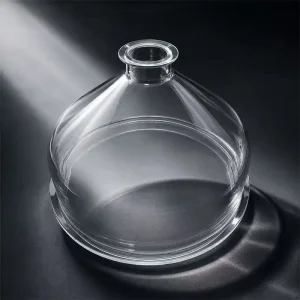
Heavy-wall quartz crucibles, high-temperature quartz thermal insulation rings, and protective bell jars capable of sustaining sustained heating cycles under severe mechanical loads and intense magnetic Czochralski (MCZ) pull regimes.
Optoelectronic substrate discs, synthetic fused silica viewports for high-vacuum chambers, and laser beam splitters featuring low bubble inclusion, wavefront distortion < λ/10, and high surface parallelism (< 5 arcsec).
Continuous flow-chemistry microchannel quartz reactors, 3-port bubblers, synthesis digestion bombs, and optical cuvettes that resist boiling concentrated acids (HF excluded) and eliminate cross-sample ion leaching.
Transporting high-aspect-ratio, oversized quartz tubes (up to 3.5m length) across continents requires sophisticated anti-vibration packaging methodologies and verified international compliance certification.
Oversized quartz tubes are suspended inside reinforced ISPM-15 compliant timber cases featuring 6-axis custom high-density molded EPE foam damping, internal silica-gel desiccant packs, and real-time 3D impact & tilt-indicator monitors.
All Southeast Quartz products fully conform to EU RoHS Directive 2011/65/EU and REACH Regulation (EC) No 1907/2006. Our manufacturing operations maintain rigorous ISO 9001 quality and ISO 14001 environmental management certifications.
To safeguard our Tier-1 semiconductor and solar module partners against supply chain disruption, we offer regional consignment warehousing agreements, guaranteed 48-hour emergency release, and scheduled batch delivery.
As wafer sizes expand toward 450mm and manufacturing geometries penetrate the sub-2nm and atomic deposition threshold, conventional quartz materials reach thermodynamic boundaries. Our active R&D directives address next-generation thermal demands:
Continuous scaling of high-density plasma ingot fusion, eliminating seed bubbles and lowering total transition metal content below 10 ppb.
Infusing proprietary yttrium and aluminum oxide nano-dopants to hinder cristobalite crystal nucleation, extending continuous thermal capability up to 1,350°C.
Direct laser glass sintering (DLGS) for complex internal fluidic passages and semiconductor wafer carriers with non-machinable internal thermal channels.
Embedding fiber-optic Bragg grating sensors directly within quartz tube wall structures to monitor real-time thermal flux and structural fatigue.
Essential answers for process engineers, fab managers, and technical buyers specifying quartz products for high-temperature and vacuum applications.
Please provide outer diameter (OD), inner diameter (ID) or wall thickness, overall length, dimensional tolerances, end-geometry (flat ground, flared, flange type, ball-and-socket, or custom welded ports), thermal operating profile (continuous operating temperature and peak cycle temperature), operating atmospheric chemistry (reducing, oxidizing, vacuum level, or corrosive halide presence), and complete engineering CAD drawings in 2D (PDF/DWG) and 3D (STEP/IGES) formats.
Transparent fused quartz typically operates continuously at up to 1,100°C – 1,150°C, with short exposures up to 1,250°C – 1,300°C. Its theoretical softening point is 1,683°C. In high-temperature service above 1,100°C, even microscopic surface fingerprints or alkali trace residues will accelerate cristobalite crystallization and premature devitrification. Clean handling with powder-free nitrile or lint-free gloves and periodic acid cleaning are critical.
Every sealed or welded assembly undergoes multi-phase verification: precision coordinate measuring machine (CMM) dimensional checks, helium mass spectrometry leak testing (detection threshold < 1×10¯&sup9; mbar·L/s), hydraulic or pneumatic proof-pressure testing according to customer design safety factors, and optical polariscope strain inspection to guarantee complete stress relief annealing.
While often used interchangeably, "Fused Quartz" strictly refers to silica produced by melting naturally occurring high-purity crystalline quartz rock or sand (ideal for furnace tubes, crucibles, and high-temperature structures), whereas "Synthetic Fused Silica" is synthesized via chemical flame hydrolysis or plasma oxidation of silicon precursors (e.g., SiCl&sub4;), offering extreme deep UV (193nm) optical transmission and virtually zero trace metal impurities.
Yes. Southeast Quartz integrates automated glass-blowing lathes, continuous flame synthesis, and multi-axis CNC cold diamond machining. We routinely manufacture oversized furnace tubes up to 550mm OD, large CVD bell jars, slotted wafer boats with pitch accuracy down to ± 0.05mm, precision microchannel plates, and multi-flanged vacuum reactor chambers.
Finished components undergo ultrasonic cleaning in dedicated deionized water cascades, followed by controlled hydrofluoric acid etching to strip outer micro-defects and trace contaminants. Parts are rinsed with 18.2 MΩ·cm ultra-pure water, dried with filtered nitrogen, and sealed inside dual-layer Class 100 cleanroom-certified polyethylene anti-static bags within our climate-controlled packing facility.
Explore our precision-machined fused silica plates, heat-resistant quartz support rings, furnace reaction tubes, and custom optical rods designed for high thermal stability and zero contamination.



