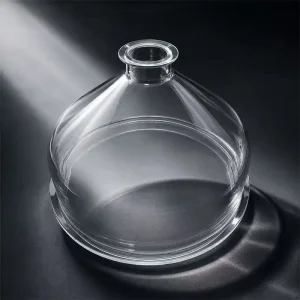
State-of-the-art semiconductor diffusion, plasma synthesis, and crystal blank fabrication rely on ultra-high purity quartz tubes, wafer boats, and precision optical glass plates directly from ISO-certified factory lines.





Modern embedded microcontrollers, edge IoT endpoints, and real-time clocks (RTC) demand precision temporal baselines. Sourcing managers and electrical design engineers require holistic visibility into tuning fork oscillator metrics before finalizing Tier-1 vendor qualifications.
The mathematical choice of 32,768 Hz ($2^{15}$ cycles per second) provides a direct, ripple-free binary division to exactly 1.000 Hz, enabling micro-amperage RTC sleep-state monitoring. Flexural-mode piezoelectric quartz bars oscillate in opposing tines, nullifying center-of-mass translation and minimizing energy dissipation into package anchors.
As form factors shrink from cylindrical can packages to 2012 (2.0×1.2mm) and 1210 (1.2×1.0mm) ceramic surface-mount packages, Equivalent Series Resistance (ESR) escalates from 35 kΩ up to 90 kΩ. Procuring teams evaluate the transconductance oscillation allowance ($|-R| / \text{ESR} \ge 5$) to prevent cold-start oscillation failures.
Mismatched load capacitance induces systematic frequency pulling. Enterprise sourcing specifies strict $C_L$ values (typically 6.0 pF, 7.0 pF, 9.0 pF, or 12.5 pF). Modern low-power BLE/SoC chipsets mandate ultra-low $C_L$ (3.7 pF to 6.0 pF) to minimize current drain ($I = 2\pi f C V^2$), preventing battery drainage in 10-year smart metering applications.
Tier-1 OEM buyers require dual-sourcing assurances, complete ingot-to-resonator traceability, and lot-level statistical process control (SPC). Purity of upstream quartz raw material ensures minimal hydroxyl (OH-) absorption bands, preventing long-term drift and premature crystal aging under elevated thermal environments.
Customized tuning fork crystal oscillators provide mission-critical synchronization across automotive powertrains, smart energy grids, implantable healthcare electronics, and ultra-high-density computing infrastructure.
Automotive electronic control units (ECUs), gateway domains, and battery management systems (BMS) operate across harsh -40°C to +125°C ranges with heavy vibrational exposure. Ceramic seam-welded vacuum packaging shields tuning fork resonators from thermal expansion stresses, meeting AEC-Q200 Grade 1 and Grade 0 compliance.
Key Architecture: Gold-tin (Au-Sn) alloy hermetic sealing ensures vacuum retention below $10^{-3}\ \text{Pa}$, eliminating dampening from ambient gas molecules.
Automated Meter Reading (AMR) and Advanced Metering Infrastructure (AMI) demand guaranteed 15-to-20-year lifespans on single-cell lithium thionyl chloride ($Li-SOCl_2$) batteries. Tuning fork oscillators engineered with inverted parabolic temperature coefficients ($\beta \approx -0.034\ \text{ppm/}^{\circ}\text{C}^2$) optimize billing time-of-use accuracy.
Key Architecture: Integrated TCXO (Temperature-Compensated Crystal Oscillator) circuitry provides real-time digital polynomial compensation down to ±5 ppm across the full operating curve.
Cardiac pacemakers, neurostimulators, and continuous glucose monitors (CGM) necessitate sub-miniature footprints (1210 package: $1.2 \times 1.0 \times 0.5\ \text{mm}$) combined with ultra-strict biocompatible and shock-resistance profiles exceeding 5,000G ballistic drop tests.
Key Architecture: Ultra-clean chemical wet-etch photolithography creates micro-grooved tines that concentrate electric fields, achieving low motional resistance within sub-millimeter cavity volumes.
| Application Sector | Primary Frequency | Package Footprint | Target Load Cap ($C_L$) | Temp Coefficient ($\beta$) | Compliance Mandate |
|---|---|---|---|---|---|
| Automotive Powertrain / BMS | 32.768 kHz & Custom Multipliers | 3215 / 2012 SMD Ceramic | 9.0 pF / 12.5 pF | $-0.034 \pm 0.005\ \text{ppm/}^{\circ}\text{C}^2$ | AEC-Q200, IATF 16949, PPAP L3 |
| Smart Gas & Electric Meters | 32.768 kHz RTC (or Digital TCXO) | 3215 SMD / Cylindrical Metal | 6.0 pF / 7.0 pF | $-0.032 \pm 0.004\ \text{ppm/}^{\circ}\text{C}^2$ | MID European Standard, ANSI C12 |
| Wearables & Medical Biosensors | 32.768 kHz Micro-Tuning Fork | 1610 / 1210 Ultra-Compact | 3.7 pF / 4.0 pF | $-0.035 \pm 0.005\ \text{ppm/}^{\circ}\text{C}^2$ | RoHS, REACH, ISO 13485 Flow |
| Industrial Edge Gateway (PLC) | 32.768 kHz / 75.000 kHz | 2012 SMD Seam Sealed | 9.0 pF / 12.5 pF | $-0.034 \pm 0.006\ \text{ppm/}^{\circ}\text{C}^2$ | IEC 60068 Harsh Environment |
The transition from legacy mechanical wire-sawing to precision photolithographic chemical etching has revolutionized quartz resonator economics, dimensional yield, and electromechanical efficiency.
Traditional wire-cut tuning forks suffered from geometric irregularities and micro-cracking, limiting tine minimization. Advanced factories implement wafer-level MEMS photolithography on high-purity single crystal alpha-quartz blanks (Z-cut or rotated X-cut).
By executing anisotropic chemical wet-etching with buffered hydrofluoric solutions (BHF), factories form precise three-dimensional micro-grooves along the length of each vibrating tine. These etched grooves reposition the electrode metallization into an optimized quad-field configuration. The concentrated electric field significantly suppresses motional capacitance ($C_1$) loss and slashes equivalent series resistance by up to 45%, unlocking reliable oscillation inside sub-miniature 1610 and 1210 package cavities.
Air friction inside the resonator cavity dampens flexural motion, degrading the mechanical Quality Factor ($Q$) from ~80,000 in vacuum down to under 12,000 at atmospheric pressure. Modern production employs automated ultra-high vacuum (UHV) furnaces operating at pressures lower than $1 \times 10^{-4}\ \text{Torr}$.
Ceramic packages are sealed using seam-welding or eutectic gold-tin ($Au_{80}Sn_{20}$) preforms without organic fluxes that could outgas over decades of operational life. Following encapsulation, automated femtosecond laser trimming systems vaporize atomic layers of gold mass balance pads at the fork tips through optical access ports, executing fine frequency calibration with sub-0.5 ppm resolution at room temperature ($+25^{\circ}\text{C}$).
The frequency component supply chain links raw silicon dioxide refining, synthetic crystal autoclaving, precision quartzware furnace tooling, and cleanroom microelectronic packaging.
Located in Donghai County, Jiangsu, China—the globally recognized epicentre of the quartz industry—manufacturers leverage unmatched proximity to high-purity natural silica reserves and advanced synthetic autoclaves. Access to factory-direct oversized fused quartz diffusion tubes, plasma-melted ingots, and high-temp carrier boats significantly lowers capital expenditure across wafer processing cycles.
While Silicon MEMS resonators have gained traction in high-vibration consumer verticals, piezoelectric single-crystal quartz retains absolute superiority in temperature stability, phase noise, and ultra-low power consumption. Tuning fork quartz crystal oscillators consume less than 1.0 μA, whereas equivalent electrostatic silicon MEMS solutions often draw 3x to 8x higher active supply currents.
Post-pandemic procurement protocols require electronic manufacturing service (EMS) partners to mitigate single-point dependency risks. Direct OEM factory supply lines with vertical integration—from raw quartz processing to automated tape-and-reel SMD packaging—safeguard high-volume product deliveries against geopolitical and freight volatility.
Rigorous mechanical, environmental, and hermetic stress testing protocols guarantee long-term field stability across European, North American, and Asia-Pacific industrial standards.
Each production lot is pressurized with tracer helium gas inside an environmental chamber followed by ultra-sensitive mass spectrometer sniffer analysis. Reject thresholds are set at $1 \times 10^{-9}\ \text{Pa}\cdot\text{m}^3/\text{s}$, guaranteeing decades of vacuum integrity against moisture and oxygen permeation.
Tuning fork tines represent high-aspect-ratio cantilever beams sensitive to physical impact. Factories validate designs via MIL-STD-202G Method 213 (5,000G, 0.3 ms half-sine pulse) and random vibration testing up to 2,000 Hz, preventing crystal cleaving or electrode peel-off in portable smart devices.
Components adhere to EU Directive 2011/65/EU (RoHS 2.0) and Regulation (EC) No 1907/2006 (REACH SVHC). Sealing metallization utilizes 100% lead-free, halogen-free, and conflict-free sourced tin-silver-copper or gold-tin alloys verified via third-party SGS/Intertek ICP-OES analytical screening.
Frequency tuning fork oscillators depend heavily on matching MCU circuit board traces. Global engineering service centers provide complementary negative resistance margin ($|-R|$) validation, drive level ($D_L$) testing, and stray capacitance ($C_S$) mapping for customer custom PCB design revisions.
Direct technical responses addressing impedance calculation, temperature compensation, PCB layout parasitic mitigation, and high-volume procurement parameters.
Precision-machined high-temperature quartz apparatus engineered for semiconductor diffusion, chemical vapor deposition (CVD), and ultra-clean laboratory crystallization environments.