Explore our helium-leak tested, high-temperature quartz solutions fabricated directly in Donghai, Jiangsu to rigid dimensional tolerances and trace-metal specs.



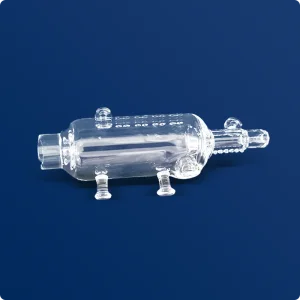


Examining thermodynamic behavior, micro-structural purity, hydroxyl [OH⁻] radical mitigation, and mechanical integrity in sub-micron fabrication environments.
CVD processes operate under severe thermal regimes—cycling continuously between 800°C and 1,250°C. High-quality CVD quartz tubes must possess a glass transformation point approaching 1,120°C and a softening threshold beyond 1,680°C. Southeast Quartz engineers employ specialized oxy-hydrogen flame dynamic annealing to relieve intrinsic stress, keeping the residual stress birefringence under 15 nm/cm to prevent micro-fissures and structural sagging during sustained LPCVD runs.
Hydroxyl ions accelerate thermal devitrification into cristobalite phases and cause vacuum degradation in LPCVD/PECVD equipment. Our electric-fused and plasma-refined fused quartz formulations restrict OH⁻ content to under 15 ppm (with specialized dry-purged batches down to < 5 ppm). Total metallic impurities (Fe, Cu, Ni, Na, K, Li) are maintained strictly below 8-12 ppm cumulative, preventing dopant migration and cross-contamination across active silicon substrate regions.
In low-pressure deposition (LPCVD) and Atomic Layer Deposition (ALD), maintaining negative pressures down to 10⁻³ Torr is mandatory. Southeast Quartz subjects all flanged reactor tubes, source bottles, and gas injectors to helium mass-spectrometry leak detection. Standard production gates enforce a leak threshold of less than 1.0 × 10⁻⁹ mbar·L/s across ground ball joints and precision O-ring flange couplings, safeguarding toxic and pyrophoric gas containment.
How Tier-1 semiconductor wafer foundries, photovoltaic cell makers, and advanced materials labs audit and select strategic fused quartz suppliers.
Deposition film thickness uniformity hinges directly on symmetrical boundary layers. Sourcing specifications mandate outer diameter (OD) and inner diameter (ID) deviations within ±0.3 mm on tubes exceeding 300 mm diameter. Southeast Quartz implements dynamic laser triangulation calipers across 3-axis cold machining centers to eliminate ovality and ensure airtight robotic docking with stainless steel furnace flanges.
Global semiconductor fabs enforce comprehensive chain-of-custody tracking. Every production lot at our facility is backed by ICP-MS (Inductively Coupled Plasma Mass Spectrometry) compositional certificates documenting elemental parts-per-billion (ppb) concentrations for harmful elements like boron, phosphorus, iron, and heavy transition metals that could degrade device yields.
In PECVD and downstream NF₃/CF₄ chamber cleaning steps, quartz walls undergo intense energetic radical bombardment. We deliver fire-polished and chemically smoothed fused quartz surfaces exhibiting surface roughness Ra < 0.2 µm, significantly retarding particulate shedding and micro-crack propagation over hundreds of hours of production exposure.
| Performance Parameter | Standard Commercial Grade | Southeast Quartz Semiconductor Grade | Compliance / Test Standard |
|---|---|---|---|
| SiO₂ Purity | 99.9% - 99.95% | ≥ 99.999% | ICP-MS Verified |
| Hydroxyl (OH⁻) Concentration | 80 - 150 ppm | < 15 ppm (< 5 ppm custom) | FTIR Spectrometry |
| Softening Point | 1,630 °C | 1,683 °C | ASTM C338 Standard |
| Thermal Expansion (0-1000°C) | 5.8 × 10⁻⁷ / K | 5.5 × 10⁻⁷ / K | Dilatometric Profiling |
| Helium Leak Tightness | 1.0 × 10⁻⁶ mbar·L/s | ≤ 1.0 × 10⁻⁹ mbar·L/s | Vacuum Mass Spec (PASSED) |
| Surface Roughness (Ra) | Ra 0.8 - 1.2 µm | Ra ≤ 0.2 µm (Optical Polish) | Laser Profilometer |
Combining high-purity natural silica deposits with automated manufacturing, robotic thermal lathes, and localized raw material vertical integration.
Situated in Donghai County, Jiangsu—the premier silica processing hub of the Eurasian continent—Southeast Quartz eliminates extended raw material transit lead times. We directly source high-purity crystalline quartz sand, convert it through specialized continuous plasma fusion, and draw mother tubes under immediate physical quality control, insulating our global clients from upstream raw glass shortages.
Traditional quartzblowing relies heavily on artisan glassblowing, which introduces dimensional variance. Our Industry 4.0 facility bridges automated gas-oxygen synchronization on heavy-duty motorized glass lathes with 5-axis CNC ultrasonic diamond grinding. This dual-path process achieves micro-slotted wafer boats, precision flange facets, and complex 3-port injector nozzles with sub-millimeter repeat accuracy.
Vertically integrated ingot pulling and preform tube drawing reduce unit manufacturing costs by 28% to 42% compared to Western European or North American boutique fabricators. Furthermore, dedicated engineering shifts convert customized client CAD models (STEP/DWG) into manufactured, serialized, and helium-inspected components in 10 to 14 business days.
Purpose-built fused quartz vessels engineered for critical thin-film deposition, photovoltaic passivation, and advanced nanotechnology synthesis.
Used in 200mm and 300mm front-end-of-line (FEOL) semiconductor fabs. Horizontal and vertical reaction tubes host SiH₂Cl₂ (dichlorosilane) and NH₃ decomposition at 750°C-850°C. Our fire-polished interiors prevent particulate spallation and provide continuous chemical resistance against aggressive in-situ chlorine by-products.
Next-generation photovoltaic manufacturing demands oversized furnace tubes exceeding 450 mm in outer diameter to support M10/G12 wafer throughput. Southeast Quartz delivers ultra-large bore quartz tubes paired with precision-slotted quartz boats that withstand rapid POCl₃ phosphorus or boron tribromide (BBr₃) doping cycles without sagging.
Scientific university research institutes and advanced aerospace nanomaterial producers use our transparent fused quartz process tubes for thermal catalytic CVD growth of single-layer graphene sheets. Exceptional UV-to-NIR optical transparency permits external infrared radiant heating while sustaining thermal gradients up to 1,200°C.
Addressing geopolitical supply chain vulnerabilities, multi-region cleanroom logistics, and the structural economics of critical quartz consumables.
With billions invested through the US CHIPS and Science Act and the EU Chips Act, foundries are scrambling to secure long-term consumable channels. While local OEM equipment makers maintain high list prices for replacement consumables, Southeast Quartz acts as a qualified secondary and primary source, providing identical dimensional replacements at significant TCO (Total Cost of Ownership) savings.
Quartz glass is inherently brittle, demanding zero-shock logistics. Every tube and boat leaving our facility undergoes multi-stage cleanroom acid immersion, drying under Class 100 HEPA hoods, and double polyethylene vacuum sealing. Heavy custom wooden crates utilize multi-density custom polyethylene foam suspension, achieving zero-breakage rates over 99.4% across 40+ export nations.
Global demand spikes for high-purity quartz have historically strained raw ingot supplies. By maintaining strategic reserve stocks of raw plasma-fused ingots and drawing our own oversized tubing stock in-house, Southeast Quartz shields strategic international clients from spot-market volatility and delivery postponements.
Comprehensive engineering insights regarding quartz performance, devitrification risks, maintenance routines, and custom drawing submission parameters.
Explore precision-ground fused silica plates, slotted wafer boats, and heat-resistant quartzware engineered directly for high-temperature industrial environments.
Connect directly with Southeast Quartz design and material specialists to audit tolerances, select optimized quartz purity grades, and accelerate your production timeline.
Submit your 2D PDF or 3D STEP/DWG drawings. Our engineering division conducts a thorough Design for Manufacturability (DFM) assessment within 24 business hours, evaluating thermal expansion parameters, flange mechanical stress concentrations, and concentricity limits.
Prior to flame forming, raw fused silica stock is checked via spectroscopic impurity profiling to confirm that heavy metal content satisfies your specified semiconductor threshold. Every shipped production lot is accompanied by an authenticated Certificate of Conformance (CoC).
Finished components undergo multi-stage acid etching, DI water cascade purification, and Class 100 cleanroom packaging. Integrated export crating with vibration damping ensures secure, uninterrupted delivery to manufacturing foundries across North America, Europe, and Asia-Pacific.
