Direct factory supply of certified fused quartz components manufactured under Class 10,000 cleanroom environments with automated thermal lathe forming and optical-grade cold machining.




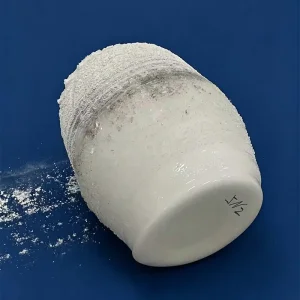


In modern industrial manufacturing, high-purity fused silica and quartz glass stand as critical enablers for sub-7nm semiconductor lithography, high-efficiency TOPCon solar cells, excimer laser cavities, and extreme-purity biopharmaceutical synthesis.
As semiconductor lithography migrates past FinFET into Gate-All-Around (GAA) structures and sub-2nm nodes, process contamination tolerances drop to parts-per-billion (ppb) regimes. Standard borosilicate glasses fail instantaneously due to sodium leaching and thermal disintegration at elevated thermal budgets.
The photovoltaic industry's transition from P-type PERC to N-type TOPCon and Heterojunction (HJT) architectures demands prolonged thermal exposure cycles for POCl3 diffusion and boron deposition. Quartz components must support non-stop thermal cycles up to 1,200°C without devitrifying.
Synthetic fused silica displays an optical transmission window spanning 185 nm (deep ultraviolet) through 3,500 nm (infrared). This spectral breadth makes it indispensable for excimer laser output couplers, spectrometer windows, and microchannel fluidic devices.
| Physical / Chemical Property | Testing Standard | High-Purity Natural Fused Quartz | Synthetic Fused Silica (CVD Grade) |
|---|---|---|---|
| SiO₂ Purity Ratio | ICP-OES / GD-MS | ≥ 99.995% to 99.999% | ≥ 99.9999% (6N) |
| Hydroxyl (OH⁻) Concentration | FTIR Spectrometry | < 5 to 30 ppm (Heat Treated) | High-OH (~1,000 ppm) or Low-OH (<1 ppm) |
| Coefficient of Thermal Expansion (CTE) | ASTM E228 (20°C - 320°C) | 5.5 × 10⁻⁷ / K | 5.2 × 10⁻⁷ / K |
| Continuous Operating Temp / Strain Point | ASTM C598 | 1,120°C (Continuous) / 1,070°C | 1,160°C (Continuous) / 1,120°C |
| Dielectric Strength (20°C, 1 MHz) | ASTM D149 | 25 - 40 kV / mm | 35 - 50 kV / mm |
| Helium Leak Tightness Rate | Helium Mass Spectrometry | < 1.0 × 10⁻¹⁰ mbar·L/sec | < 1.0 × 10⁻¹⁰ mbar·L/sec |
Located in Donghai County, Jiangsu Province—the epicenter of the world's quartz raw materials refining and hot-glass processing—our production facility leverages unprecedented geographic synergy to compress procurement cycles and optimize engineering costs.
Immediate proximity to ultra-pure crystalline quartz ore processing and plasma melting facilities ensures guaranteed access to consistent quartz ingots, round bars, and parent hollow tubes without cross-border shipping delays.
Integrated master glassblowers and multi-axis CNC ultrasonic cold machining teams can transform complex CAD drawings into physical prototypes within 5 to 7 operational days, slashing development cycles for global equipment OEMs.
High local supplier concentration lowers transportation surcharges, scrap recovery expenditures, and tooling setup fees, passing an estimated 25% to 40% direct bill-of-materials cost reduction to international procurement teams.
Extensive warehousing of standard oversized tubes (OD 150mm–550mm) and high-purity plates cushions overseas semiconductor and solar clients against international logistics disruptions and seasonal material price surges.
Evaluating real-world stress conditions, chemical exposures, and dimensional tolerances where quartz glass components serve as decisive operating consumables.
Operating Environment: Atmospheric and Low-Pressure Chemical Vapor Deposition (LPCVD), thermal diffusion, and polysilicon annealing running between 900°C and 1,200°C under toxic, silane, and dopant gas flows.
Operating Environment: Non-stop factory throughput producing M10 and G12 monocrystalline silicon cells through phosphorus and boron diffusion furnaces requiring exceptional structural resistance to continuous thermal creep.
Operating Environment: Extreme oxidative acid digestion, high-temperature fractional distillation, and precursor fluid delivery systems vulnerable to metal leaching.
How pioneering processing technologies, synthetic vapor deposition, and decarbonized plasma vitrification are reshaping thermal component performance for next-generation advanced manufacturing.
Refining high-purity natural silica sand via automated plasma torch melting at 2,000°C. Standardizing low-alkali tube drawing with wall thickness tolerances below ±0.15mm.
Deploying silicon tetrachloride (SiCl4) vapor hydrolysis to yield ultra-pure synthetic silica with 0.1 ppb metal purity, eliminating deep-UV solarization in advanced lithography.
Introducing diamond ultrasonic cold grinding to achieve sub-micron dimensional tolerances and Ra < 0.05 μm surface finishes without inducing micro-cracks or subsurface lattice strain.
Transitioning furnace operations from hydrocarbon burners to clean hydrogen-oxygen torches, preventing carbon inclusions while substantially mitigating factory scope 1 emissions.
Every industrial quartz product undergoes meticulous non-destructive testing, optical strain verification, and heavy-duty structural packaging designed to survive multi-modal global shipping.
Sealed quartz reactor chambers, furnace tubes, and 3-port bubblers are evaluated using dry helium leak detectors capable of registering micro-fissures down to 1×10⁻¹⁰ mbar·L/s, guaranteeing total seal safety under toxic gas operations.
Following high-temperature lathe fabrication, all glass components undergo complete thermal annealing cycles. Full-field polariscopic inspection ensures optical retardation is kept below 10 nm/cm to prevent spontaneous devitrification fracturing.
Oversized quartz tubes and fragile wafer carriers are isolated inside multi-layered expanded polyethylene (EPE) custom molds, sealed within vacuum moisture-barrier bags, and crated inside heavy plywood frames fitted with 3-axis drop and tilt indicators.
Comprehensive custom fabrication offerings for furnace processes, cleanroom chemical wet benches, and analytical laboratory digestion equipment.

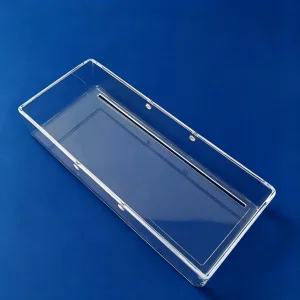

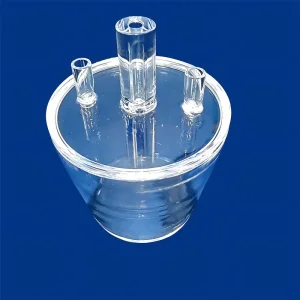
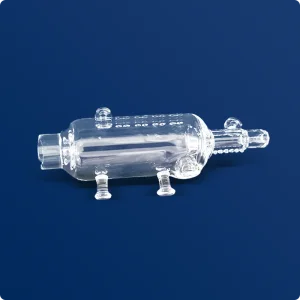
In-depth answers addressing thermal stress, chemical compatibility, devitrification risks, and drawing tolerances for procurement teams and process engineers.
