Engineered from Grade-A semiconductor fused silica (SiO₂ ≥ 99.99%) offering continuous thermal performance up to 1,100 °C, absolute chemical inertness, and laser-inspected dimensional accuracy.





Modern materials engineering, next-generation semiconductor fabrication, and clean energy transitions have transformed quartz research glassware from passive laboratory vessels into mission-critical, dimensionally active process hardware.
Scientific research in sub-2nm semiconductor lithography and atomic layer deposition (ALD) cannot tolerate transition metals (Fe, Cu, Ni) or alkali ions (Na, K, Li) in excess of parts-per-billion thresholds. Today's research glassware utilizes high-purity natural silica sand or synthetic silicon tetrachloride (SiCl₄) vapor axial deposition to achieve silicon dioxide contents surpassing 99.999% (5N), eliminating lattice migration under intense thermal stress.
Unlike standard borosilicate (Pyrex) glassware which fails above 500 °C or under rapid cooling, fused quartz possesses an extraordinarily low thermal expansion coefficient of 5.5 × 10⁻⁷ / K. A red-hot quartz furnace tube at 1,150 °C can be quenched directly into ice water without micro-cracking or catastrophic crystalline phase transition, providing researchers absolute safety during violent exothermic reactions.
With an optical transmission curve extending seamlessly from the deep ultraviolet (185 nm) through the visible spectrum into the mid-infrared (3.5 µm), synthetic quartz research glassware serves as both structural reaction containment and the optical window for in-situ spectroscopy, photolysis, Raman characterization, and high-energy laser stimulation.
In high-temperature research glassware procurement, the concentration of structural hydroxyl groups (OH⁻) governs the upper continuous service boundary. Electrically fused quartz typically retains an OH⁻ content below 5 to 30 ppm, raising the strain point to approximately 1,070 °C and annealing point to 1,180 °C. Flame-fused silica, containing 150 to 400 ppm OH⁻, offers superior UV transmission but exhibits lower viscosity at elevated temperatures. Understanding this thermodynamic dichotomy ensures that furnace designers do not experience premature tube sagging or accelerated cristobalite devitrification during prolonged isothermal operations.
When designing experimental apparatus subjected to high thermal flux, corrosive gas chemistry, and ultra-high vacuum (UHV), material selection dictates both the fidelity of experimental data and laboratory safety.
| Physical / Chemical Property | High-Purity Fused Quartz | Borosilicate Glass 3.3 | Synthetic Sapphire (Al₂O₃) | Polycrystalline Alumina (99.7%) |
|---|---|---|---|---|
| Maximum Continuous Operating Temp | 1,100 °C – 1,150 °C | 450 °C – 500 °C | 1,800 °C | 1,650 °C |
| Thermal Shock Resistance (ΔT) | > 1,000 °C (Quenchable) | ~ 150 °C – 180 °C | ~ 100 °C – 150 °C | ~ 200 °C |
| Coefficient of Thermal Expansion (CTE) | 0.55 × 10⁻⁶ / K | 3.3 × 10⁻⁶ / K | 5.8 – 7.7 × 10⁻⁶ / K | 8.0 × 10⁻⁶ / K |
| Optical Transmission Range | 185 nm – 3,500 nm | 310 nm – 2,200 nm | 150 nm – 5,500 nm | Opaque (Non-Transmissive) |
| Corrosion Resistance to Strong Acids | Resistant to all acids (except HF & hot H₃PO₄) | Susceptible to hot alkaline and acidic attack | High resistance to chemical reagents | Good, but vulnerable to micro-porosity leaching |
| Custom Fabricability & Lathe Work | Exceptional (Welding, Blowing, CNC) | High (Standard Glassblowing) | Extremely difficult (Laser/Diamond only) | Green machining / Sintering only |
| Helium Permeation / Vacuum Integrity | Hermetic (< 1×10⁻⁸ mbar·L/s) | Moderate (Outgassing at 300°C) | Hermetic | Micro-porosity dependent |
At Southeast Quartz, located within the epicenter of global quartz processing in Donghai County, Jiangsu, we integrate digital manufacturing 4.0 methodologies with artisanal master lampworking to eliminate lead-time bottlenecks and ensure absolute batch-to-batch repeatability.
Our workshop pairs diamond-tooled ultrasonic CNC milling machines with high-precision surface grinders. We achieve tolerances as tight as ±0.01 mm on planar windows, intricate microchannel flow cells, and milled wafer carrier slots without micro-cracking.
Automated glassblowing lathes burning stoichiometric H₂-O₂ gas mixtures permit localized fusion zones reaching 2,100 °C. This clean flame ensures seamless butt welds, flanged closures, and ground taper joints without carbon smoke deposits.
Hot-formed quartz retains residual internal hoop stresses. Every finished part undergoes programmable ramp-and-soak thermal annealing cycles up to 1,200 °C followed by controlled cooling to relieve mechanical strain and prevent stress fractures during heating.
Post-fabrication, glassware passes through multistage hydrofluoric/nitric acid purification baths and ultrasonic rinsing with 18.2 MΩ·cm deionized water inside cleanroom environments to remove all trace iron, alkali dust, and surface finger oils.
Send our senior engineering team your DWG, STEP, or PDF schematics. We review thermal expansion tolerances, glassblowing feasibility, and quote within 24 hours.
Procuring research glassware from OEM factories demands stringent non-destructive and analytical verification protocols to safeguard multimillion-dollar CVD furnaces, MBE reactors, and vacuum beamlines.
Vacuum-tight process vessels, reaction flasks, and flanged furnace chambers are 100% helium leak tested using Pfeiffer vacuum sniffing systems. Any component with a leak rate greater than 1.0 × 10⁻⁸ mbar·L/s is rejected, guaranteeing stability in ultra-high vacuum operations.
Optical birefringence polariscopes measure optical retardation across welded joints, flange transitions, and curved geometries. We enforce strict residual stress limits (≤ 5 nm/cm optical path), preventing catastrophic failure under high-temperature cycling.
Raw materials and finished quartzware are systematically sampled and analyzed via Inductively Coupled Plasma Mass Spectrometry (ICP-MS). We ensure trace concentrations of Fe, Al, Cu, Na, and B adhere strictly to SEMI F21 specifications for microelectronics manufacturing.
Across North America, the European Union, East Asia, and the Middle East, high-purity quartz research glassware powers primary breakthroughs across diverse deep-tech disciplines.
Diffusion tubes, wafer carrier boats, wet-bench cleaning tanks, source bottles, and bubbling cylinders for silicon, gallium nitride (GaN), and silicon carbide (SiC) epitaxial wafer processing. High resistance to dry etching gases like Cl₂ and NF₃ ensures clean chamber operations.
TOPCon and Heterojunction (HJT) solar cell developments rely on ultra-large diameter quartz furnace tubes (Ø > 350 mm) and high-purity thermal process boats to handle high-temperature boron and phosphorus diffusion at up to 1,050 °C without sagging.
Microchannel flow cells, precision spectrophotometer cuvettes, UV digestion vessels, and chromatography columns. Transparent fused silica eliminates background fluorescence and affords 90%+ UV transmission down to 190 nm for critical quantitative assays.
Key considerations when specifying, cleaning, maintaining, and sourcing quartz research apparatus from industrial factories.
Devitrification is the phase transition of amorphous fused silica into crystalline cristobalite, which occurs at temperatures above 1,150 °C. It is drastically accelerated by alkaline ionic contaminants such as sodium or potassium (even from bare fingerprints). When cooled through 200 °C to 275 °C, cristobalite undergoes rapid volume shrinkage (~5%), causing flaking, cloudiness, and mechanical failure. To prevent devitrification, handle quartz only with lint-free gloves, clean in a 5% to 10% hydrofluoric acid bath prior to high-temperature runs, and dry in a clean laminar flow hood.
We accept CAD files in STEP, IGES, DWG, and vector PDF formats. Your drawings should clearly state critical tolerances (e.g., ±0.05 mm or ±0.5 mm), inner and outer diameters, wall thickness, bevel requirements, surface polish grade (commercial flame polished vs. optical 40/20 scratch-dig), continuous operating temperature, working gases, and whether helium mass spectrometry leak testing or pressure testing is required.
Oversized quartz tubes and custom reactor glassware are packed inside shock-absorbing, multi-density high-resilience EPE (Expanded Polyethylene) contoured cradles within heavy-duty export plywood crates. Crates feature external anti-tip sensors (Tip-N-Tell) and drop impact monitors (Drop-N-Tell), and are fully fumigation-certified according to ISPM 15 standards for zero-breakage international transit.
Transparent fused quartz is melted to eliminate all internal gaseous inclusions, delivering crystal-clear optical clarity, superior tensile strength, and high dielectric performance. Opaque (translucent) silica contains microscopic encapsulated air bubbles that scatter light. It is ideal for thermal insulation flanges, heat shielding baffles, and infrared furnace heating jackets where optical transparency is not required.
From heavy-wall CVD diffusion tubes to multi-neck reaction vessels and high-temperature lamp holders, our in-house manufacturing lines handle single-piece prototyping to container-load supply contracts.


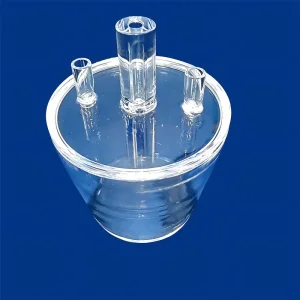
Lianyungang Southeast Quartz Products Co., Ltd. operates state-of-the-art production facilities at No. 1 Qingsheng Rd., Qinghu Industrial Park, Donghai County, Jiangsu, China. We welcome university procurement departments, research institutions, and industrial equipment OEMs to request material test reports (MTR), third-party purity certifications, and factory video audits.
