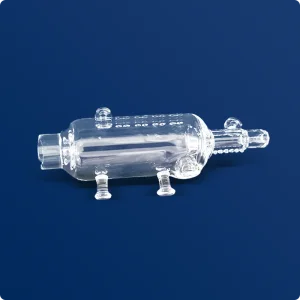
Ultra-pure fused silica tubes, wafer-carrier quartz boats, and thermal containment components precision-engineered for sub-micron processing and high-temperature thermal cycling.





The progression of advanced process nodes (sub-7nm, Gate-All-Around architectures, and 3D NAND vertical scaling) drives tighter physical and chemical specifications for quartz furnace core components.
Traditional 4N (99.99%) quartz is no longer sufficient for high-yield diffusion and LPCVD. The industry is standardizing on synthetic and ultra-refined natural fused silica exhibiting total alkali metals (Li, Na, K) below 0.1 ppm to eliminate deep-level carrier traps and gate oxide dielectric breakdown.
Next-generation Silicon Carbide (SiC) and Gallium Nitride (GaN) power device processing entails prolonged oxidation and activation annealing cycles approaching 1250°C. Modern tubes demand optimized hydroxyl (OH-) content minimization to suppress high-temperature structural sag, ovality distortion, and premature devitrification.
Automated front-opening unified pod (FOUP) handling and robot-driven furnace loading systems require furnace tubes and slotted boats to achieve diametrical and pitch tolerances within ±0.05 mm, minimizing wafer tilt, asymmetric thermal shading, and gas flow turbulence.
Tier-1 integrated device manufacturers (IDMs) and pure-play wafer foundries evaluate fused quartz suppliers under rigorous supply chain robustness, technical feasibility, and total cost of ownership (TCO) benchmarks.
Foundry procurement heads require dual-sourcing validation and raw-material origin transparency. Locating manufacturing in recognized industrial quartz clusters ensures uninterrupted access to premium natural rock and synthetic boules, buffering against geopolitical bottlenecks.
Modern fab lines treat quartz furnace tubes as yield-critical hot-zone consumables. Enterprise purchase orders require comprehensive Certificate of Analysis (CoA) records accompanying every individual unit.
With aggressive roadmap cadences in 300mm diffusion tooling, process development teams require engineering agility capable of converting complex STEP/CAD files into flame-worked, CNC-machined prototypes within condensed timeframes.
Engineered quartz products serve across key thermal and optical sectors, maintaining chemical passivity under aggressive thermal chemistries.
Quartz tubes establish the primary microenvironment for Dry/Wet O₂ oxidation, POCl₃ dopant drive-in, and rapid thermal processing (RTP). Exceptional thermal-shock resistance (expansion coefficient ~5.5×10⁻⁷/K) ensures integrity across rapid ramp and soak profiles.
Oversized quartz tubes (diameters reaching 450mm–650mm) accommodate high-volume N-type TOPCon and heterojunction (HJT) boron/phosphorus diffusion, maximizing throughput while sustaining thermal uniformities within ±1°C.
Fused silica substrates with transmission spanning from deep ultraviolet (DUV 193nm) across near-infrared (NIR 2100nm) support optical viewport, spectrometer microchannel flow cell, and high-energy excimer laser cavity requirements.
Inert containment vessels, digestion tubes, and acid-resistant reaction columns prevent metallic ion leaching during ultra-trace analytical chemistry, organometallic CVD precursor vapor routing, and high-pressure plasma synthesis.
Operating directly in Donghai County—the crystal and fused quartz hub of the Eurasian continent—Southeast Quartz combines continuous hot-work glassblowing lathes with high-precision 5-axis CNC diamond grinding. This integrated ecosystem ensures complete supply traceability from plasma-fused ingot synthesis down to finalized, cleanroom-bagged quartzware assemblies.
Reliable components require deterministic process validation. Every unit manufactured complies with international baseline standards, backed by export-grade logistics security.
Sealed quartz furnace tubes, bubblers, and double-walled bell jars undergo rigorous mass-spectrometer vacuum leak auditing. With leak rate detection thresholds sensitive down to < 1×10⁻⁹ mbar·l/s, assemblies prevent hazardous process gas egress and atmospheric oxygen ingress in high-vacuum CVD processes.
Post-machining quartzware undergoes multi-stage HF/HNO₃ chemical etching to dissolve residual surface micro-cracks and metallic tooling contaminations. Components are flushed with 18.2 MΩ·cm ultra-pure water (UPW) and double vacuum-sealed inside ISO Class 5/6 cleanroom envelopes.
Fragile, oversized quartz furnace tubes require engineered transport solutions. Components utilize custom high-density suspension crating, shock-watch and tilt-indicator telematics, fully insured under Incoterms (FOB, CIF, DDP) for seamless delivery across Europe, the Americas, and APAC.
Continuous investment in quartz fabrication infrastructure meets the stringent needs of advanced power devices, 300mm automated fabs, and next-generation atomic-layer processes.
Expanding CVD soot remelting and plasma-fused processes to drive hydroxyl (OH) concentrations below 5 ppm while suppressing trace aluminum and iron contaminants below 10 ppb.
Upgrading precision lathe hot-working capacities for outer diameters exceeding 650mm with continuous wall-thickness tolerances under ±0.2mm for mega-batch thermal tools.
Deploying specialized fire-polishing and anti-devitrification surface micro-texturing to double tube operational lifespans under corrosive halogenated (Cl/F) etching ambients.
Full implementation of laser-inscribed 2D matrix direct part marking (DPM) and laser-interferometric 3D dimensional profiling for digital fab integration.
Expert insights regarding quartz selection, devitrification mitigation, thermal limits, and quality verification standards.
Explore precision-machined quartzware, high-durability laboratory digestion vessels, and custom structural hardware for thermal process lines.