Industrial White Paper & Wholesale Specification

Wholesale Infrared Fused Silica Manufacturer & Product Solutions

Precision-melted low-hydroxyl (Low-OH) fused silica, infrared thermal optics, and engineered quartzware customized for high-temperature semiconductor processing, IR pyrometry, and advanced photonic systems.

Thermal Stability & Extreme Purity

Precision Infrared Fused Silica & High-Temp Quartz Products

Direct factory supply of tight-tolerance quartz apparatus, low-expansion transparent carriers, and oversized thermal shielding tubes engineered in Donghai, China.


Custom High-Temperature Resistant Quartz Lamp Holders
View Product Specs
Custom High-Quality Fused Silica Quartz Plate
Custom High-Quality Fused Silica Quartz Plate Supplier
View Product Specs
Industrial Grade High-Temperature Resistant Quartz Lamp Holder
View Product Specs
Quartz Boats for High-Temperature Processes
High-Quality Quartz Boats for High-Temperature Processes
View Product Specs
Custom High-Temperature Resistant Quartz Glass Rings
View Product Specs
High-Purity Oversized Fused Quartz Tube
High-Purity Oversized Fused Quartz Tube for Industrial Use
View Product Specs
Custom Oversized High-Temperature Fused Quartz Tube
View Product Specs
High-Temperature Resistant Quartz Insulation Ring
Transparent Quartz Glass Ring & High-Temp Insulation Ring
View Product Specs
Optical Physics & Material Science

Infrared Fused Silica: Overcoming Hydroxyl (OH⁻) Attenuation

Engineered for deep-penetration infrared transmissive applications, our IR-grade electrically fused silica minimizes absorption bands across 1.4 µm, 2.2 µm, and notably the critical 2.73 µm fundamental vibration band.

Low-OH Purity (< 1 to 5 ppm)

Synthesized and vacuum-melted through electric fusion techniques to strip hydroxyl ions, preventing thermal lensing and beam distortion in broadband IR spectroscopy and mid-wave IR lasers.

Thermal Shock Resilience

Retaining an exceptionally low coefficient of thermal expansion (CTE ≈ 5.5 × 10⁻⁷/K), our IR components endure thermal gradients exceeding 1,000 °C without internal structural cleaving or optical birefringence.

Extended IR Transmission Range

Delivers flat, high internal transmission exceeding 92% across the 260 nm to 3,500 nm spectrum, eliminating the deep 2,730 nm OH⁻ valley inherent to standard flame-fused synthetic silica.

Corrosion & Plasma Invariance

Resistant to halogen and fluorine plasmas in reactive ion etching (RIE) environments. High chemical stability guarantees surface integrity without fogging under corrosive process gases.

Global Commercial & Industrial Dynamics

Infrared Fused Silica in Worldwide Advanced Manufacturing

Sourcing patterns for high-purity fused silica have shifted globally toward vertically integrated producers capable of sub-micron precision machining alongside raw vacuum melting.

Next-Gen Semiconductor Photolithography & RTP

Rapid Thermal Processing (RTP) and atomic layer deposition (ALD) rely on IR-transparent fused silica heating envelopes and pyrometry viewports to read substrate heat without electromagnetic interference or infrared absorption anomalies.

High-Power Industrial Fiber & Solid-State Lasers

Mid-IR diode arrays and ND:YAG/fiber laser optics require end-caps, collimators, and focus debris shields made of IR fused silica to handle extreme CW energy densities without thermal degradation or laser-induced damage.

Industrial Pyrometry & Thermal Imaging Windows

Non-contact temperature measurement in blast furnaces, vacuum metallurgy, and crystal-pulling chambers utilizes optical-grade IR quartz discs that provide crystal-clear line of sight for 1 µm to 3.5 µm infrared wavelengths.

Donghai Production Cluster

Chinese Supply Chain Resilience & Direct OEM Advantages

Located in Donghai County—the global epicenter of raw quartz refining and fusion—Southeast Quartz provides end-to-end supply chain security, aggressive lead-time reduction, and full material batch traceability.

Upstream Cluster Integration

Immediate regional access to high-purity natural silica sand (99.999% SiO₂) ensures uninterrupted raw feedstocks, insusceptible to international logistical bottlenecks.

Rapid Prototype to Production

In-house computerized cold machining, CNC water-jet slicing, and multi-axis glass-blowing lathes reduce custom prototype delivery from 8 weeks to under 12 days.

Rigorous Quality Verification

Every chamber, tube, and flange undergoes helium mass-spectrometer leak evaluation (< 1×10⁻⁹ mbar·l/s), optical interferometer flatness inspection, and polarimetric stress audits.

Wholesale Cost Advantage

Direct factory integration bypasses trading middlemen, offering global OEMs 30% to 50% cost efficiencies while maintaining strict international semi-grade certifications.

≥ 99.999%
Chemical SiO₂ Purity
≤ 2 ppm
Typical Residual OH Content
1,150 °C
Continuous Working Temp
200+
Proprietary Tooling Patents
Targeted Engineering

Localized Application Scenarios & Engineering Field Integration

Different operational environments pose specific physical and atmospheric demands. Our custom-machined infrared fused silica is tailored for specialized regional field parameters.

High-Humidity Cleanrooms (Southeast Asia / Taiwan)

Hydrophobic surface finishes and sealed quartz assemblies engineered to counteract rapid devitrification accelerated by airborne alkaline vapors and cleanroom moisture fluctuations.

High-Vacuum EUV Systems (North America / Europe)

Ultra-low outgassing specifications with precision CNC tolerance matching (±0.01 mm) for direct integration into ASML/Applied Materials style vacuum handling robots.

Aggressive Chemical Refining (Gulf / Middle East)

Acid-resistant thick-walled IR reactor domes designed to resist sulfurous gases, high thermal gradients, and intense external solar radiation in heavy oil cracking analyzers.

Solar Ingot Pulling Facilities (East Asia)

High-capacity quartz crucibles and IR observation quartz sight glasses capable of resisting continuous temperatures up to 1,450 °C during long-duration Czochralski crystal growth runs.

Strategic Horizons

Technology Roadmap: 2026–2030 Quartz Innovations

Next-generation power electronics, quantum photonics, and space-based laser communications require fused silica components with even higher purity and thermal resilience.

PHASE I (2026)

Sub-PPM Low-OH Synthesis

Deployment of secondary vacuum plasma arc purification yielding OH content under 0.8 ppm for high-efficiency NIR laser transmission up to 3,600 nm.

PHASE II (2027)

Deterministic CNC Micro-Optics

Integration of Magnetorheological Finishing (MRF) achieving sub-nanometer surface roughness (Ra < 0.2 nm) and transmitted wavefront error below λ/10.

PHASE III (2028-2029)

Doped Refractory Matrixes

Titanium/Cerium co-doped silica variants for specialized UV-blocking, extreme laser-damage thresholds (>50 J/cm²), and near-zero coefficient of expansion (ULE).

PHASE IV (2030)

Robotic Closed-Loop Fabrication

AI-driven laser hot-working for automated zero-contact flanging, robotic tube jointing, and real-time stress birefringence calibration in class 100 environments.

Regulatory & Compliance

Global Compliance, Traceability & Quality Verification

Meeting international environmental directives and semiconductor purity standards through comprehensive quality documentation accompanying every export shipment.

Material Certifications (RoHS, REACH & Semi-F47)

All fused quartz lots are certified non-hazardous, heavy-metal free, and compliant with RoHS/REACH directives. Fully compliant with semi-grade cleanliness specifications.

Batch-Level ICP-MS Purity Reports

Each delivery includes comprehensive Inductively Coupled Plasma Mass Spectrometry (ICP-MS) test data detailing parts-per-billion (ppb) concentrations of alkali metals (Na, K, Li, Fe).

Reinforced Export Crating & Vacuum Packaging

Parts are treated with multi-stage ultrasonic cleanings, double-sealed in cleanroom-grade nitrogen-purged PE bags, and suspended inside reinforced wooden crates for zero breakage during transport.

Complete Catalog

High-Precision Quartz Components & Custom Assemblies

Browse our full range of manufactured quartzware: from slotted wafer carriers and vacuum bell jars to high-precision fused quartz rings and optical blocks.

High-Quality Premium Quartz Boats for Semiconductor
High-Quality Premium Quartz Boats for Semiconductor Applications
View Product Specs
Premium Quartz Boat for High Temperature Processes
Premium Quartz Boat for High-Temperature Semiconductor Processes
View Product Specs
Custom High Temperature Quartz Boats
Custom High-Temperature Quartz Boats Made with High-Purity Silica
View Product Specs
Custom Transparent Quartz Glass Rings
Custom Transparent Quartz Glass Rings & Thermal Insulation Rings
View Product Specs
Wholesale High-Purity Quartz Products
Customized High-Purity Quartz for Semiconductor & Scientific R&D
View Product Specs
High Temperature Resistant Quartz Lamp Holder
High-Temperature Resistant Quartz Lamp Holder Direct Supply
View Product Specs
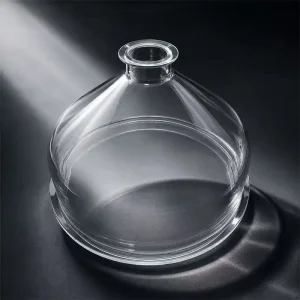
Wholesale Quartz Bell Jar
Wholesale Quartz Bell Jar with Thermal Stability for Vacuum CVD
View Product Specs
High-Quality Oversized Fused Quartz Tubes
Oversized Fused Quartz Tubes for High-Temperature Furnaces
View Product Specs
Engineering Inquiries

Infrared Fused Silica: Frequently Asked Questions

Detailed technical answers to common questions about thermal thresholds, OH content, mechanical tolerances, and custom wholesale fabrication.

What distinguishes Infrared (IR) Fused Silica from UV-Grade Synthetic Fused Silica?
The fundamental distinction lies in the hydroxyl ion (OH⁻) content and synthesis route. UV-grade synthetic silica is typically produced by flame hydrolysis of silicon tetrachloride (SiCl₄), which incorporates substantial water content (800 to 1,200 ppm OH⁻). While transparent in deep UV, this results in significant infrared absorption bands at 1.4 µm, 2.2 µm, and 2.73 µm. In contrast, IR-grade fused silica is produced via electric vacuum fusion or plasma melting of high-purity quartz crystals, driving OH⁻ levels down to < 5 ppm (and often < 1 ppm). This eliminates water-absorption valleys and enables high optical transmission across the infrared spectrum up to 3.5 µm.
What is the maximum operating temperature and devitrification threshold?
Transparent infrared fused silica features a continuous operating ceiling of approximately 1,100 °C to 1,150 °C and can withstand short excursions up to 1,300 °C. The strain point is 1,075 °C, the annealing point is 1,180 °C, and the softening point approaches 1,683 °C. Exposure above 1,150 °C in atmospheric air can initiate devitrification (crystallization into cristobalite), particularly if the surface has trace contamination from alkali elements (Na, K) or fingerprints. Handling components with clean lint-free gloves and performing periodic cleanings helps maintain high transmission life.
How does Southeast Quartz ensure zero vacuum leakage in quartz tubes and chambers?
All vacuum envelopes, furnace tubes, and flanged vessels undergo helium mass-spectrometer leak tests prior to final cleaning. The test chamber is evacuated to ≤ 10⁻⁴ Pa, and helium is sprayed at seals, welded joins, and lathe-fused flanges. We guarantee leak rates below 1.0 × 10⁻⁹ mbar·l/s, meeting ultra-high vacuum (UHV) standards for semiconductor LPCVD, diffusion, and MBE processing.
Can you provide custom CNC edge-profiling, drilling, and optical polishing on quartz plates?
Yes. Our Donghai facility houses multi-axis CNC machining centers, ultrasound coring machines, and double-sided planetary polishers. We routinely deliver surface figures of λ/4 to λ/10, scratch-dig optical specifications of 40-20 or 20-10, surface roughness Ra < 0.5 nm, and tight dimensional tolerances down to ±0.01 mm for complex shapes, wafer carriers, drilled sight-glasses, and stepped flange profiles.
What is the standard lead time for wholesale customized orders, and what data is required?
For initial engineering evaluation, we require a drawing (PDF, DWG, DXF, or 3D STEP), detailing outer/inner dimensions, tolerances, surface finish requirements, operating temperature, and gas atmosphere. Engineering reviews are delivered within 24 hours. Prototype and small batches generally ship within 7 to 12 working days, while recurring wholesale production runs are scheduled on structured monthly or quarterly blanket supply agreements.


