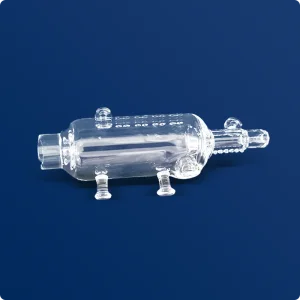
Direct factory supply of high-purity thermal process consumables, oversized diffusion tubes, and quartzware machined under strict ISO 9001 and SEMI quality management protocols.





How the global transition toward TOPCon, HJT, and Perovskite-Tandem cells is redefining thermochemical requirements for high-purity quartz furnace tubes.
In the rapidly transforming photovoltaic (PV) manufacturing landscape, the role of fused silica process tubes has elevated from passive containment consumables to active determinants of cell conversion efficiency. As the solar manufacturing sector transitions from legacy p-type PERC architectures to high-efficiency n-type topologies—predominantly Tunnel Oxide Passivated Contact (TOPCon), Silicon Heterojunction (HJT), and Interdigitated Back Contact (IBC)—thermal processing parameters have tightened exponentially. Diffusion furnaces and Low-Pressure Chemical Vapor Deposition (LPCVD) platforms now run thermal cycles surpassing 1,150°C under intensely corrosive gas phase environments (POCl3, BBr3, and silane mixtures).
The imperative for Tier-1 solar cell manufacturers lies in minimizing lattice contamination, maximizing carrier lifetimes, and suppressing wafer warpage. Fused quartz tubes used in boron/phosphorus doping and passivation film deposition must deliver total trace metallic purity below 15 ppm, with alkali metals (Li, Na, K) restricted to sub-ppm thresholds. At sustained operating regimes, alkali ions diffuse rapidly into the quartz matrix, inducing premature cristobalite nucleation and devitrification. This phenomenon causes tube sagging, vacuum loss, micro-cracking, and subsequent downtime that costs large gigawatt-scale fabs millions in lost throughput.
Refined from Donghai crystal base, eliminating metallic ionic diffusion into crystalline silicon wafers.
Electro-fused vacuum thermal stabilization preventing high-temperature sagging and structural fatigue.
Softening point at 1,683°C with prolonged thermal integrity under multi-day continuous runs.
100% mass spectrometer tested to ensure absolute hermeticity under sub-atmospheric LPCVD operations.
The adoption of 182mm (M10) and 210mm (G12) rectangular and square silicon wafers demands furnace tubes exceeding 450mm outer diameter. Our continuous rotary drawing process ensures uniform wall thickness (6.5mm – 9.0mm) across longitudinal lengths up to 3,600mm without localized stress concentrations.
Repeated cycling between 800°C push-in and 1,200°C soak temperatures induces severe hoop stress. Southeast Quartz employs proprietary flame-polishing and chemical annealing procedures that eliminate micro-fissures and surface hydroxyl species, tripling the Mean Time Between Failures (MTBF).
During LPCVD silicon oxynitride or poly-Si deposition, chlorine- and fluorine-bearing gas radials strip interior glass surfaces. Our high-density amorphous silica matrices prevent chemical etching, peeling, and particle falling that directly cause catastrophic wafer pinholes and junction shunts.
Quantitative specifications, geometric tolerances, and analytical protocols demanded by lead module manufacturers and EPC turnkey equipment contractors.
Procuring quartz furnace tubes on a wholesale industrial scale requires stringent verification regimes that exceed conventional consumer glassware testing by several orders of magnitude. Solar engineering procurement directors must balance initial Capital Expenditure (CapEx) against the lifetime Total Cost of Ownership (TCO). A lower-cost quartz tube that experiences premature ovality distortion or devitrifies after 45 days creates massive secondary costs: unplanned downtime, aborted wafer batches, manual tube extraction hazards, and lost line calibration.
| Performance Vector | Industry Standard Consumable | Southeast Quartz Industrial Grade | Metrology Verification Method |
|---|---|---|---|
| Trace Fe (Iron) Impurity | ≤ 0.8 ppm | ≤ 0.12 ppm | Inductively Coupled Plasma Mass Spectrometry (ICP-MS) |
| Alkali Metals (Na, K, Li) | ≤ 2.5 ppm cumulative | ≤ 0.6 ppm cumulative | Atomic Absorption Spectrophotometry (AAS) |
| Outer Diameter Tolerance | ±1.5 mm to ±2.0 mm | ±0.5 mm (Laser Calibrated) | Automated Dual-Axis Laser Micrometer Scanning |
| Wall Thickness Uniformity | > 15% variation | ≤ 5% variation across circumference | Ultrasonic Precision Pulse-Echo Gauge |
| Longitudinal Bow / S-Bend | ≤ 2.5 mm / 1,000 mm | ≤ 1.0 mm / 1,000 mm total length | Granite Surface Table & Dial Gauge Indicator |
| Vacuum Hermeticity | 1×10⁻⁷ mbar·l/s | ≤ 1×10⁻⁹ mbar·l/s | Helium Mass Spectrometer Leak Detector (Vacuum Mode) |
| Thermal Shock Endurance | 1050°C to 20°C (3 cycles) | 1150°C to 20°C (Quenched in water, zero microcracks) | Dynamic Thermal Shock Water Immersion Cycling |
Longitudinal sagging causes automatic robotic wafer loaders to misalign boats, risking catastrophic paddle collisions. Our thermal straightening annealing cycles preserve total straightness under 0.1% of tube span.
Precision ground water-cooled end flanges, ball-and-socket ground joints, gas inlet spigots, and optical thermowell sleeves are fused using hydrogen-oxygen automated orbital lathes.
Seamless geometric synchronization between solar quartz process tubes, slotted wafer quartz boats, push rods, paddle cantilever assemblies, and gas baffle plates prevents mechanical binds.
Every shipment includes complete melt lot numbers, ICP-MS chemical composition certificates, wall thickness maps, and helium mass-spectrometer leak certification test records.
Mitigating international logistics vulnerabilities and certifying chemical conformance across European, North American, and Asia-Pacific regulatory frameworks.
Our manufacturing ecosystem conforms to SEMI S2/S8 environmental health and safety guidelines. Raw materials adhere strictly to EU REACH (EC 1907/2006) and RoHS Directives (2011/65/EU), verified by independent SGS certification bodies to ensure complete freedom from restricted hazardous substances.
Shipping 3.5-meter long quartz tubes across ocean freight lines carries extreme resonance and mechanical shock risks. Southeast Quartz deploys custom-engineered internal foam cradles, moisture-barrier vacuum bags with desiccant systems, and reinforced plywood crates tested to ISTA 3A transit impact standards.
To safeguard customer fab continuity, we facilitate Vendor-Managed Inventory (VMI) frameworks and regional safety buffers across key industrial corridors in North America, Germany, Turkey, India, and Southeast Asia. On-call field engineers assist with drawing conversion and on-site flanged fit checks.
Pioneering synthetic quartz cladding, continuous plasma fusing, and circular recycling economies designed for sub-1% LCOE degradation targets.
The photovoltaic industry's unceasing push toward higher energy yields and longer module lifespans is driving fundamental changes in high-purity fused silica synthesis. While natural quartz sand refinement in Donghai remains the benchmark for cost-performance parity, upcoming multi-junction tandem solar cells operating under radical thermal gradients necessitate materials with next-to-zero defect density.
To bridge economic scale with semiconductor-grade purity, Southeast Quartz is pioneering bilayer fusion technology. An inner synthetic fused silica barrier (<0.05 ppm metals) is plasma-deposited onto an ultra-dense electro-fused natural quartz outer body, preventing dopant back-diffusion while keeping procurement budgets viable.
High hydroxyl concentration acts as a glass lattice flux, lowering the effective viscosity and softening point under extended 1,200°C soak stages. Our secondary high-vacuum electric furnace degassing chambers drive [OH⁻] levels down to below 2 ppm, virtually eliminating tube collapse and sag under heavy wafer loads.
In accordance with ESG carbon-neutral targets, we have introduced a comprehensive quartz reclamation loop. Expired or thermally deformed diffusion tubes are collected, stripped of dopant layers using automated ultrasonic chemical baths, re-crushed, magnetically separated, and re-melted into structural auxiliary quartz products.
Direct answers addressing material grades, tolerances, devitrification risks, and custom drawing lead times.
Explore high-temperature resistant plates, digestion tubes, and CNC-machined fused silica components for optoelectronic and solar process lines.