Engineered to rigorous Canadian metrology tolerances with ultra-low OH content, exceptional thermal shock resilience up to 1,250 °C, and class-leading DUV-NIR transmission.


High-Purity Silicon Dioxide (SiO₂) Raw Chemistry
Softening Point with Extreme Thermal Creep Stability
Surface Roughness Ra via Double-Sided CMP Polishing
Coefficient of Thermal Expansion (K⁻¹) from 20-320°C
Canada possesses one of the world's most demanding precision technology ecosystems. From the optical telecom corridors in Ottawa and Markham (Ontario) to the quantum computing research hubs in Waterloo and Sherbrooke (Quebec), industrial researchers require quartz substrate plates capable of withstanding extreme physical environments without optical distortion or chemical outgassing.
Additionally, Canada's clean energy corridors, natural resource analytical labs in Alberta and British Columbia, and biomedical photonics clusters in Montreal mandate custom quartz plates with precise flame-polished edges, ultra-low trace element contamination (<15 ppm cumulative), and stringent dimensional repeatability under thermal gradients ranging from -196 °C in cryostats to over 1,200 °C in calcination furnaces.
Domestic Canadian fabricators often face excessive material backlogs and limited raw ingot availability for large-format (up to 1,200 mm × 1,200 mm) or oversized plates. By partnering directly with specialized manufacturing plants that control the entire value chain from plasma arc fusion to 5-axis CNC diamond grinding, Canadian R&D labs and OEMs eliminate middleman overhead and secure reliable lead times across Toronto, Montreal, Vancouver, Calgary, and Edmonton.
Southern Ontario and Greater Montreal represent high-density microfabrication and integrated photonics facilities where quartz wafers, sputtering target backing plates, and vacuum viewport windows are critical consumable assets.
From metallurgical assay laboratories in Sudbury to environmental petroleum testing in Calgary, chemical digestion vessels and hot-plate reaction covers rely on quartzware for inertness against hot mineral acids.
Understanding optical transmission bands, hydroxyl (OH⁻) content, and thermal creep thresholds allows Canadian project managers to select the optimal material grade for specific process environments.
With an extremely low expansion coefficient (5.5 × 10⁻⁷ /°C), fused silica plates can be rapidly transferred from 1,100 °C into room-temperature ambient conditions without catastrophic stress fracturing, ideal for thermal furnaces and kiln viewports.
Synthetic silica plates achieve optical transmission exceeding 90% across the 185 nm to 2,500 nm spectrum. They are impervious to UV laser-induced damage (solarization) encountered in semiconductor lithography and photochemical reactors.
Except for hydrofluoric acid (HF) and concentrated phosphoric acid at elevated temperatures, fused quartz plates resist virtually all inorganic and organic chemical exposure, eliminating leaching in trace-metal testing.
| Property Parameter | JGS1 (Synthetic Fused Silica) | JGS2 (Fused Quartz / Optical Grade) | JGS3 (Infrared Optical Quartz) | Testing Standard Reference |
|---|---|---|---|---|
| Primary Usable Spectrum | 185 nm – 2,500 nm (Deep UV to VIS) | 220 nm – 2,500 nm (Standard Optical) | 260 nm – 3,500 nm (Infrared Transmissive) | Spectrophotometric Transmission DIN 5036 |
| Hydroxyl (OH⁻) Content | < 1,200 ppm (High Purity) | < 150 – 200 ppm | < 5 ppm (Water-Free IR Band) | FTIR Spectrometry / ASTM E168 |
| Trace Metal Impurities | < 5 ppm total | < 15 – 25 ppm total | < 20 ppm total | ICP-MS (Inductively Coupled Plasma) |
| Annealing Point | 1,140 °C – 1,180 °C | 1,120 °C – 1,150 °C | 1,120 °C – 1,160 °C | ASTM C598 Beam-Bending Method |
| Dielectric Constant (1 MHz) | 3.75 – 3.80 | 3.70 – 3.82 | 3.75 – 3.85 | ASTM D150 Capacitance Bridge |
| Bubble / Inclusion Class | Class 0 – Class 1 (No visible inclusions) | Class 1 – Class 2 | Class 2 | DIN 58927 / ISO 10110-3 |
Combining primary raw-material plasma fusion with localized documentation, rapid logistics, and stringent Canadian import compliance.
Seamless Canadian Border Services Agency (CBSA) customs clearance under HS Code 7002.31 and 7002.32. Full DDP shipping terms ensure door-to-door delivery with no unexpected handling surcharges or clearance delays at Pearson or Vancouver ports.
Fragile quartz substrates and precision plates are protected by custom-machined EVA shock foam, humidity-sealed anti-static cleanroom packaging, and ISPM 15 certified timber cases engineered for cross-continental intermodal transit.
Every plate and custom instrument is supplied with a comprehensive Certificate of Conformance (CoC), surface metrology interferometry scans (Zygo), and material impurity assay reports compliant with ISO 9001 and Canadian lab auditing standards.
Canadian clients regularly demand tighter mechanical tolerances than standard commodity glass processors can deliver. Our factory floors deploy computerized submerged diamond CNC saws, waterjet cutting tables, and ultrasonic drilling stations designed specifically to prevent edge micro-fracturing and internal stress accumulation.
Whether you require wafer-thin 0.2 mm quartz cover-slips, complex notched step plates, beveled laser prisms, or thick 100 mm thermal viewport discs capable of withstanding 50 bar differential pressure, our fabrication facilities process raw ingots into finished parts according to CAD/STEP files with micron-level precision (±0.01 mm).
Real-world integration scenarios demonstrating where our fused silica components provide mission-critical operational stability across Canadian provinces.
Cleanroom fabrication facilities in Kanata and Markham utilize synthetic fused silica plates as low-loss carrier substrates for thin-film dielectric deposition, optical waveguiding, and high-frequency RF device testing where thermal stability prevents delamination.
Institutes and research laboratories in Sherbrooke and Montreal deploy ultra-flat JGS1 quartz window plates in dilution refrigerators and ultra-high-vacuum (UHV) chambers, preserving polarization purity at temperatures hovering near 4 Kelvin.
In pilot carbon-capture plants and hydrogen fuel cell testbeds in Calgary and Vancouver, fused quartz observation plates and microfluidic reaction cells monitor high-pressure catalysis reactions in environments too caustic for borosilicate glass.
The transition toward sub-2nm semiconductor lithography, high-power fiber laser cutting, and nuclear fusion research (such as Canadian fusion energy initiatives) is pushing quartzware suppliers to pioneer new material frontiers. Our manufacturing engineering team is actively advancing three vital developmental pathways:
By controlling both raw quartz ore refining in Donghai and cleanroom laser finishing lines, our facilities rapidly transition custom Canadian prototypes into high-volume serialized production with guaranteed batch-to-batch chemical homogeneity.
Explore our complete manufacturing series, fully customizable according to CAD drawings, technical sketches, and operating parameters.


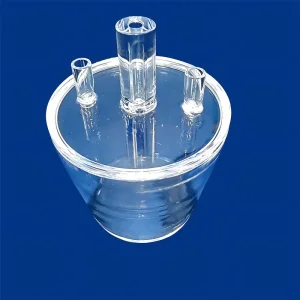

Comprehensive engineering clarifications for Canadian procurement leads, cleanroom managers, and equipment design engineers.
Send us your dimensional drawings, operating temperature limits, and target specifications. Our factory engineering team will provide a manufacturability review, formal quotation, and delivery schedule to your Canadian facility within 24 business hours.
Send Inquiry Now

