Premium fused silica and ingot solutions configured for fabrication shops, precision optical polishing centers, and laboratory furnace systems across London.
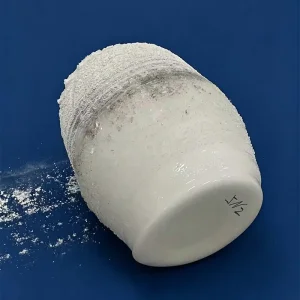


Plasma-fused quartz represents the pinnacle of vitrified silicon dioxide (SiO₂) engineering. Unlike traditional gas-oxygen flame fusion—which introduces high concentrations of bonded hydroxyl groups ([OH⁻] typically exceeding 150–200 ppm) and ambient refractory contaminants—our Inductively Coupled Plasma (ICP) arc fusion operates at temperatures exceeding 2,200°C in an ultra-clean, controlled gas atmosphere.
By vaporizing micro-impurities and achieving complete molten homogenization of crystalline feedstock without direct electrode contact, the plasma process yields large-diameter cylindrical ingots free of internal thermal strain, striae, and seed micro-bubbles. This makes our plasma ingots the primary material of choice for London's tier-1 laser optic fabricators, semiconductor equipment rebuilders, and deep-ultraviolet lithography engineers.
Our ingots are systematically inspected for optical homogeneity (Δn down to 1–4 × 10⁻⁶), residual thermal stress birefringence (< 5 nm/cm), and total elemental metallic impurities (< 8 ppm total via GDMS analysis), ensuring dependable machinability into ultra-precise windows, prisms, and plasma etch rings.
Examining the structural supply-chain demand across London’s research institutions, quantum technology incubators, and the UK’s precision photonic manufacturing base.
London serves as the commercial nexus of the UK's Golden Triangle. High-density research hubs—including Imperial College London (White City Campus), University College London (UCL), and the Harwell Science & Innovation Campus—require custom plasma quartz components for high-flux neutron moderators, synchrotron beamlines, and vacuum spectroscopy cells where optical purity is non-negotiable.
With London positioning itself as a global quantum computing capital, local photonics startups and optical fabrication facilities in Greater London and Surrey demand ultra-homogeneous plasma-fused quartz ingots as master substrate blanks for ion trap windows, cryogenic optical resonators, and telecommunication fiber preforms with zero bubble inclusions.
Positioned along the M4/Thames Valley corridor near the Culham Centre for Fusion Energy (CCFE), advanced engineering subcontractors require large-scale plasma-fused quartz observation ports and high-temperature furnace tubes capable of withstanding extreme plasma radiation and thermal cycling under ultra-high vacuum conditions.
Addressing the common failure points in raw material qualification: bubble distribution, trace element contamination, and supply lead-time volatility.
For decades, London-based procurement directors and precision optical machinists have faced rigid constraints: long 16-to-24-week delivery horizons from incumbent European distributors, marked-up pricing on intermediate stock, and minimum order restrictions that hamper agile R&D and rapid pilot production.
Furthermore, technical failures in downstream CNC diamond grinding and chemical mechanical planarization (CMP) often trace back to sub-par raw materials: localized index of refraction variation (Δn), micro-striae, and latent devitrification triggered by trace alkali metals (Na, K, Li > 1.5 ppm). When quartz ingots are heated in semiconductor diffusion furnaces or exposed to high-energy excimer laser radiation, these latent flaws cause rapid thermal cracking and optical clouding.
Southeast Quartz solves this systemic bottleneck by providing direct Tier-1 mill sourcing. Every plasma-fused quartz ingot shipped to the London market comes accompanied by comprehensive inspection certificates, including 100% laser interferometer wavefront mapping, polarimeter stress reports, and lot-specific GDMS trace metal assays.
| Element / Metric | Standard Flame Fused | Plasma-Fused Ingot (Our Spec) |
|---|---|---|
| Aluminum (Al) | 8.0 – 14.0 ppm | < 3.0 ppm |
| Iron (Fe) | 0.3 – 0.8 ppm | < 0.05 ppm |
| Alkali Metals (Na+K+Li) | 1.5 – 3.0 ppm | < 0.4 ppm |
| Hydroxyl Group [OH⁻] | 150 – 250 ppm | Custom < 5 to 20 ppm |
| Bubble Inclusions (DIN 3140) | Class 2 – 3 | Class 0 / 1 (Bubble Free) |
| Stress Birefringence | 15 – 25 nm/cm | ≤ 5 nm/cm (Annealed) |
Our manufacturing complex is situated in Donghai County, Jiangsu—the premier international processing epicenter for high-purity crystalline silica and refined quartz glass. By anchoring our production within this specialized industrial cluster, Southeast Quartz integrates the complete vertical supply chain from raw silica refining to CNC multi-axis ultrasonic diamond machining.
Our Industry 4.0 production facility utilizes closed-loop automated plasma fusion furnaces equipped with multi-channel infrared pyrometry, ensuring uniform thermal field gradient control during continuous ingot growth. This eliminates crystal lattice slip planes and thermal internal memory.
For our London and Greater London clients, this translates into unprecedented supply chain responsiveness: custom dimension ingots (diameters from 50 mm up to 450 mm, lengths up to 2,000 mm) manufactured with consistent lot-to-lot repeatability, lead times reduced by up to 60% compared to Western European intermediaries, and direct door-to-door DDP air and sea freight logistics clearing customs directly at London Heathrow (LHR) and London Gateway.
Every custom piece is subjected to helium mass-spectrometry leak detection (down to 1.0 × 10⁻¹⁰ mbar·L/s), high-pressure hydrostatic testing, and precision coordinate measuring machine (CMM) dimensional verification against client CAD files.
By eliminating multiple tiers of brokers and European distributors, London buyers gain high-precision engineered quartzware and master ingots at wholesale factory-direct margins, preserving capital for specialized downstream processing.
From cleanroom semiconductor wafer fab lines to bespoke scientific glassblowing ateliers, our plasma-fused materials deliver unyielding physical consistency.
Fabrication lines in the UK rely on our plasma-fused quartz ingots for slicing into wafer carriers, lift-pins, and gas distribution showerheads. The high purity and absence of mobile ions (Na+, K+) prevent cross-contamination during 1200°C thermal oxidation and diffusion cycles.
For London industrial laser cutting systems, medical aesthetic lasers, and defense optical laboratories, our low-OH plasma quartz offers an exceptional Laser-Induced Damage Threshold (LIDT) across 1064 nm and 532 nm harmonics, minimizing thermal lensing.
Biomedical researchers in London's Knowledge Quarter use our precision CNC-slotted plates and micro-channel quartz parts for fluorescence spectroscopy and DNA sequencing flow cells, benefiting from near-zero autofluorescence and superior deep-UV transmittance down to 200 nm.
Authoritative technical clarifications addressing material purity, international logistics, custom machining tolerances, and optical validation.
Plasma fusion employs an electrodeless inductively coupled high-frequency plasma discharge (ICP) reaching temperatures beyond 2,200°C in an inert or oxidizing atmosphere. Unlike gas-oxygen flame fusion, which introduces high water/hydroxyl content ([OH⁻] > 150-200 ppm) resulting in pronounced absorption bands at 2.73 µm, plasma-fused ingots maintain tight OH control (< 5–30 ppm) and eliminate carbon/metallic contamination from electric graphite electrodes. This creates an optically isotropic ingot with low bubble inclusions, high thermal shock resistance, and low thermal stress birefringence.
We supply raw or polished plasma-fused quartz ingots with outside diameters ranging from 20 mm up to 450 mm and lengths up to 2,000 mm. For CNC cold-machined components (plates, rings, discs, and slotted boats), our 5-axis ultrasonic machining centers achieve dimensional tolerances down to ±0.02 mm, surface roughness Ra < 0.2 nm (super-polished optical grade), flatness up to λ/10 per inch @ 632.8 nm, and parallelism within 10 arcseconds.
All shipments to the UK market are engineered for zero-breakage transport. Quartz ingots and machined components are cleaned via automated ultrasonic acid purification, vacuum double-sealed in cleanroom-grade polyethylene bags, embedded in form-fitting high-density closed-cell EPE foam, and encased within shock-isolated wooden export crates fitted with tilt and impact indicators. We support flexible Incoterms, including CIF London Gateway, CIP London Heathrow (LHR), and DDP (Delivered Duty Paid directly to your facility with full customs clearance and VAT management handled).
Every production batch includes an exhaustive Certificate of Analysis (CoA). Standard documentation comprises: (1) GDMS trace metal spectroscopic breakdown verifying SiO₂ purity ≥ 99.999%; (2) FTIR spectrophotometer transmission curve validating hydroxyl [OH⁻] content; (3) Shadowgraph/laser scattering bubble classification report adhering to ISO 10110 / DIN 3140; (4) Polarimetric residual stress analysis report; and (5) Helium mass spectrometer leak test certification for sealed vessels.
Full-scale manufacturing capabilities covering high-temperature process tubes, precision vacuum rings, wafer wet-cleaning vessels, and bubblers.


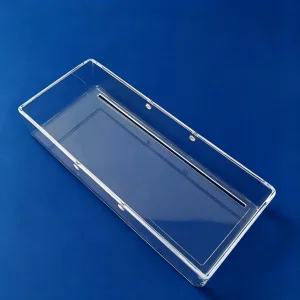
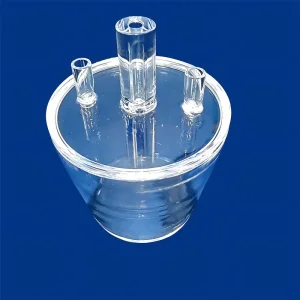

Submit your CAD drawings (PDF, STEP, DWG) or optical material specifications. Our quartz application engineers will analyze manufacturability, verify tolerance compliance, and return a comprehensive quotation with lead times within 24 hours.
