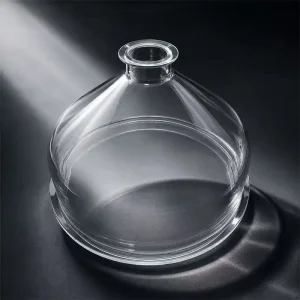
Explore our primary range of drawing-based quartzware, manufactured from ultra-pure feedstock in Donghai, Jiangsu. Every piece undergoes automated optical verification and helium leak testing prior to worldwide dispatch.
In modern semiconductor fabrication, telecommunications, and vacuum metallurgy, the quartz rod serves as a foundational component—operating not merely as structural glass, but as a critical, contaminant-free thermal waveguide, wafer-carrier beam, optical preform substrate, and high-voltage dielectric barrier. Operating under severe environmental stresses, a processed quartz rod must withstand continuous thermal thresholds exceeding 1100°C, zero-pressure cryogenic vacuums, violent thermal shocks (ΔT > 1000°C instantaneous quenching), and aggressive halogen-plasma chemistries.
The service lifetime of a quartz rod hinges upon intrinsic impurity profiles. Alkali metals such as Sodium (Na), Potassium (K), and Lithium (Li) act as crystallization nuclei that accelerate devitrification into cristobalite above 1150°C. Our refining ensures total alkali content < 0.8 ppm, while hydroxyl ([OH⁻]) concentration is tailored between < 2 ppm (electrically fused) for high-temperature dimensional creep resistance, and up to 1200 ppm (synthetic fused silica) for deep-UV laser transmission without optical solarization.
Fused quartz demonstrates one of the lowest coefficients of thermal expansion (CTE ≈ 5.5 × 10⁻⁷ /°C from 20°C to 320°C) among industrial structural solids. This near-zero expansion gives our processed rods unmatched resistance to thermal fracture. High-temperature creep deformation remains negligible under sustained loads at 1100°C, ensuring that horizontal wafer boats and suspension rods retain absolute coaxial alignment during rapid heating and cooling cycles in LPCVD furnaces.
Processing high-purity quartz rods demands specialized cold-grinding protocols to bypass micro-crack propagation inherent to brittle vitreous silica. Southeast Quartz employs dedicated 5-axis CNC ultrasonic machining centers running diamond-impregnated vitrified tooling. We achieve tight outer diameter tolerances down to ±0.005 mm, total runout < 0.02 mm over 1000 mm lengths, and customized laser-slotted pitch profiles for semiconductor wafer handling arrays.
| Material Property | Semiconductor Grade Fused Quartz (Natural) | Optical Grade Fused Silica (Synthetic) | Standard Commercial Quartz |
|---|---|---|---|
| SiO2 Chemical Purity | ≥ 99.995% | ≥ 99.9999% (Electronic Grade) | ≥ 99.90% |
| Hydroxyl [OH⁻] Content | < 5 – 25 ppm (Electrically / Gas Fused) | < 1 – 1,200 ppm (Target Grade Dependent) | 100 – 300 ppm |
| Continuous Service Temp | 1,150 °C | 1,050 °C | 1,000 °C |
| Softening Point | 1,683 °C | 1,600 °C | 1,650 °C |
| Surface Roughness (Ra) | Fire-polished: < 0.01 μm | Lapped: 0.1 μm | Super-polished: < 0.2 nm (CMP) | Commercial Ground: 0.8 μm |
| Total Runout / Straightness | ≤ 0.03 mm / 500 mm | ≤ 0.01 mm / 500 mm | ≤ 0.20 mm / 500 mm |
Manufacturing industrial-grade quartz rods requires an integrated workflow that harmonizes thermodynamic stress management with microscopic abrasive cutting. Southeast Quartz maintains end-to-end processing control from raw plasma ingots to finished assemblies.
Our hot-forming shop uses CNC gas-synchronized lathes fueled by high-purity H2/O2 burners. Controlled torch kinematics enable bubble-free rod splicing, high-precision rod tapering, flange fusion, and ball-end forming without introducing micro-bubbles or surface carbon residues.
Thermal forming introduces severe internal hoop stresses that cause catastrophic shattering during subsequent machining or furnace service. Every processed rod undergoes prolonged soak annealing inside electric kilns at 1180°C, followed by scheduled cooling rates down to 200°C.
Mechanical grinding creates sub-surface damage layers micro-fractured at the crystal lattice level. We subject machined rods to multi-stage hydrofluoric (HF) and nitric (HNO3) acid wash baths in cleanrooms to etch away disturbed silica micro-debris and strip surface metallic ions.
High-purity quartz rods serve as non-negotiable structural and functional elements across advanced technological domains. Our products deliver predictable mechanical integrity, chemical non-reactivity, and zero ionic migration.
In horizontal and vertical diffusion, oxidation, and LPCVD reactors, quartz rods form the structural backbone of wafer carriers, thermocouple protection wells, push rods, and wafer lifters. Zero trace iron and copper contamination preserves minority carrier lifetimes in sub-7nm silicon wafer processing.
Telecommunications and data center AI clusters require ultra-low attenuation fiber. Our high-homogeneity synthetic fused silica rods serve as core handle rods, plasma deposition support mandates, and collapsed preform jacket rods, guaranteeing uniform refractive index distributions (Δn < 10⁻⁵).
High-efficiency solar cells demand pure monocrystalline ingots. In Czochralski (CZ) pulling furnaces, our quartz support rods, seed holders, and continuous charge feeder components ensure consistent crystal structure without melt slippage or dopant contamination.
Headquartered in Donghai County, Jiangsu Province—the premier silicon crystal and quartz processing capital of the Eurasian continent—Southeast Quartz leverages geographical proximity to world-class quartz feedstock, complete auxiliary supply chains, and digital industrial automation.
Unlike workshops dependent on imported, secondary rod blanks, Southeast Quartz controls the raw supply interface. From high-purity natural silica sand purification to electric arc melting, plasma boule synthesis, and mechanical drawing, our integrated workflow eliminates mid-tier broker markups and buffers lead times against global market volatility.
Our raw feedstock stores maintain continuous inventories of standard diameters (2 mm to 150 mm) in transparent, opaque, and synthetic grades. This strategic buffer shortens prototype turnaround to 3–5 working days and accelerates large-volume enterprise fulfillment.
Our workshop integrates Industry 4.0 principles, pairing computer-controlled thermal drawing lathes with real-time laser micrometer feedback loops. Diameter profiles are continuously scanned at 1,000 measurements per second, dynamically adjusting draw rates to restrict variance to sub-micron bands.
Cold-machining centers utilize cloud-connected CAD/CAM systems, translating customer STEP and DWG mechanical drawings directly into multi-axis toolpaths. Automated laser engraving adds serial batch codes to every individual rod, ensuring complete supply chain traceability down to the raw melt furnace lot.
Procuring quartz components for mission-critical cleanroom and high-temperature environments demands thorough supplier qualification. Below is our formal QA inspection framework, aligned with leading international semiconductor fabs and scientific equipment builders.
Every ingot lot is sampled and analyzed via Inductively Coupled Plasma Mass Spectrometry (ICP-MS). We measure 32 elemental impurities to certify baseline compliance with fab contamination protocols.
Finished rods undergo multi-point laser micrometer scans and Zeiss Coordinate Measuring Machine (CMM) mapping for length, concentricity, straightness runout, and pitch precision on slotted carrier bars.
Visual and dark-field optical magnification inspects internal structural homogeneity, certifying bubble class, open surface pores, and cord marks under DIN 58927 / ISO 10110 standards.
Composite rod assemblies, welded junctions, and flanged vacuum feedthroughs undergo helium mass-spectrometry leak detection, maintaining leak-rate seals below 1 × 10⁻⁹ mbar·L/sec.
Navigating cross-border procurement of high-precision glassware requires robust regulatory management, export-compliant packaging, and dedicated technical liaisons to ensure smooth integration into overseas production lines.
To prevent transit dust, humidity, and atmospheric alkali salt deposition, rods undergo cleanroom multi-layer vacuum heat-sealing in clean PE/anti-static bags before placement in custom-molded high-density EVA foam cassettes and reinforced fumigated export wooden crates.
Our bilingual technical support team responds within 24 hours to design inquiries. We review mechanical drafts, suggest tolerance optimizations to lower processing costs, and offer direct engineering consultations for custom semiconductor tooling integration.
Every order is supplied with full mill certificates, Certificate of Conformance (CoC), RoHs/REACH environmental compliance declarations, and ICP-MS lot analyses. DDP, CIF, and FOB shipping configurations ensure hassle-free customs clearance worldwide.
As semiconductor architectures advance past 2nm GAA (Gate-All-Around) nodes and photonic communications move to petabit bandwidths, quartz processing must anticipate tighter purity standards and novel geometries. Southeast Quartz is pioneering the following technical vectors:
Standardization of 5N purity raw feedstock, 5-axis ultrasonic CNC slotting for 300mm wafer boats, and polariscopic stress-free annealing for all industrial rod profiles.
Deploying femtosecond laser micro-cutting to achieve sub-surface micro-crack-free slotting and integrated internal microfluidic channels inside solid quartz rod arrays.
Developing ultra-smooth CMP processes for cylindrical quartz surfaces, achieving roughness below Ra < 0.1 nm for extreme ultraviolet (EUV) optical waveguides and quantum resonators.
Pioneering plasma-enhanced vapor deposition 3D printing of near-net-shape fused silica rod assemblies, minimizing material waste and eliminating thermal joint boundaries.
Comprehensive technical and operational answers to aid process engineers, optical designers, and global procurement managers in specifying high-quality quartz rods.
Engineered to support extreme thermal environments, vacuum chambers, and high-purity chemical processes. In-house flame forming, welding, and ultrasonic machining tailored to exact equipment blueprints.
Submit your mechanical drawings (STEP, DWG, PDF) along with operating temperature, chemical exposure parameters, and annual production volumes. Our technical engineering division will respond with DFM feedback and an official quote within 24 hours.