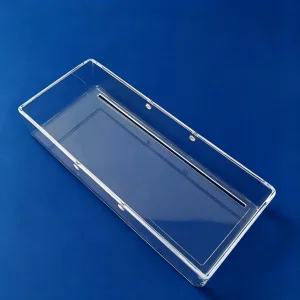
Direct-from-factory catalog items ready for dimensional customization, laser marking, and rapid global procurement.
In the extreme architecture of modern plasma etch, atomic layer deposition (ALD), and chemical vapor deposition (CVD) equipment, the quartz chamber ring operates not merely as a passive mechanical separator, but as an active boundary condition dictating process yield, RF electric field uniformity, and chamber uptime.
Fused silica exhibits an exceptionally low dielectric loss tangent (tanδ < 0.0001) across high-frequency RF domains. Our chamber rings prevent parasitic plasma ignition outside the designated wafer reaction zone, ensuring optimal plasma density distribution and edge-to-center process homogeneity.
Exposed to fluorine (CF₄, SF₆, NF₃) and chlorine gas chemistries, inferior materials degrade rapidly via micro-flaking and micro-cracking. Southeast Quartz utilizes electric-fused and synthetic silica with structural homogeneity that minimises particle excursion and extends Mean Time Between Cleans (MTBC).
With a thermal expansion coefficient of approximately 5.5 × 10⁻⁷/K between 20°C and 1000°C, these rings maintain micro-gap tolerances under rapid thermal cycling (RTC) and rapid thermal annealing (RTA), completely eliminating mechanical stress against surrounding aluminum or ceramic vacuum flanges.
For fab directors, foundry procurement specialists, and OEM equipment engineers across North America, Europe, Taiwan, South Korea, and Japan, purchasing quartz chamber components involves strict balancing between raw material integrity and supply continuity.
Direct-sourcing through specialized Chinese manufacturers situated in high-purity mineral clusters such as Donghai bypasses multi-tier distributor markups while unlocking direct technical consultation. Southeast Quartz mitigates critical procurement bottlenecks:
Engineered specifically for wet-chemical and vacuum-plasma interfaces. Review physical, optical, mechanical, and impurity thresholds verified via glow-discharge mass spectrometry (GDMS).
| Critical Property | Reference Value (High Purity) | Synthetic Fused Silica Grade | Measurement Standard |
|---|---|---|---|
| Silicon Dioxide (SiO₂) Content | ≥ 99.995% | ≥ 99.9999% | ISO 13357 / Spectrochemical |
| Density (ρ) | 2.20 × 10³ kg/m³ | 2.201 × 10³ kg/m³ | ASTM C693 |
| Coefficient of Thermal Expansion (CTE) | 5.5 × 10⁻⁷ / °C (20°C - 320°C) | 5.2 × 10⁻⁷ / °C | ASTM E228 Dilatometry |
| Dielectric Constant (ε) | 3.75 (at 1 MHz) | 3.80 (at 1 MHz) | ASTM D150 |
| Softening Point / Annealing Point | 1683°C / 1215°C | 1730°C / 1250°C | Fiber Elongation Method |
| Hydroxyl Radical (OH⁻) Concentration | < 30 ppm (Low-OH Type) | < 5 ppm / > 1000 ppm (Custom) | FTIR Spectrometry |
| Surface Micro-Roughness (Ra) | Ra ≤ 0.2 μm (Fire Polished ≤ 0.05 μm) | Optical Polish ≤ 0.01 μm | White Light Interferometry |
| Trace Elements: Al / Fe / Cu / Na / K | ≤ 14.0 / 0.1 / 0.05 / 0.3 / 0.4 ppm | Total Metals < 0.02 ppm | ICP-MS Inductively Coupled |
Tailored geometric architectures developed to solve chamber contamination, thermal gradient stress, and chemical corrosion across four major macro industries.
Used as focus rings, gas distribution rings, and chamber collar liners inside ICP/RIE tools. Our high-density quartz suppresses edge micro-chipping under intense energetic ion bombardment, preventing wafer contamination.
In MOCVD, LPCVD, and SiC/GaN epitaxy running beyond 1050°C, our thermal shield rings safeguard susceptor assemblies and deliver laminar gas-flow uniformity without chemical outgassing.
Photovoltaic wafer diffusion furnaces utilize large-diameter quartz rings and flanges. High purity stops transition metals from diffusing into the p-n junction, maintaining peak solar cell conversion efficiency.
Providing structural retention and optical hermetic isolation inside high-power excimer laser systems and UV curing reactors. High VUV-to-NIR transmission avoids thermal lensing.
As wafer foundries transition toward Gate-All-Around (GAA) nanosheet transistors and High-NA EUV lithography, the demands on chamber consumable components have shifted fundamentally.
Implementation of chemical-mechanical polishing (CMP) and proprietary multi-stage acid leaching protocols. Eliminating subsurface micro-cracks induced during CNC grinding reduces plasma etch erosion rates by up to 34%.
Integration of ultra-low concentrations of yttrium (Y₂O₃) and aluminum dopants within the fused silica network. This generates an in-situ passivating protective layer during reactive ion etching, dramatically lengthening component chamber life.
Scaling continuous fused rings beyond 650mm outer diameter for next-generation batch ALD and panel-level packaging (PLP) chambers using laser-assisted fusion bonding without organic sealants or metallic adhesives.
At Lianyungang Southeast Quartz Products Co., Ltd., every single chamber ring is treated as a mission-critical sub-assembly. We understand that a single micro-void or trace metallic particle contamination can destroy hundreds of processed wafers, representing millions of dollars in foundry losses.
Our QA system is ISO 9001 certified and complies fully with SEMI standards (SEMI F47, SEMI C31 for chemical and purity qualifications). Before vacuum packaging in our Class 1000 cleanroom, components undergo rigorous multi-step testing:
Headquartered in Donghai County, Jiangsu, China — the apex of the Eurasian quartz industrial corridor — Southeast Quartz maintains integrated logistical channels servicing key industrial hubs:
Fully compliant with EU RoHS 3 (Directive 2015/863) and REACH (EC 1907/2006). Certificates of Analysis (CoA) provided with each delivery.
Essential technical, commercial, and engineering guidelines for specifying custom fused quartz chamber components.
Direct-from-factory high-temperature and vacuum quartz components engineered for integrated equipment fabrication.
Submit your manufacturing drawings in 2D (PDF/DWG) or 3D (STEP/IGES) formats. Receive comprehensive manufacturability analysis, dimensional tolerance feedback, and wholesale factory quotation within 24 hours.