

Explore our baseline precision fused silica products, high-temperature thermal rings, lamp holders, and customized quartzware manufactured to strict ISO and ASTM standards.




From resistive ceramic heating coils and gas combustion ovens to spectral-matched fused silica infrared radiating emitters: How photon-driven thermodynamics revolutionized industrial efficiency.
Traditional convective heating relies on thermal mass transfer through air molecules, resulting in 40–60% thermal dissipation losses. Fused quartz infrared emitters leverage Planck's Radiation Law, converting electrical input directly into electromagnetic radiant photons (0.78 μm to 10.0 μm). By selecting precise halogen or carbon filament architectures, engineers match emitter wavelengths exactly to the absorption resonance of targeted polymers, water molecules, or semiconductor substrates.
Heavy resistive coils require up to 15–30 minutes of ramp-up and cool-down cycles, causing massive thermal inertia that degrades process control and poses safety hazards during emergency line halts. Modern short-wave and fast-response medium-wave quartz tube heaters reach 100% nominal thermal output in 1 to 2 seconds. This enables hyper-responsive closed-loop PID control and immediate shutoff to eliminate product scorching during line stoppages.
Conventional borosilicate glass collapses and softens above 500°C. In contrast, electrical-grade fused quartz (fused silica) features a continuous silicon-oxygen tetrahedron network with an SiO₂ purity exceeding 99.99%. Possessing an ultra-low thermal expansion coefficient of 5.5 × 10⁻⁷ /K, fused quartz heating elements endure instantaneous temperature shocks from 1100°C down to 20°C without mechanical rupture, micro-fracturing, or surface contamination.
Industrial thermal engineers and procurement directors balance upfront capital expenditure against mean time between failures (MTBF), radiant flux uniformity, and supply chain transparency.
Standard quartz tubes scatter infrared 360° omnidirectionally. Tier-1 buyers require directional orientation through back-coated reflectors. Gold reflector sputtering provides up to 98% directional IR reflectance, whereas high-purity white ceramic oxide coatings endure sustained operating temperatures above 900°C without flaking, discoloration, or spectral drift.
Premature element burnout is predominantly caused by atmospheric oxygen intrusion through the molybdenum foil pinch seal. High-end procurement requires hermetic glass-to-metal fusion tested via helium mass spectrometry leak detectors to maintain internal noble gas pressurization and sustain the tungsten-halogen regeneration cycle.
In wide-web ovens exceeding 2,500 mm in span, horizontal quartz elements experience gravitational creep and thermal sagging at continuous temperatures above 800°C. OEM buyers prioritize twin-tube (figure-of-8) cross-sectional geometries (11x23 mm or 15x33 mm) extruded from high-viscosity synthetic silica to ensure beam stiffness.
For mid-wave and long-wave infrared applications, internal hydroxyl radicals induce deep absorption notches around 2.72 μm, causing localized overheating and envelope expansion. High-tier quartz manufacturing employs thermal vacuum baking and plasma gas treatment to suppress OH⁻ concentrations below 5 ppm.
How Lianyungang Southeast Quartz leverages the world’s dense crystal and fused quartz industrial cluster to compress production lead times, deliver micron-grade tolerances, and provide unshakeable volume security.
Donghai County represents China's deepest supply hub for natural crystal refining and synthetic quartz feedstock. Southeast Quartz maintains direct upstream traceability from raw quartzite purification to ingot plasma-arc melting. This eliminates middleman raw-material surcharges, dampens global commodity price volatility, and guarantees high-grade quartz tubes with defect-free crystal matrixes for industrial radiant applications.
Manual glassblowing can introduce wall-thickness variations and localized thermal stresses. Our Factory 4.0 facility integrates multi-axis CNC laser cutting, automated precision grinding, and robotic hydrogen-oxygen flame lathe workstations. This achieves dimensional runout tolerances within ±0.15 mm and uniform envelope thickness along tubes extending up to 6,000 mm in total length.
Every single quartz tube and sealed infrared element undergoes rigorous multi-stage end-of-line testing. We utilize helium mass spectrometer leak detection down to 1×10⁻⁹ Pa·m³/s, pneumatic bursting validation, and spectrophotometric transmission verification across 200–4500 nm spectra. Custom batch documentation accompanies every commercial export crate.
Select the precise electromagnetic spectral band, filament composition, and envelope geometry configured for your machine design and substrate thermal absorption profile.
| Emitter Technology | Peak Wavelength | Filament Core | Filament Temp | Response Time | Recommended Applications |
|---|---|---|---|---|---|
| Short-Wave Halogen (NIR) High Penetration |
0.8 – 1.4 μm | Tungsten Wire + Halogen Gas Cycle | 1,800°C – 2,400°C | < 1.0 Second | PET blow molding, automotive powder coating, high-speed wafer sintering, steel strip heating. |
| Fast-Response Medium-Wave Balanced Dynamics |
1.4 – 2.0 μm | Specialized Tungsten Alloy Core | 1,400°C – 1,800°C | 1.0 – 2.5 Seconds | Plastics thermoforming, screen printing inks, photovoltaic ribbon soldering, glass lamination. |
| Carbon Fiber Quartz (CIR) Surface Curing King |
2.0 – 3.5 μm | High-Purity Carbon Fiber Yarn | 800°C – 1,200°C | 2.0 – 5.0 Seconds | Water-based paints drying, wood coating, composite consolidation, textile drying, food baking. |
| Standard Medium-Wave (MIR) Deep Volumetric Heat |
2.2 – 4.0 μm | Nickel-Chromium (NiCr) / FeCrAl | 700°C – 950°C | 60 – 120 Seconds | Continuous annealing ovens, rubber vulcanization, sheet thermoforming, paper converting. |
| Twin-Tube Industrial Radiator Rigid High-Power |
Custom (NIR / CIR / MIR) | Single-End / Double-End Filaments | Configurable | Instant to Fast | Wide industrial conveyor ovens (up to 6.5 meters), high-yield automotive paint tunnels. |
Discover how precision-engineered fused quartz infrared heating elements optimize production speeds, reduce reject rates, and maximize thermal transfer in world-class automated facilities.
Modern N-type TOPCon and HJT solar cell manufacturing lines demand rapid thermal spikes without cross-wafer thermal warping. Our short-wave quartz halogen infrared elements deliver instantaneous, uniform radiant flux across multi-gigawatt metallization firing furnaces, enabling silver/aluminum contact formation in seconds while protecting delicate passivated wafer surfaces.
Automotive body-in-white cathodic electrodeposition (e-coat) and lithium-ion battery electrode slurry drying require flash-off without micro-bubble skin formation. Carbon quartz infrared emitters emit in the fundamental absorption resonance of water and organic solvents (2.5–3.2 μm), evaporating moisture evenly from the inside out to eliminate blistering.
Sub-micron wafer processing relies on ultra-pure fused quartz reaction chambers, furnace liners, and precision infrared arrays. Our low-hydroxyl clear quartz tubes provide supreme optical purity, enabling uniform photon transfer during rapid thermal annealing, chemical vapor deposition (CVD), and wafer degassing with zero metallic particle contamination.
In high-speed rotary stretch-blow machines producing up to 80,000 PET bottles per hour, preform wall heat penetration must remain uniform down to ±1.5°C. Short-wave quartz emitters with customized gold reflector segments channel intense directional heat directly into the preform core, preventing surface chalking or uneven wall thinning.
Continuous flexographic, gravure, and digital printing presses operating at 400 m/min demand ultra-rapid ink curing on delicate polymer films. Fast-medium-wave twin-tube emitters deliver exact surface curing without thermal distortion or film stretching, backed by immediate power step-down during roll changeovers.
Quartz infrared emitters comply fully with FDA and EU food contact sanitation regulations. Unlike open gas flame ovens that introduce combustion by-products (NOx, CO₂), clean electric quartz tubes provide pure, sanitary infrared heat for industrial drying of seeds, coffee roasting, continuous baking, and surface pasteurization.
In-depth engineering answers covering failure modes, reflector chemistry, wiring configurations, and supply chain logistics for enterprise procurement teams.
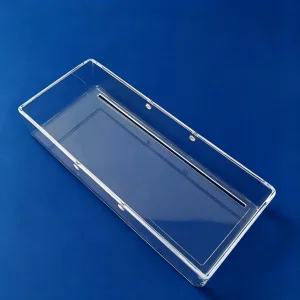
Complete your thermal processing system with matching fused silica boats, precision cleaning tanks, ground plates, and custom chamber accessories direct from Donghai.



Send your CAD drawings, dimensional specifications, or target heating parameters. Our factory technical group provides manufacturability feedback, optical simulation, and formal wholesale price schedules within 24 hours.