Explore high-purity fused silica furnace tubes, semiconductor transport rods, and bespoke optical vessels calibrated to deliver ultra-low thermal expansion and zero trace-metal leakage.





Strategic analysis of quartzware manufacturing, synthetic vs. natural quartz demand cycles, and raw material sovereignty in mission-critical thermal processing.
As microelectronics scale past advanced technological nodes, thermal budget management during LPCVD and atomic layer deposition (ALD) mandates quartz reactor tubes with trace metal concentrations under 0.1 ppm. Zero alkali migration is required to eliminate lattice defect generation.
The global transition to TOPCon, HJT, and Perovskite-Tandem solar configurations has triggered severe demand for oversized quartz diffusion tubes (OD > 450 mm). Tubes must maintain dimensional circularity at prolonged soaking temperatures reaching 1,200 °C.
Concentrations in natural high-purity quartz (HPQ) mines have led Tier-1 industrial buyers to diversify procurement. Vertically integrated factories using automated electric fusion and plasma refinement deliver cost control without compromising structural reliability.
Aligning thermal quartzware supply with the National Industrial Development and Logistics Program (NIDLP) and mega-scale infrastructure projects across the Kingdom.
Operating within industrial hubs like Jubail and Yanbu, high-temperature reaction columns demand thermal quartz reactor liners capable of enduring violent cyclic thermal stress and hostile hydrocarbon reforming conditions without sulfur or acid erosion.
Under the Saudi Green Initiative and PIF-backed solar deployment, local cell manufacturing requires heavy-wall, large-bore diffusion furnace tubes designed to avoid sag under high wafer-payload configurations in phosphorus oxychloride (POCl3) diffusion processes.
Academic and R&D corridors at King Abdullah University of Science and Technology (KAUST) and Oxagon require custom-calibrated optical and laboratory quartzware, sub-micron tolerance flow cells, and vacuum bell jars for synthesis and clean energy research.
High-temperature solid oxide electrolyzer cells (SOEC) developed for the Kingdom's green ammonia plants utilize gas-tight fused quartz containment tubes to analyze syngas flow integrity at sustained temperatures beyond 850 °C.
Saudi titanium and aerospace alloy research lines deploy ultra-high-purity quartz vacuum chambers and furnace liners to prevent interstitial nitrogen and oxygen pickup during specialized sintering protocols.
Thermal desalination infrastructure across the Red Sea and Arabian Gulf relies on transparent, corrosion-free quartz sight glasses, sensor sheaths, and lamp sleeves operating in harsh, hot brine environments.
Quantitative thermal, mechanical, and purity criteria establishing long-term dimensional stability and low failure rates under severe duty cycles.
| Property Parameter | Test Standard / Value | Operational Significance for Furnace Tubes |
|---|---|---|
| SiO₂ Purity Grade | ≥ 99.995% (Synthetic grades up to 99.9999%) | Precludes heavy metal and alkali ion diffusion into silicon wafers during high-temperature thermal drives. |
| Strain Point / Annealing Point | 1,075 °C / 1,180 °C | Governs internal stress relaxation; proper vacuum annealing prevents spontaneous shatter during cycling. |
| Softening Point | ≈ 1,683 °C | Allows continuous service up to 1,150 °C and short-duration process operations up to 1,300 °C. |
| Thermal Expansion (CTE) | 5.5 × 10⁻⁷ / °C (20 °C – 320 °C) | Exceptional thermal shock resistance; components can be repeatedly quenched from 1,100 °C into cold air. |
| Helium Leak Integrity | < 1 × 10⁻⁹ mbar·L/sec | Ensures sub-atmospheric vacuum retention in chemical vapor deposition (CVD) and epitaxial processes. |
| Hydroxyl (OH⁻) Content | Standard < 20 ppm / Dehydroxylated < 2 ppm | Low OH prevents premature high-temperature sag and retards devitrification during continuous heating. |
Comprehensive manufacturing, quality assurance, and international logistics engineered to mitigate operational risks for Middle Eastern plants.
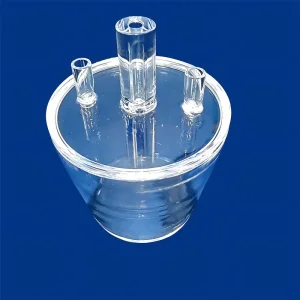
Tubes are configured to exact original equipment manufacturer (OEM) specs or tailored blueprints: water-cooled stainless flanges, quartz ground joints, gas injection injectors, welded manifolds, and thermocouple ports fabricated via precision multi-axis CNC.
Every furnace tube is measured with coordinate measuring machines (CMM) for wall consistency and roundness. Critical vessels undergo helium mass-spectrometer leak checks down to 10⁻⁹ mbar·L/sec and hydro-pneumatic stress evaluations prior to crating.
Fragile, oversized quartz vessels require custom suspension crating. We employ shock-isolated foam beds, moisture-barrier vacuum packaging, and dynamic impact indicators to ensure zero-breakage delivery into Jeddah Islamic Port, King Abdulaziz Port Dammam, or via air freight to Riyadh.
Strategic trajectory of thermal equipment consumables supporting the decarbonization and microelectronics roadmap through 2035.
Next-gen oversized tubes (OD > 500 mm) utilize proprietary nitrogen- and rare-earth-doped fused silica matrices. This micro-doping increases viscosity at 1,250 °C, quadrupling tube operational lifetimes and preventing mechanical sag in horizontal furnaces.
Eliminating geographic dependency on crystalline feedstock, inductively coupled plasma (ICP) synthesis delivers chemically pure synthetic fused silica with total metallic impurities below 5 ppb, crucial for sub-2nm semiconductor tooling.
Ultra-fast laser texturing on internal furnace tube walls prevents film flaking during silicon and nitride deposition campaigns. This reduces particulate generation and extends cleaning intervals by over 40%.
Authoritative technical and logistical clarifications for plant engineers, procurement teams, and academic researchers.
Explore our complete catalog of industrial heating supports, precision-ground quartz plates, heavy-duty quartz vessels, and vacuum components.



Connect directly with our senior quartz thermal engineering team in Donghai. We provide full manufacturability reviews, material certificates, and rapid-dispatch pricing for facilities across the GCC.
