Factory-direct high-temperature fused quartzware machined from ultra-pure natural quartz silica and plasma-fused ingots, serving wafer fab diffusion lines, LPCVD reactors, and industrial heating furnaces worldwide.






Understanding the thermodynamic stability, devitrification kinetics, and chemical stoichiometry of amorphous silicon dioxide (SiO₂) in horizontal and vertical diffusion chambers operating up to 1,250°C.
Furnace-grade fused quartz consists of a non-crystalline network of silicon-oxygen tetrahedra ([SiO₄]⁴⁻). The lack of long-range lattice order bestows an exceptionally low coefficient of thermal expansion (CTE ≈ 5.5 × 10⁻⁷/K), enabling components to endure instantaneous quenching from 1,150°C into ambient cold water without thermal shock cracking.
At continuous service temperatures exceeding 1,100°C, fused quartz enters a metastable state where nucleating surface contaminants induce crystallization into α- and β-cristobalite. By implementing vacuum plasma fusion and strict low-hydroxyl (OH⁻ < 20 ppm) processing, our factory drastically elevates the crystallization activation barrier, prolonging service life.
Modern microelectronics demand furnace tubes that do not release mobile ions. Trace contamination of sodium (Na), potassium (K), copper (Cu), and iron (Fe) induces wafer gate-oxide breakdown and minority carrier lifetime degradation. Our high-purity natural quartz sand achieves ≥99.995% (4N5) up to 99.999% (5N) chemical purity.
| Physical / Chemical Property | Standard Quartz Tube Grade | Semiconductor Fab Grade (Ultra-Pure) | Test Standard / Verification Method |
|---|---|---|---|
| SiO₂ Purity Level | ≥ 99.99% (4N) | ≥ 99.998% - 99.999% (5N) | GDMS / ICP-OES Trace Element Analysis |
| Strain Point / Annealing Point | 1,075 °C / 1,180 °C | 1,120 °C / 1,215 °C | ASTM C598 Beam Bending Viscometry |
| Softening Point | ≈ 1,670 °C | ≈ 1,685 °C - 1,710 °C | ASTM C338 Fiber Elongation Standard |
| Thermal Expansion (0–1,000 °C) | 5.5 × 10⁻⁷ / °C | 5.2 - 5.4 × 10⁻⁷ / °C | Push-Rod Dilatometry Standard |
| Hydroxyl (OH⁻) Concentration | < 50 ppm | < 15 ppm (Low-OH Thermal Process) | FTIR Infrared Absorption at 2.73 µm |
| Vacuum Hermetic Integrity | < 1.0 × 10⁻⁸ mbar·L/s | < 1.0 × 10⁻⁹ mbar·L/s | Helium Mass Spectrometer Leak Detection |
Located in Donghai County, Jiangsu Province—the global manufacturing nexus for fused silica processing—Southeast Quartz leverages fully vertically integrated supply infrastructure, precision thermal tooling, and unmatched cost-velocity.
Donghai processes over 70% of China's high-purity quartz reserves and raw materials. Our factory obtains direct access to multi-stage purified silica sand, high-density transparent fused ingots, and oversized mother tubing, cutting raw-stock transit latency to hours rather than months.
We bridge master glassblower craftsmanship with 5-axis CNC diamond tooling. High-temperature hydrogen-oxygen lathe welding operates alongside computerized grinding, diamond-wheel slotting, and laser profile validation for sub-micron geometrical compliance.
Localized industrial scale and complete auxiliary tooling infrastructures yield a 30% to 50% capital expense reduction compared to Western boutique quartz fabricators, empowering overseas wafer fabs to drastically curtail periodic replacement overheads without quality sacrifice.
With over 200 utility model patents and comprehensive in-house tooling workshops, we translate CAD, DWG, or STEP drawings into pilot production runs within 7–10 days, followed by helium leak testing and full dimensional CMM certification.
High-purity natural silica refined via acid leaching and electric vacuum fusion.
Capability to fabricate oversized single-body quartz tubes for 300mm wafer furnaces.
Strict Total Indicated Runout (TIR) ensuring precision automated robot wafer loading.
Every sealed flange and bubbler tested to <1.0×10⁻⁹ mbar·L/s before release.
How surging photovoltaic cell architectures, semiconductor vertical furnace transitions, and high-power thermal photonics are driving radical transformations in quartz tube manufacturing.
Legacy horizontal furnace tubes are rapidly yielding to vertical furnace chambers in 200mm and 300mm wafer fabrication. Vertical arrangements eliminate mechanical sagging caused by gravity over extended runs at 1,200°C, provide superior laminar gas flow, and allow tighter thermal control (±0.5°C across the flat zone). This necessitates high-aspect-ratio oversized quartz tubes up to 2.5 meters in height with ultra-flat ground seal flanges.
The photovoltaic migration from P-type PERC to N-type TOPCon (Tunnel Oxide Passivated Contact) and Heterojunction (HJT) cell architectures has intensified the demand for boron diffusion and LPCVD quartzware. Boron diffusion runs at elevated temperatures (~1,050°C to 1,120°C) compared to phosphorus, accelerating quartz tube devitrification and thermal stress. Tubes must feature thicker walls, synthetic or low-OH raw material blending, and specialized inner-wall surface treatments.
While natural quartz sand remains the cornerstone for general furnace tubes, sub-5nm advanced node processes demand synthetic fused silica synthesized from silicon tetrachloride (SiCl₄) vapor deposition. Synthetic quartz eliminates metallic contamination down to parts-per-trillion (ppt) levels and exhibits zero bubble inclusions (DIN 58927 Class 0). Chinese manufacturers are integrating plasma torches to produce synthetic-lined dual-layer composite furnace tubes.
As photovoltaic wafer formats migrate toward 210mm (G12) and rectangular 182R formats, furnace tube inner diameters have expanded beyond 380mm–460mm. Engineers must scrutinize the tube's sag resistance (creep resistance) and guarantee that annealing furnaces effectively relieve residual hoop stress (birefringence optical path difference < 10 nm/cm).
How Southeast Quartz furnace tubes, wafer boats, and reactor components interface with hostile thermal chemistry across semiconductor, solar, optical, and laboratory ecosystems.
Used in silicon wafer doping (POCl₃ phosphorus oxychloride liquid source or BBr₃ boron tribromide) and dry/wet O₂ oxidation. Quartz tubes form the primary reaction chamber, sustaining 1,000°C–1,150°C while preventing halogen vapor corrosion.
Deposition of silicon nitride (Si₃N₄), polysilicon, and silicon dioxide thin films under sub-atmospheric conditions (0.1–1.0 Torr) at 600°C–800°C. Heavy dielectric film buildup exerts intense tensile stresses on tube walls during cool-down.
RTP and spike annealing require ramp rates exceeding 100°C–200°C per second powered by high-flux tungsten halogen lamps. Quartz reaction chambers must feature supreme optical transmittance across UV-to-near-IR bands (200nm–3,500nm).
Massive high-throughput wafer carrying systems for multi-tube solar cell manufacturing lines. Wafer boats must sustain repetitive loading cycles by automated robotic arms without slot pitch expansion or pitch deformation.
Single-crystal silicon pulling (Czochralski CZ) and epitaxial growth involve high-vacuum thermal environments where thermal gradients across the chamber dome can induce dangerous implosion hazards if wall thickness is irregular.
Aggressive acid distillation, high-temperature gas-phase halogenation, and microwave hydrothermal digestion systems where borosilicate glass dissolves or leaks contamination.
Procuring quartz furnace tubes for commercial semiconductor fabs requires rigorous validation covering chemical spectroscopy, geometrical tolerances, and ESD cleanroom packaging.
Every production batch requires an Inductively Coupled Plasma Mass Spectrometry (ICP-MS) certificate detailing 15 key element impurities:
Automatic robotic paddle wafer loading into horizontal and vertical furnaces leaves virtually zero clearance for tube deflection:
Particulate contamination on quartzware surfaces causes devastating yield loss on silicon wafers:
Key technical inquiries answered by our metallurgical and process glassblowing engineering teams.
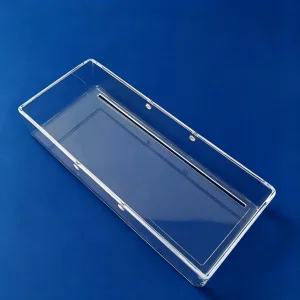
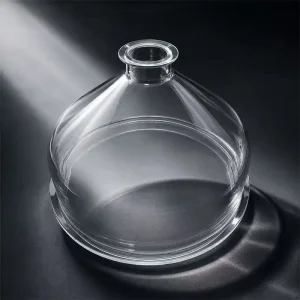
Discover our comprehensive range of custom quartz cleaning tanks, bell jars, oversized tubes, and optical-grade rods manufactured in accordance with strict international semiconductor cleanroom standards.