Precision-Engineered High-Purity Fused Quartz Consumables, Crucibles & Furnace Components for Global Semiconductor, Photovoltaic, and High-Temperature Industrial Processing.
Explore our certified thermal furnace products, fused quartz tubes, and precision-machined laboratory elements.
Fused quartz crucibles, diffusion tubes, and structural thermal components represent mission-critical consumables underpinning the global green-energy and semiconductor transformation.
In crystalline silicon ingots for solar PV and semiconductor wafers, high-purity fused quartz crucibles serve as the only molten vessel capable of sustaining temperatures exceeding 1,450°C without introducing detrimental metal ionic contamination.
Characterized by a near-zero coefficient of thermal expansion (5.5 × 10⁻⁷/K), fused silica allows extreme thermal cycling between ambient and 1,200°C without structural fracture, ensuring uninterrupted semiconductor batch diffusion runtimes.
Beyond molten metals, quartz vessels exhibit extreme resilience against acids (with the exception of hydrofluoric and phosphoric acids above 300°C), delivering unmatched service lives in CVD reactors, epitaxy lines, and harsh chemical syntheses.
Centering production in Donghai County—the crystal and quartz processing epicentre—provides distinct technological agility and supply chain resilience.
Direct proximity to centralized refinement facilities ensures guaranteed access to low-bubble, low-OH, and high-purity natural silica sand. This minimizes material transfer latency, maintains batch-to-batch chemical homogeneity, and keeps wholesale pricing lean.
By coupling computerized CNC milling, surface grinding, and laser slicing with experienced manual flame lathemanship, we execute complex geometries, multi-port quartz bubblers, flanged furnace extensions, and precision-grooved wafer carriers without reliance on secondary subcontractors.
Sealed vessels and high-vacuum components undergo helium mass-spectrometry leak detection, polariscopic internal stress analysis, and spectrophotometric transmission verification to guarantee total compliance with European and American high-temperature equipment standards.
How specialized quartz formulations resolve critical operational challenges across diverse processing environments.
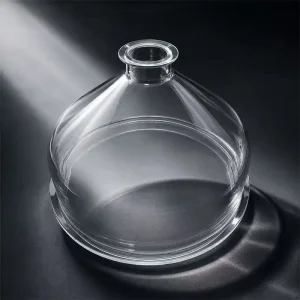
Crucibles for polysilicon crystal pulling; slotted quartz boats, furnace process tubes, and bell jars utilized in LPCVD, PECVD, and wet cleaning benches demanding non-detectable alkali metal leach rates.
Oversized fused quartz vessels formulated to resist devitrification during extended 1,450°C Czochralski continuous pulls, maximizing monocrystalline ingot lengths for N-type and TOPCon wafers.
Heavy-duty, high-temperature quartz crucibles engineered for rare-earth specialty glass smelting, UV laser optics synthesis, and clear viewing sight glasses operating under severe infrared radiation.
High-thermal shock crucibles tailored for vacuum induction melting (VIM) of platinum, gold, high-entropy alloys, and high-purity synthetic powders without metallic cross-contamination.
Comprehensive engineering parameters for technical buyers evaluating thermal endurance, chemical purity, and mechanical tolerances.
| Property Parameter | High-Purity Transparent Grade | Opaque / Arc-Fused Crucibles | Test Methodology |
|---|---|---|---|
| SiO2 Purity (%) | ≥ 99.99% - 99.999% | ≥ 99.98% | ICP-OES / GDMS Trace Analysis |
| Continuous Max Temperature | 1,150 °C | 1,200 °C | Long-Term Creep Evaluation |
| Short-Term Max Exposure | 1,300 °C | 1,450 °C | Transient Thermal Loading |
| Coefficient of Thermal Expansion | 5.5 × 10⁻⁷ / K (20°C - 320°C) | 5.4 × 10⁻⁷ / K | Dilatometry |
| Hydroxyl (OH) Content | < 5 ppm to < 30 ppm (Process Dependent) | ≤ 20 ppm | FTIR Spectrometry |
| Typical Impurity Limits (Al, Fe, Ti, Cu) | Total Metals < 15 ppm | Total Metals < 25 ppm | Spectrophotometric Verification |
Evolving wafer scale and high-temperature metallurgy require dynamic adaptations in crucible geometry and inner-wall stability.
Driven by 210mm silicon wafers and high-capacity CZ furnaces, procurement trends require scaling crucibles up to 36 inches in diameter, demanding advanced electric arc fusion to avoid structural deformation under prolonged thermal loads.
Micro-bubble-free synthetic quartz coatings applied to internal crucible walls dramatically decelerate inner crystallization and oxygen liberation, facilitating 300+ hour continuous pulls without particulate shedding into the silicon melt.
Global semiconductor fabs and Tier-1 solar cell makers actively establish strategic partnerships with verified Chinese Tier-1 suppliers to eliminate single-source regional bottlenecks, guarantee rapid fulfillment, and decouple from high-cost legacy markets.
Essential guidance on specifying, handling, and ordering custom fused quartz components directly from the manufacturing facility.
Explore our transparent rings, lamp holders, specialized vacuum bell jars, and extended oversized process tubes.